Dieser Artikel ist auch in deutscher Sprache verfügbar: Zum deutschen Artikel.
In the context of the economic downturn in Germany, the argument that electricity prices in Germany are too high is frequently put forward. In April 2026, the SPD and CDU/CSU coalition introduced a subsidised industrial electricity tariff for industry and large-scale electricity consumers, limited to the three-year period up to 2028. However, there are over 44 million people in Germany who live in rented accommodation, across more than 21 million tenant households, as well as a large number of small and medium-sized enterprises and many small businesses and tradespeople who do not benefit from the advantages of this industrial electricity tariff.
Homeowners and landowners can, through their own initiative and with the help of financing, equip their properties with photovoltaic (PV) systems, biogas plants or wind turbines to generate their own electricity and either consume it immediately or feed it into the national grid. They are then remunerated for any electricity not consumed by themselves, in accordance with government regulations. Those who own suitable land can also generate and use hot water via solar thermal systems.
How can you reduce your electricity costs?
But what options are available to the many millions of tenants, tradespeople, business owners and small-scale electricity consumers to reduce their electricity costs somewhat? I would like to highlight a few potential savings here:
– Installing and using balcony power plants,
– Direct neighborhood sharing of renewable electricity (Energy Sharing)
– Increased use of smart meters and schemes offering flexible electricity tariffs
– Use of established methods for storing electricity when electricity prices are low:
– Use electricity as sparingly as possible and save electricity. Reduce electricity costs by purchasing appliances and systems with low energy consumption; in other words, pay attention to the energy efficiency class.
– Use as few electricity-consuming appliances as possible,
– Saving energy should be the top priority, as heat or electricity that is not needed does not have to be generated. Advice is available from independent energy advisers (EBs) at consumer advice centres, environmental organisations, as state-appointed EBs or EBs from the Chamber of Industry and Commerce (IHK) and Leipziger Stadtwerke (LSW) for both private individuals and businesses.
In fact, the federal government should break down the costs of electricity generation into two categories: electricity generated from renewable energy sources (RES) such as solar, wind, biomass and hydro; and electricity generated from fossil fuels (coal, gas) and nuclear power stations.
This would ensure that these costs are not obscured, as the costs of generating electricity from RE are falling steadily as the sector expands, and consumers could benefit from falling prices as a result of this separation. Compared with the costs of electricity from fossil fuels, the costs of renewable energy (RE) – such as that from wind turbines – have now largely fallen below 6 cents per kilowatt-hour (kWh).
Cost drivers: grid charges
The main cost drivers are grid charges for grid expansion, the costs of maintaining base-load power supply (billions in subsidies from the Ministry of Economic Affairs for additional gas-fired power stations) and taxes.
It is particularly relevant to note that electricity prices are made up of the costs of electricity procurement by the supplier, government taxes, and the costs that are most easily influenced: grid charges, including levies, concession fees and charges for grid usage. Grid charges are significantly influenced by the necessary grid expansion, as the existing centralised electricity supply structure based on large power stations must be transformed into decentralised structures comprising many small-scale electricity suppliers and consumers.
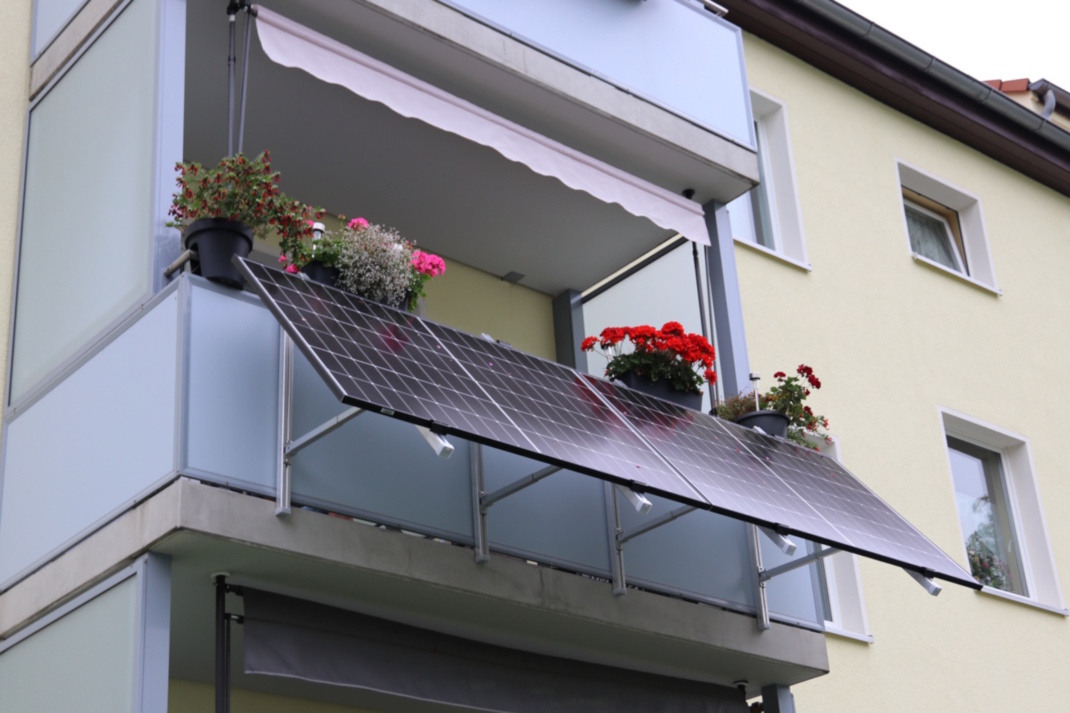
Use of plug-in solar systems = balcony power stations (Bkw) for generating one’s own electricity and reducing self-consumption
Installing a balcony power plant is now well established and relatively straightforward:
– Check potential locations for a suitable socket (Schuko) for connection and ensure there is no shading. Find a stable surface on which to place the system or secure it firmly to balcony railings or walls. You can find out whether a Bkw is worthwhile using the plug-in solar simulation tool provided by BUND or the Consumer Advice Centre.
– Where possible, inform your landlord about the installation of a plug-in solar system; they are not permitted to prohibit the installation,
– Check with your insurer whether your personal liability insurance or home contents insurance covers damage caused by the plug-in solar system,
– Purchase the appropriate module or a complete system. Currently, a maximum inverter capacity of 800 watts and a solar output of 2,000 watts are permitted; each module weighs approximately 20 kg. The system should be equipped with a solar inverter and, if possible, a battery storage unit. The battery storage unit is used to store unused electricity for times when little or no electricity is being generated.
– A grant may be applied for depending on income; in Leipzig, this is possible via the Free State of Saxony,
– Installation of the system by plugging it into a socket
– Free registration of the system with the Market Master Data Register (MaStR): select ‘Registration of a system, a system operator or another market participant’, then select ‘Solar system’ with the option ‘plug-and-play solar system’, if necessary, create a user account with your personal details and activate it via the link in the confirmation email; log in using your new account details and register the Bkw. The Federal Network Agency will request some key details from the Bkw and the location. You will then receive the MaStR number and a registration confirmation to keep on file.
– If you still have an old electricity meter with a dial, this may be replaced by the metering point operator. You do not need to worry about this.
– Check when you generate a lot of electricity yourself (depending on the position of the sun) and try to use that electricity yourself at those times. This can help you reduce your electricity bill slightly.
Sharing self-generated electricity with the neighbourhood – Energy Sharing
Cost-conscious homeowners, tenants and businesses can avoid the dilemma of high electricity prices by using cost-effectively generated renewable electricity from the local area via direct feed-in or direct contracts as consumers. Discussions on decentralised neighbourhood electricity supply have been taking place within the ‘Ampel’ coalition since 2024, and initial regulations on this have been put forward.
The amended Energy Industry Act (EnWG) came into force on 1 June 2026. This provides neighbourhoods with the opportunity to share electricity generated from renewable energy sources (under Section 41b for energy supply contracts with domestic customers outside the basic supply scheme).
It sounds rather complicated, and unfortunately it is. These regulations are not as easy to implement as they need to be. Yet another cumbersome and bureaucratic piece of legislation resulting from conservative politics.
It would make sense to establish simple, transparent and, therefore, workable guidelines so that several interested households can join forces to share the electricity generated locally on a decentralised basis. This is commonly referred to as ‘energy sharing’.
One participant generates and supplies electricity using a PV, biogas or wind power plant, whilst other consumers or households in the surrounding area use this electricity from renewable sources. In other European countries such as Switzerland, Spain or Austria, this concept has been practised successfully for years.
The advantage is that any electricity not consumed by the producer can be sold directly to neighbours. This would increase the return on investment for an electricity generation plant, whilst neighbours could obtain low-cost electricity from local sources and would be less dependent on price fluctuations on the electricity exchanges. There would also be less need to rely on long-distance transmission networks, meaning lower grid charges would be possible.
However, neighbourhood electricity distribution requires a significant financial investment from those involved. To support this investment in direct marketing, the government should suspend the tax burden on the companies or users involved, guarantee subsidies and remove bureaucratic obstacles. These measures should form part of the energy transition strategy aimed at stabilising the electricity grid.
Tomorrow’s second part of this article will address the obstacles to the direct marketing of self-generated electricity.
Empfohlen auf LZ


So können Sie die Berichterstattung der Leipziger Zeitung unterstützen:





There is one comment