Perhaps this is the worst possible time. But it comes as no surprise: Germany has been in an economic slump for six years. Money is running short everywhere. Local authorities are now groaning under the weight of massive financial strain. But the downturn is not leaving associations and clubs unscathed either. Leipzig’s environmental organisations are also feeling the pinch. BUND Leipzig is now calling on the city council to put funding for environmental protection organisations on a long-term footing. A motion by the Greens on this matter is due to be voted on 1 July.
Given the increasingly difficult funding landscape, BUND Leipzig is calling for a city council resolution to make multi-year funding the norm. The Green Party group in Leipzig tabled a motion to this effect at the start of the year, which is due to be voted on in July – despite the administration’s opposition.
A difficult funding situation jeopardises valuable environmental work
The operating conditions for charitable organisations in Leipzig have deteriorated noticeably in recent years. Funding pots are shrinking or being scrapped altogether, and approval periods are becoming shorter. For BUND Leipzig, this means that an increasing proportion of its working capacity cannot be channelled into protecting nature and the environment, but instead into filling in forms and submitting applications.
Added to this is structural uncertainty. It is often unclear until the end of the year whether posts funded by project grants will still exist the following year. This affects not only the organisation itself, but also the people who carry out the association’s work.
“The current difficult funding situation is noticeably limiting our ability to work towards positive change in our city,” explains Anika Jahn, co-chair of BUND Leipzig. “At the same time, highly competent people are affected, whom we are losing due to a lack of planning certainty. We need longer-term prospects here. Even though multi-year funding carries a certain risk of losing grants over several years, a shift towards a long-term approach would nevertheless be entirely in the best interests of the cause.”
What multi-year funding would change in concrete terms
The motion tabled by the Green Party parliamentary group offers three specific advantages for organisations such as BUND Leipzig:
1. Time saved: There would be no need for repetitive application and accounting procedures for similar or multi-year projects. This time can be invested directly in nature conservation and educational work.
2. Focus on content: Long-term projects can be developed consistently, rather than having to be readjusted annually to meet funding conditions.
3. Planning security for staff: Permanent staff are given secure prospects for the future. This is crucial for retaining qualified staff and providing professional support for voluntary work.
Furthermore, multi-year funding is not a new concept. In child and youth welfare, it has long been the norm. In the environmental and cultural sectors, however, organisations must continue to plan their work on a grant-by-grant basis. This creates uncertainty and prevents precisely the kind of long-term structural work that makes effective nature conservation possible in the first place.
It’s about civil society engagement
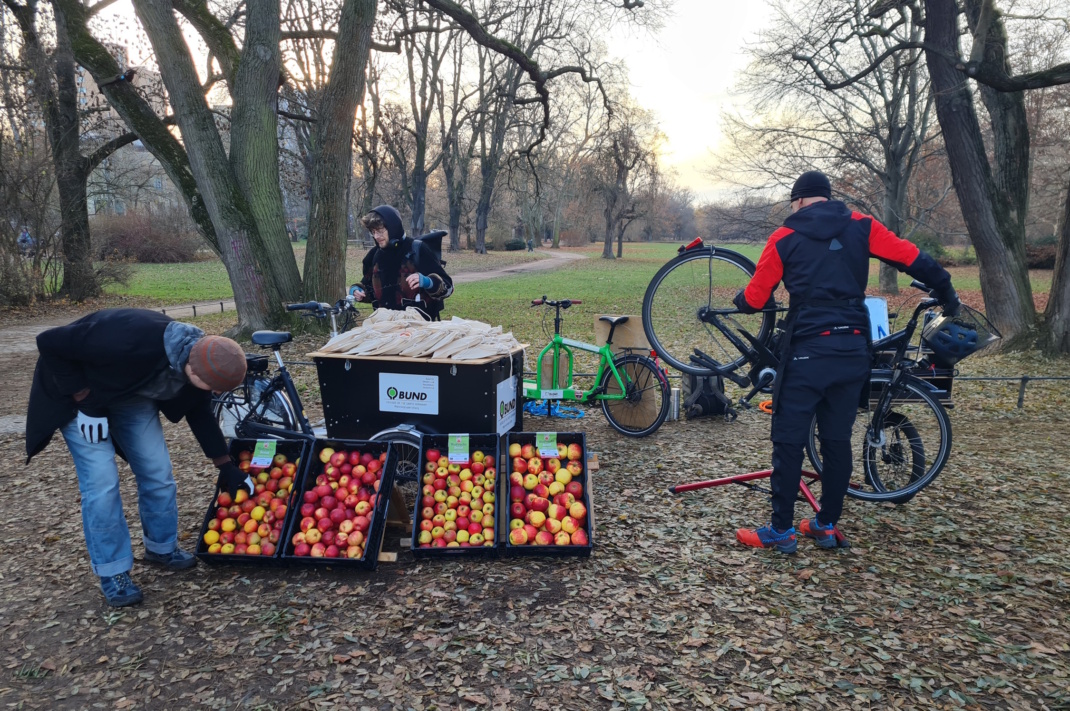
For BUND Leipzig, funding forms the basis for tangible local change. Thanks to this support from project grants in the past, BUND Leipzig has, amongst other things, been able to involve young people in local climate policy, set up a city-wide citizen science project to protect butterfly biodiversity, reward climate-friendly behaviour through a regional currency, and support the catering sector and neighbourhoods in switching to reusable packaging.
These and many other projects cannot be implemented without third-party funding. If funding structures collapse or are planned at too short notice, it is not only nature conservation that suffers. It affects the entire spectrum of civil society engagement that sustains a vibrant city: neighbourhood projects, educational work, cultural initiatives – and with them, voluntary structures that have grown over many years.
BUND Leipzig expressly supports the motion put forward by the Green Party group and calls on the political groups on the City Council to vote in favour of improving funding conditions in July.
Multi-year funding would be an important step in the right direction, but is not sufficient on its own to reliably meet staffing requirements. Organisations such as BUND Leipzig act as an extra-parliamentary counterbalance, for example in participatory processes and through the submission of statements. This work is part of a functioning democratic urban society. BUND Leipzig is therefore not only campaigning for multi-year funding, but is also calling on Leipzig to take the step towards institutional funding.
Become a sponsor
At the same time, BUND Leipzig is now relying more than ever on support from the wider community. This is partly due to nationwide austerity measures, which have led to the cancellation or reduction of numerous funding streams for environmental and nature conservation work, as well as political education.
“Given the current situation, the organisation is more dependent than ever on people who make nature conservation work possible directly through a sponsorship with BUND Leipzig. This regular contribution, according to one’s personal means, helps to maintain permanent posts and secure long-term projects,” explains Martin Hilbrecht, co-chair of BUND Leipzig.
Empfohlen auf LZ


So können Sie die Berichterstattung der Leipziger Zeitung unterstützen:



There is one comment