
Dieser Artikel ist auch in deutscher Sprache verfügbar: Zum deutschen Artikel.
The OECD has published the PISA 2025 study, entitled ‘Ready for the Future?’, and the results for Germany answer this question with a ‘No’. So here we go again with analyses, research, finger-pointing and half-baked reforms. However, it is not as though no one had warned of the problems in the education system.
For years, staff in nurseries, schools of all types and the Education and Science Union (GEW), to name but a few, have been warning of the collapse of our education system. The GEW Saxony has issued a statement on this, entitled “PISA: The low point was foreseeable – GEW calls for immediate action in the budget and the Saxon education dialogue”, as reported by Ralf Julke. We spoke to the regional chair, Burkhard Naumann, about this via Zoom.
First, a look at the figures
The key raw data can be found in the OECD paper, Volume 1 of which is available in German in extract form. If we turn to page 28, to the table ‘Overview of performance in science, reading literacy, mathematics and computer-based problem-solving’, we find that Germany is generally still in line with the OECD average. In science, the average is 482 points; Germany scores 486. In reading literacy, the figures are 461 to 465; in mathematics, 463 to 464; and in computer-based problem-solving, Germany scores 498 points, which is below the average of 500.

The decline in skills shown in the table is dramatic. In science, scores are 7 points lower; in reading literacy, 15 points lower; and in mathematics, 11 points lower than in PISA 22.
What about the socio-economic factors? On page 30, we find the table ‘Overview of the influence of socio-economic differences and migration background on performance in science’. On sheet 2, i.e. page 31, we find Germany quite far down the list. It is worth looking at the figures in columns 4 and 5 here. The performance of both disadvantaged and advantaged pupils has declined: by 7 points for the former and by 3 points for the latter.

The decline in results between 2022 and 2025 therefore does not affect only the so-called ‘educationally disadvantaged’ groups.
Interview with Burkhard Naumann (GEW)
Mr Naumann, the PISA study covers the whole of Germany – are there actually any specific figures for Saxony?
The study presents the overall results for the Federal Republic in an international comparison. There are no separate results for Saxony.
The GEW has been warning about this for a long time; now you’ve been proved right. That’s not a pleasant situation, is it?
First of all, I read the Minister for Education’s response yesterday. He doesn’t see it the same way we do. I don’t know whether it just slipped out during the conversation that Germany’s decline was to be expected, given the consequences of the COVID-19 pandemic, social media and the shortage of teachers. As if the rest of the world didn’t have a Covid-19 pandemic or social media. These are global challenges, but different countries have dealt with them in different ways.
I think we need to look at this on two levels. The first is what is actually happening in schools, particularly when it comes to quality. Do we have enough time? It’s becoming clear that the education system in Germany is driving – or at least reinforcing – social division. I believe that’s the biggest problem, because the role of the education system is to ensure educational equity. Children aren’t born any less intelligent simply because their parents have certain educational backgrounds. That’s not the case; they simply face difficult circumstances. It is the state’s responsibility to address these differences in a targeted manner. Our education system fails to do this. On the contrary, it has been perpetuating these differences for decades. Studies consistently show that the education system in Germany essentially replicates the educational paths of the parents.
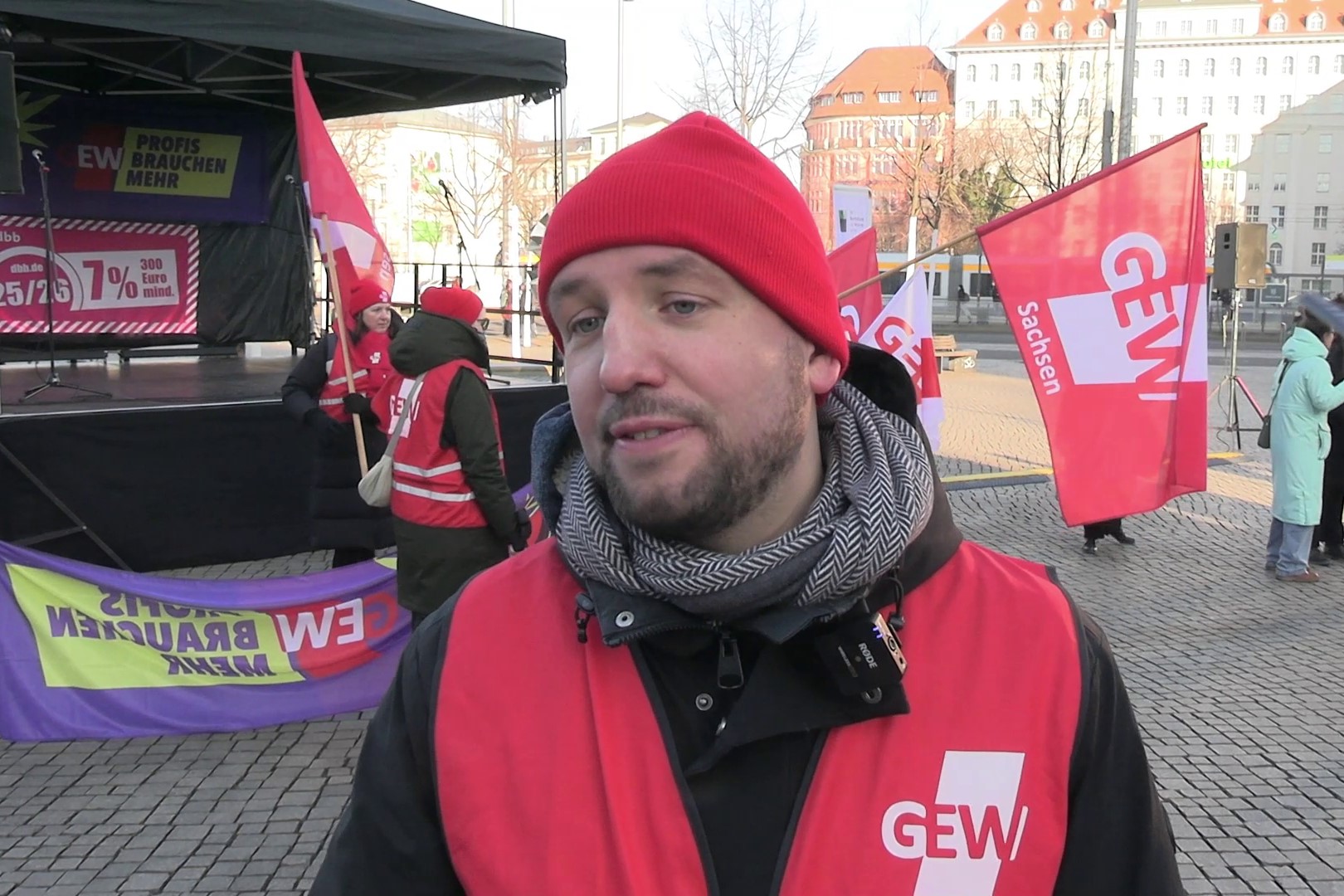
Interviewee Burkhard Naumann at the demonstration on 21 January 2026, photo: Thomas Köhler
What is striking about the study – as I noted in my introduction – is that there is a decline in performance among both disadvantaged and advantaged children. So it is not the case that those with a better educational background improve or maintain their standard; rather, they too are performing worse. How should we interpret this?
The real message one can take from this is that nobody can afford to be indifferent. It affects everyone, including children and young people who start out with better opportunities.
The Minister for Education cited social media as a cause of poor performance. How are schools dealing with this issue?
Schools have now gained a great deal of experience in this area and have established sets of rules. However, even a mobile phone ban does not solve everything; it remains an ongoing daily challenge. When mobile phones are collected, it is now common for pupils to hand in a second mobile phone instead. But it is not enough to limit the discussion to schools.
At present, attempts are being made to regulate teachers and pupils through mobile phone bans and similar rules; we would actually like to see the EU take a tougher line on this issue. When it comes to the protection of young people, the platforms must be regulated; their addictive business model requires strict regulation. Not to mention that most social media use takes place outside school.
The GEW has listed many reasons: secondments, cancelled lessons, teaching subjects or at school types for which teachers are not qualified, lowered standards in German as a second language – the list goes on. What needs to be done?
These are mainly recent developments; the results of the PISA study cannot yet be attributed to them. However, they are a sign that the wrong education policy is still being pursued.
What needs to be done? In any case, there must be massive investment in early childhood education. It is evident that, in terms of their skills, children are already drifting further and further apart whilst still at nursery. Schools can hardly make up for what is missed during early childhood.
Does this concern the linguistic and social skills that children are supposed to acquire at nursery?
In theory, Saxony’s new Education and Upbringing Plan creates the right conditions for achieving educational equity, but it fails in its implementation. However, the consequence should not be to introduce a curriculum in nursery schools or to make them even more like schools. The problem is that we are failing to put the plan into practice; this is primarily due to staffing issues.
The Startchancen-Qualitätsentwicklungsgesetz (SCQEG)
now stipulates that there are to be language tests for four-year-olds in the coming years. As the GEW, we reject this because the educational staff know where the weaknesses lie, where the strengths are, and where investment is needed. The Education and Care Plan provides the right answers to these questions. However, there is not enough time to implement it, as staff are already fully occupied simply with covering childcare hours.
What about staffing levels in Saxony’s childcare centres?
We simply do not have the right conditions in place; Saxony ranks second from last in Germany in terms of staffing ratios in childcare centres. The same problem exists in schools. With so many children and young people to look after, it is impossible to give each one the individual attention they need. You can try to raise the average standard of the whole group, but you cannot provide individual support. This creates divisions, because you cannot cater to the different needs. So, in nurseries and schools alike, we face the same internal problem: we do not have the right staffing levels.
Is there a fundamental problem in the education system?
I’d say that, in theory, we’re already well-positioned when it comes to nurseries. However, we’re now facing a mass closure of nurseries and have a staffing problem.
As for schools, I’d say we need to move away from the 19th-century school system if we really want to move into the 21st century. The practice of streaming pupils according to academic performance after Year 4 has been scientifically disproved for decades. As I said earlier, it merely reproduces the parents’ own educational path. Parents who did not attend a grammar school themselves are reluctant to send their child to one, whilst parents who did attend a grammar school are determined to see their children there. This remains a problem, and many opportunities are being squandered as a result. Internationally, extended co-educational learning is already the norm. It is also scientifically proven that, under the right conditions, this benefits both high-achieving and lower-achieving pupils. There is no such thing as a division between ‘stupid’ and ‘clever’ children and young people. People have strengths and weaknesses in different areas
,
and so they can support one another.
A transition to a comprehensive school system in the German education system would probably spark a debate just as ideologically and emotionally charged as that surrounding the G8/G9 Abitur. Current pupils, in particular, would likely face difficulties. Could it work nonetheless?
That is why we are calling for a Saxon education dialogue, where people sit down together and all sides are prepared to say: we do not want to argue about who is right, but we want to examine what is the right thing to do. We must look to the scientific evidence. The education system is always 20 to 30 years behind scientific findings. That simply cannot be right. I am not aware of any scientific recommendation that suggests separating pupils after Year 4 is a good idea.
We need sensible reforms that do not come at the expense of the current generations of pupils who are experiencing these reforms. That is why we must proceed with caution here. But ultimately, I would say that, given the history of this whole debate and how emotionally charged it is, the entire education system – including nursery schools – needs to be put under the microscope. All stakeholders must examine this together. What are the truly good elements that we must carry forward, and what are the things we’re simply dragging along because nobody dares to tackle them or because they’ve never been resolved due to ideological battles?
Let’s take that as our closing remark; thank you for the conversation.
Conclusion: PISA 2025 is yet another wake-up call; perhaps it really is time for fundamental changes to the education system. Limiting the causes to the Covid-19 pandemic and social media will come back to haunt us by the next PISA study at the latest.
Empfohlen auf LZ


So können Sie die Berichterstattung der Leipziger Zeitung unterstützen:



There is one comment