Dieser Artikel ist auch in deutscher Sprache verfügbar: Zum deutschen Artikel.
That really was something else, and even Leipzig’s city administration rarely manages to take three years to respond to a motion from the city council with its own position. This is exactly what happened with a motion tabled by the Green Party group in April 2023: ‘Enabling temporary and mobile urban green spaces’.
After all, Leipzig’s city administration has known just how important a bit of cooling greenery is in the urban area not just since the heatwave of the last few days, but ever since the scorching summer of 2018. On 1 July, the Greens’ motion finally came before the city council.
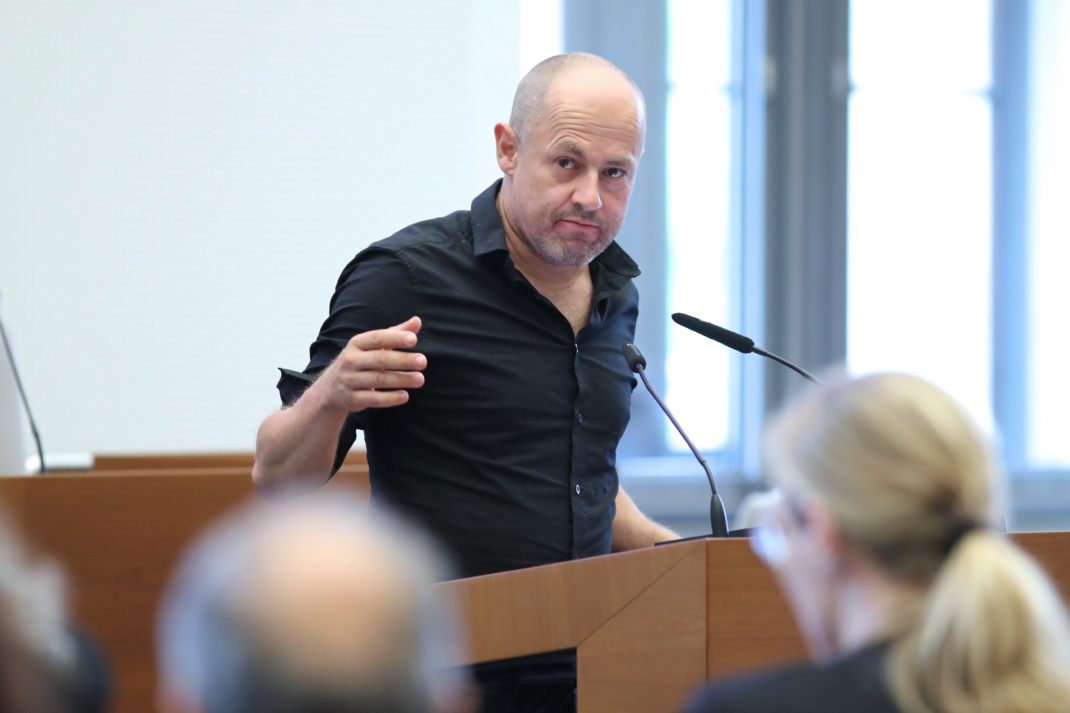
In his speech, the Green Party’s parliamentary group leader, Dr Tobias Peter, naturally also addressed a problem that has continued to worsen since 2018. Although the city council has resolved to achieve net-zero land sealing for the urban area by 2030,
But – one need only think of the Capa Wood, now threatened with clearance – the city is not meeting its targets. On the contrary, according to Tobias Peter: Since 2018, according to its own figures – despite the replanting of several streets – Leipzig has lost 15,000 trees.
Partly due to drought, but mostly as a result of new construction projects for which green urban plots were completely cleared. In total, says Peter, around 8 square kilometres of green space has been lost within the city limits and can therefore no longer help to cool the area during heatwaves.
The proportion of sealed surfaces in the city has risen from 29 to 31 per cent during this period alone. And this, of course, causes heat to build up in the densely built-up urban area – as was the case recently, when Leipzig experienced temperatures above 35 degrees Celsius for twelve days running and tropical nights with temperatures of up to 29 degrees.
As temperatures then rose towards 40 degrees, it is well known that this brought the entire LVB tram network to a standstill because the joint sealant on the tracks melted.
And that, too, is down to a lack of shade and a lack of greenery. Yet Leipzig is finding it incredibly difficult to really learn how to cool the urban area during the heatwaves that are set to become increasingly frequent.
More planters on the pavements
In 2023, the Greens proposed making greater use of temporary greenery in areas where planting trees straight away is not an option. But it actually took the administration three years to take a stance on this essentially straightforward proposal.
On 1 July, the administration’s position was finally set out, and it fully endorsed the Green Party’s proposal. The reason it took three years becomes clear from the key wording:
“The City Council notes that the coordination and implementation of temporary and mobile urban greening in public spaces will be carried out within the framework of the existing staff resources and budget of the Department for Urban Greenery and Waterways.”
This is because, previously, responsibilities were spread not only across several departments but also across several administrative divisions. It obviously takes time for some to be prepared to relinquish their powers and for others to get the coordination sorted out.
The relevant special-use by-law, which facilitates the installation of benches and planters, was even amended as early as 2023. The experience gained during the Covid-19 pandemic, when a number of parking bays were transformed in this way into – green – outdoor seating areas, also proved helpful.
However, the Department for Urban Greenery and Waterways also rightly points out that planting actual trees must take priority in order to provide permanent shade for streets and squares:
“With the ‘Leipzig 2030’ street tree concept adopted in 2019, the City of Leipzig continues to prioritise the systematic expansion of permanent, ground-based greenery in public spaces. Due to its root penetration, water absorption capacity and long-term CO₂ sequestration, ground-based vegetation forms the backbone of climate-resilient and water-sensitive urban development.
Temporary and mobile greening can complement this objective. Planters and mobile elements do not replace permanent green-blue infrastructure, but can contribute as a low-threshold, flexible building block for revitalising and trialling sites. They make it possible to make greening visible and tangible in the short term in heavily sealed areas or spaces due for redevelopment.”
A cautious trial run
And this has indeed already been tried out in a number of streets where it was not possible to plant trees immediately: “In Leipzig, such approaches have already been implemented and further developed:
• Gottschedstraße (2022): Temporary pot planting to enhance the street environment, with plans to supplement and expand this in 2025.
• Liviaplatz (2022): Temporary greening elements in public spaces; a functional and design-based further development of the site (autumn 2025 / spring 2026).
• Mobile Green Room (summer 2025): Used as a flexible communication and social space to raise awareness of urban greening and climate adaptation.”
However, these projects also demonstrate that temporary greenery can only ever be a stopgap solution, and that the local authority must focus much more attention on removing impervious surfaces and planting permanent greenery. But it continues to struggle with this.
Now that it has at least been clarified who is responsible for temporary green spaces, Tobias Peter withdrew the Greens’ motion from 2023. Even so, his comment on the – misguided – net-zero land sealing suggests that this tough battle with an obstinate local authority is not yet over.
Empfohlen auf LZ


So können Sie die Berichterstattung der Leipziger Zeitung unterstützen:





There is one comment