Dieser Artikel ist auch in deutscher Sprache verfügbar: Zum deutschen Artikel.
What opportunities do independent candidates and those put forward by smaller parties have to present their issues to the electorate during the election campaign? This question arises not only in the current mayoral election campaign in Leipzig. Here at the LZ, we’ve made it simple for ourselves. We are conducting interviews with all candidates across the democratic spectrum who wish to take part, giving them the opportunity to introduce themselves. During the crucial phase of the election campaign, we will speak again with those who secure official nomination.
Why is this an issue today? On 22 August, the ‘KlimaFair’ climate fair took place in Leipzig; one of the items on the programme was: ‘Leipzig’s mayoral election put to the climate test: a major panel discussion at KlimaFair 2026’. The accompanying press release stated:
“Among those taking part in the panel discussion were Dirk Panter (SPD), Skadi Jennicke (Die Linke), Alexander Türpe (FDP), Dirk Thärichen (independent) and Wolfram Günther from Alliance 90/The Greens. The organizing alliance regrets that, despite an invitation, no response was received from the CDU and the seat will therefore remain empty.”
This was followed by a series of confusions
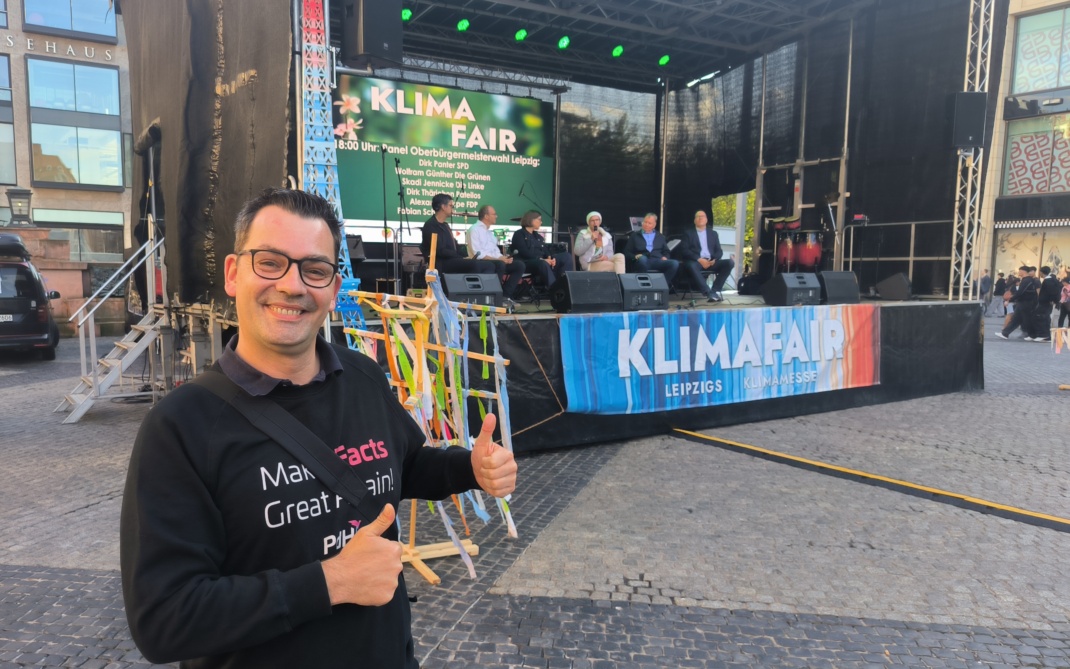
Fabian Schmidt, the PdH’s mayoral candidate, was invited by email on 11 August to a panel discussion at 4.30 pm on citizen participation, the local pet by-law, youth participation and the tree and green space protection by-law. This panel discussion did not take place; instead, he was invited at short notice to the panel with the mayoral candidates, scheduled for 6.00 pm. We have the email containing the invitation and the message regarding the change of date. His name did not appear on the KlimaFair programme, although it could be seen on the banner behind the podium.
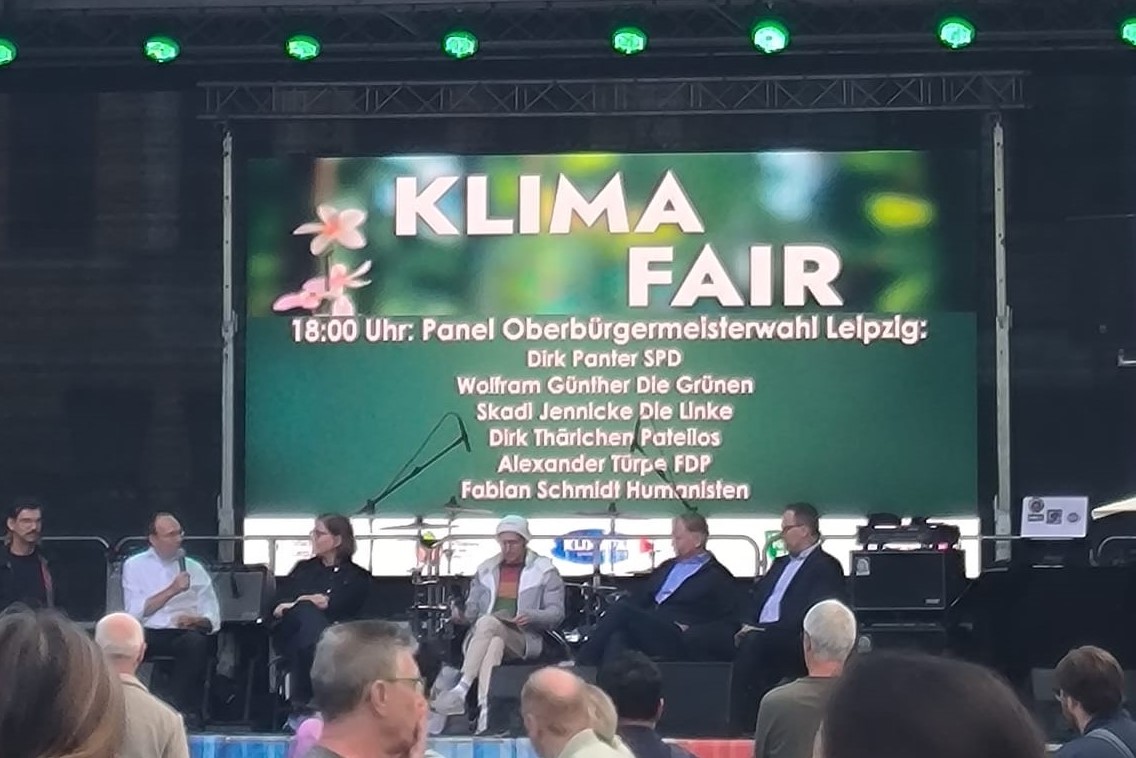
Fabian Schmidt is pictured on the banner at the KlimaFair panel. Photo: PdH LV Saxony
When Fabian Schmidt arrived, he was told that he could not take part. There had been objections from the other participants. The reason given was that, although Fabian Schmidt had been nominated by the PdH, he was not yet an ‘officially recognised candidate’. The PdH is not represented on either the Leipzig City Council or the Saxon State Parliament. Consequently, the candidacy is not legally official until the required signatures of support have been collected and the district electoral committee has confirmed them. Ralf Julke described this in detail in April, using Ralf Kohl as an example.
We put in an enquiry.
It was Sunday when we made the enquiry, but the candidate we contacted and the other candidates replied quickly.
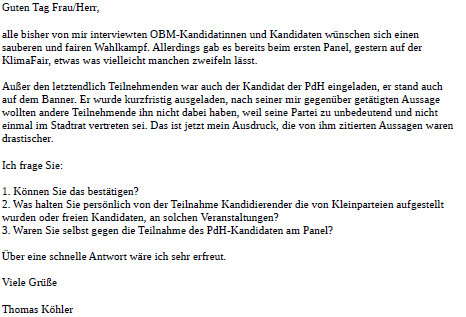
enquiry to the panel participants. Screenshot: LZ
Alexander Türpe (FDP) wrote succinctly: “I had heard about the discussion and my understanding was that it concerned the mayoral candidates. I pointed that out. Until shortly before the panel discussion, I had no idea that he had been invited. As far as I’m aware, it was ultimately the organizer who decided.”
Dirk Panter (SPD) commented as follows: “As far as I’m concerned, the candidate would have been very welcome to take part. Other than that, I wouldn’t wish to comment further on the matter.”
Dirk Thärichen (independent) replied: “I wouldn’t have had any objection – but ultimately, it’s always the organizer’s decision.”
Skadi Jennicke’s (Die Linke) response was longer and somewhat cryptic: “Every officially nominated candidate for the mayoral election should be allowed to take a seat on the panel. The decision on the composition of the panel is made by the organizer. It is only fair that this is communicated to the panel participants in advance, so that everyone can prepare appropriately for the debate. I have not commented on representation on the city council or the size of other parties.”
It is worth having a closer look at Wolfram Günther’s response.
“1. 3. I was aware of this discussion and would not have had any problem with taking part myself.
2. In principle, everyone standing for election should be given the opportunity to do so, so that voters can form their own opinion.
I believe it is right that there are also corresponding, far-reaching regulations in place for public-service institutions. One relevant factor here is whether individuals are actually candidates (i.e. whether the legal eligibility requirements have been met, such as the necessary signatures and documents being submitted in the case of independents or so-called micro-parties).
Civil society organizers have greater autonomy in this regard – in both directions.
They decide for themselves whom to invite onto their stage. If organizers decide, for organizational reasons (such as space or speaking slots to be allocated) or political reasons (such as not providing a platform for enemies of democracy), to invite only, for example, the most promising candidates or indeed not to invite certain ones at all, I must, in principle, accept that. Incidentally, I am also free to decline invitations if I find the composition of the panels unacceptable.”
What do these answers mean?
Skadi Jennicke refers to officially nominated candidates for the mayoral election. She therefore appears to believe that there would only be room on the panel for candidates fielded by parties represented on the city council or in the state parliament. It’s almost amusing that Wolfram Günther hasn’t even been officially nominated yet. The Alliance 90/The Greens’ nomination meeting isn’t until 8 September; so far, he has merely announced his candidacy.
In the final paragraph of his reply, Wolfram Günther correctly points out that civil society organizers such as KlimaFair, just like us as a media outlet, can invite all candidates – regardless of their nomination status – and discuss matters with them.
What does the organizer say?
Things apparently got a bit chaotic due to cancellations and changes to the programme. We described the background in our introduction. It should be noted that Fabian Schmidt’s participation was apparently not communicated to the other participants or the moderator.
Lisa Falkowski, speaking on behalf of the organizer, informed us that there was only a limited time slot available and that they might then have had to include Volt and other parties on the panel as well. In that case, the discussion would not have proceeded properly within the planned timeframe. Furthermore, the moderator would not have been prepared for such a last-minute change. Following internal consultation, the organizers decided to stick with the original line-up, which had been announced and prepared. However, there are plans to give the smaller parties a voice in a different context.
Conclusion: A number of things did not go to plan. The organizers’ mishaps are excusable; the people who organize this event do so largely on a voluntary basis. The organizers have also apologized to Fabian Schmidt and reviewed the incident with him.
A separate matter is the refusal by at least one of the other participants to allow Fabian Schmidt to take part, which ultimately led to the cancellation.
Of course, there is a legal criterion for official nomination. However, before the election is officially announced and the subsequent collection of supporting signatures – which candidates such as Fabian Schmidt must undergo – those candidates who are already on the safe side should not place further obstacles in their way. The smaller parties, particularly those not yet represented in parliament such as PdH and Volt, but also independent candidates, need every platform available to make themselves known to voters.
That, too, is part of democracy and fairness.
Empfohlen auf LZ


So können Sie die Berichterstattung der Leipziger Zeitung unterstützen:



There is one comment