Dieser Artikel ist auch in deutscher Sprache verfügbar: Zum deutschen Artikel.
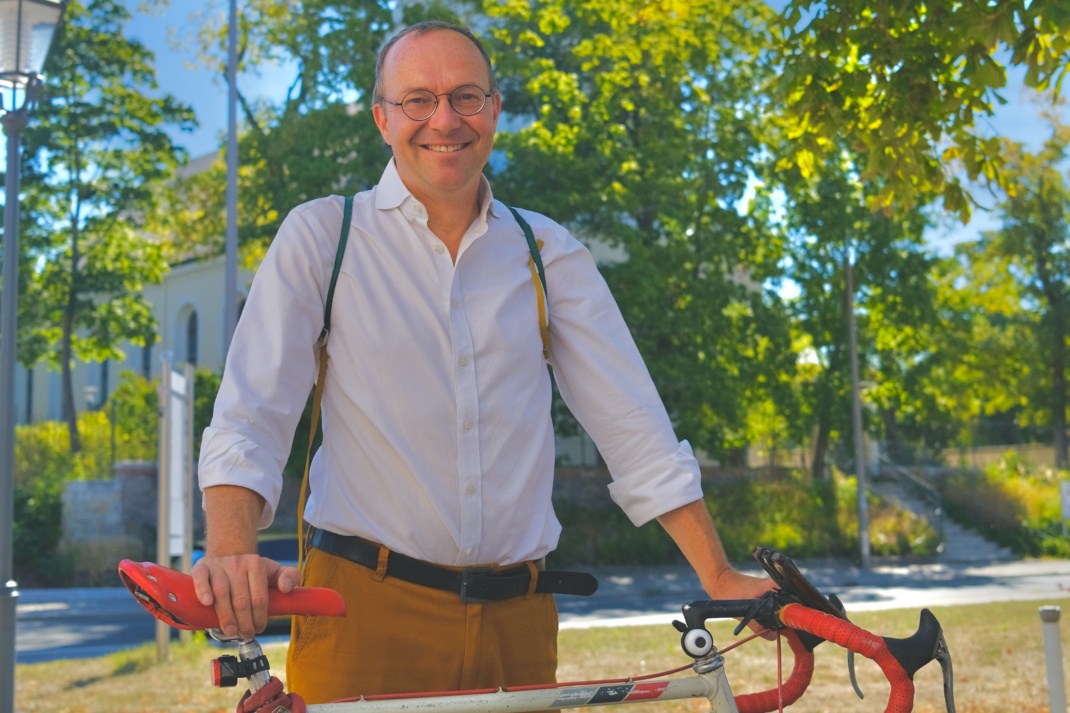
The proportion of women standing in the forthcoming election for the new mayor currently stands at 10 per cent of the candidates; this has not changed even following the announcement of The Greens candidate. With Wolfram Günther, not only is another political heavyweight entering the fray, but also another native of Leipzig.
Although this is, for the time being, merely the announcement of his candidacy – the nomination meeting is due to take place on 8 September – we met with Wolfram Günther for an interview. In our view, no surprises are to be expected at the nomination meeting.
Mr Günther, did you find it easy to accept this candidacy when you were approached by the executive committee?
When I was asked, I didn’t have to think twice. I was born and brought up in Leipzig; I started a family here and opened my law firm here. Leipzig is my city, and that’s why I’ve been involved here: with the Stadtforum, the Monument Foundation and the Transport Round Table. I can see very clearly where we need to take decisive action to ensure that Leipzig remains just as cool, liveable and cosmopolitan in the future. I have very specific ideas about what has been left undone and what needs to be done.
You may not be at home in local politics, but you are in regional politics. So you know how to deal with public office; that’s nothing new to you. What may be new is the role as head of the administration and as the 71st member of the City Council, whose vote may prove decisive under certain circumstances. How do you handle that?
Through the City Forum and the Heritage Foundation, I – or rather, we – have been heavily involved in local politics, always from the perspective of the citizens.
I didn’t become an administrative lawyer by accident. The way the state treats us, the citizens, is, in principle, the side of our democracy that we experience on a day-to-day basis. That’s what interested me. In my law practice, I specialized primarily in planning law. There, I worked extensively with citizens’ initiatives, environmental organizations and businesses – in other words, once again with civil society. Without them, there is no democracy.
I then became a minister in the Ministry for the Environment, Agriculture, Energy, and Climate Protection. I’d say I know the civil service pretty well from both sides – that of the citizens and that of the person in charge.
As I’ve read, you’ve been heavily involved in environmental issues, heritage conservation, construction and urban development. As Lord Mayor, you’d be faced with the full range of responsibilities, from libraries to nurseries, housing and so on. What would be your priority for those famous first 100 days?
Leipzig is one of the most liveable and attractive cities in the country. Leipzig thrives on open spaces and the commitment of its citizens. That is in our DNA. It was true when the Gewandhaus was founded, and it remains true today with the ‘superblocks’ in the east of Leipzig. But this Leipzig DNA is under threat. Open spaces are dwindling. And more and more obstacles are being put in the way of those who are committed to the city. I hold the current city leadership responsible for this. Preserving open spaces and clearing away the obstacles for those who are committed – that would be my top priority.
And Leipzig must continue to develop economically. This, too, requires freedom and fewer obstacles – from the start-up in Biocity to the late-night shop. Leipzig must remain a city for everyone: for people for whom the rent is a strain on their finances, as well as for those who want to build a life here. That represents a huge diversity of needs. And this doesn’t always coincide with where people make the loudest noise or are best organized. However, it is important to take all these needs into account. That is what I mean by a city for everyone.
But that shouldn’t mean that, as Lord Mayor,you know everything better than civil society, should it?
Of course not; the whole point is to develop things together with the citizens. But some people don’t make their voices heard. A single parent can’t attend every residents’ meeting. That doesn’t mean, however, that her concerns should be swept under the carpet; rather, they must be recognized. And that applies equally to female entrepreneurs and even to the local administration. People everywhere want to get involved, but are far too often held back. They must be given the space to pursue their ideas; we need to make that happen again.
This isn’t the first candidate interview I’ve conducted; everyone so far has had their priorities. What are yours?
We find ourselves in a very challenging environment, both economically and geopolitically. This doesn’t stop at Leipzig’s doorstep – take jobs in the automotive industry, for example. Not everything is within our control. But it is within our power to create the right conditions in Leipzig to strengthen existing businesses, to foster growth, and to support start-ups, the hospitality sector and the creative industries.
Leipzig must be better adapted to a future of climate change. Just how urgent this is was once again impressively demonstrated this summer. Adapting to climate change is also a social issue. A city for everyone also means that all people in every neighbourhood can get through hot days and tropical nights safely and comfortably.
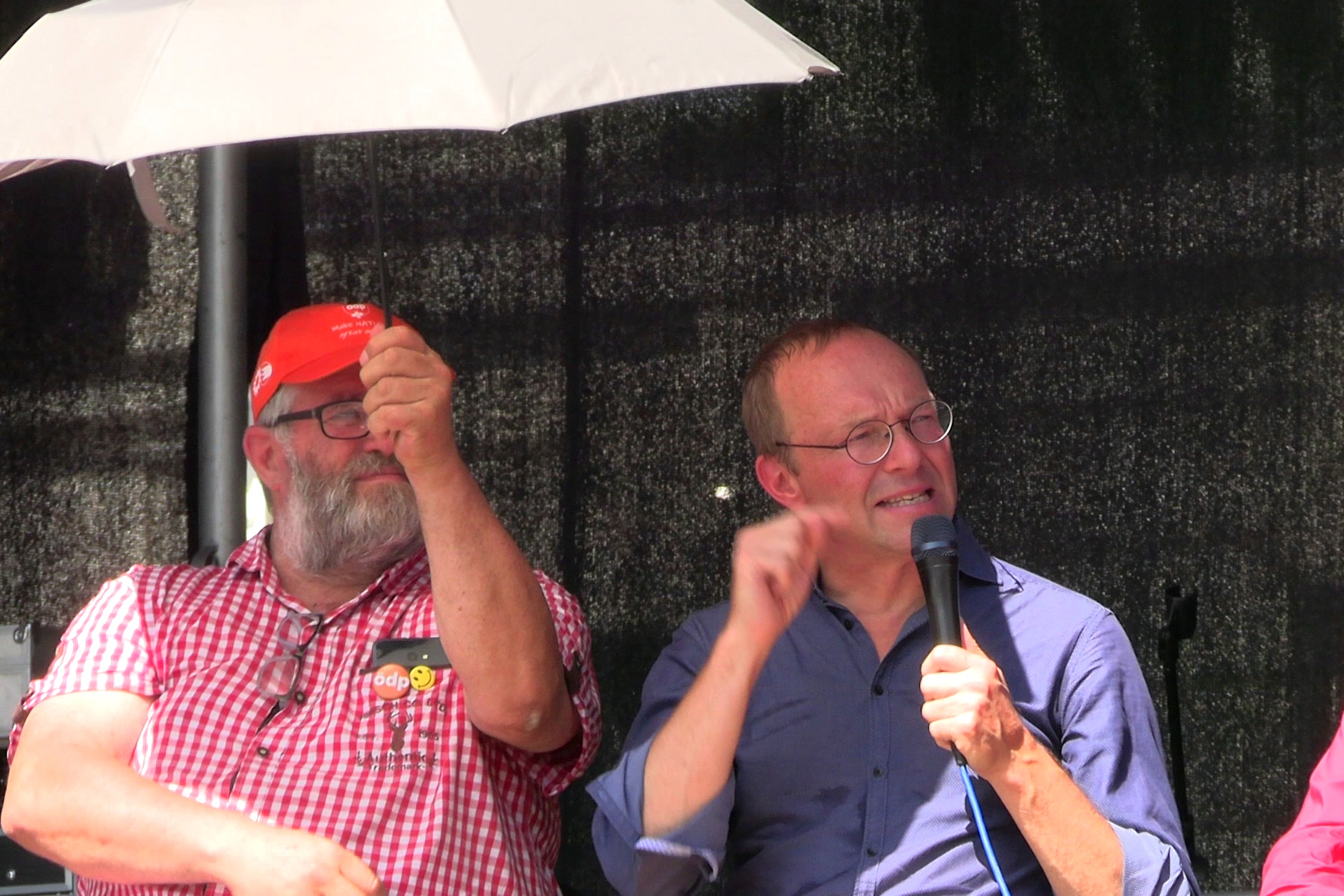 , at the panel discussion on the ‘heat transition’ at KlimaFair 2024. Photo: Thomas Köhler
Housing must remain affordable, and there must be no further social segregation within the city’s neighbourhoods. I am determined to prevent Leipzig from having such segregated neighbourhoods, where people with a great deal of money live in some areas whilst social problems are concentrated in others.
A major issue is mobility – mobility in this city that is truly designed with people in mind. A great many people get about on foot; far more people than in the past cycle regularly; and there is a public transport network that is very frequent but also very expensive, and in some neighbourhoods definitely in need of improvement. And many people simply have to rely on their cars. We need to improve this interplay between different forms of transport by providing specific solutions in specific locations. I’m not in favour of waging war on the car, but I am very much in favour of creating a better quality of life in public spaces.
Speaking of the ‘war on the car’, the Greens are always accused of being ideological. Are you driven by ideology, or are you pragmatic?
I make a point of keeping the different perspectives in mind. I’m a keen road cyclist, I drive a car, I use the train and I love experiencing cities on foot. Mobility must be designed for everyone and based on actual needs. It’s not about displacement or an ‘either/or’ approach. And there are many factors to consider: quality of life, safety – for children, for example – but also air quality.
Finally, one more question: assuming you were to become Lord Mayor, what do you envisage Leipzig looking like at the end of your first term in 2034?
I’d like us to have a housing market in 2034 that doesn’t displace people, but enables everyone to live here without fear. I’d like us to have made much more progress when it comes to this city’s adaptation to climate change – in terms of greening, de-sealing and water bodies, for example. I’d like us to have made real progress in saving the floodplain forest, because it acts as this city’s natural air-conditioning system. I want to live in a city where people treat one another with respect, where the various stakeholders and groups are involved in decision-making. And where committed people find the freedom to take action and help shape the city.
I am aware of the city’s difficult financial situation. By 2034, thanks in part to digitalization, we will have succeeded in maintaining a functioning administration with fewer resources – perhaps even one that functions even more effectively than it does today. Conversely, the people working in the administration should enjoy making things happen and driving progress. Under no circumstances must we cut back on Leipzig’s future viability.
Mr Günther, thank you for the interview.
Wolfram Günther is the tenth candidate; there are bound to be more to come. We will speak to the candidates again later, during the critical phase of the election campaign.
Empfohlen auf LZ


So können Sie die Berichterstattung der Leipziger Zeitung unterstützen:


There is one comment