Dieser Artikel ist auch in deutscher Sprache verfügbar: Zum deutschen Artikel.
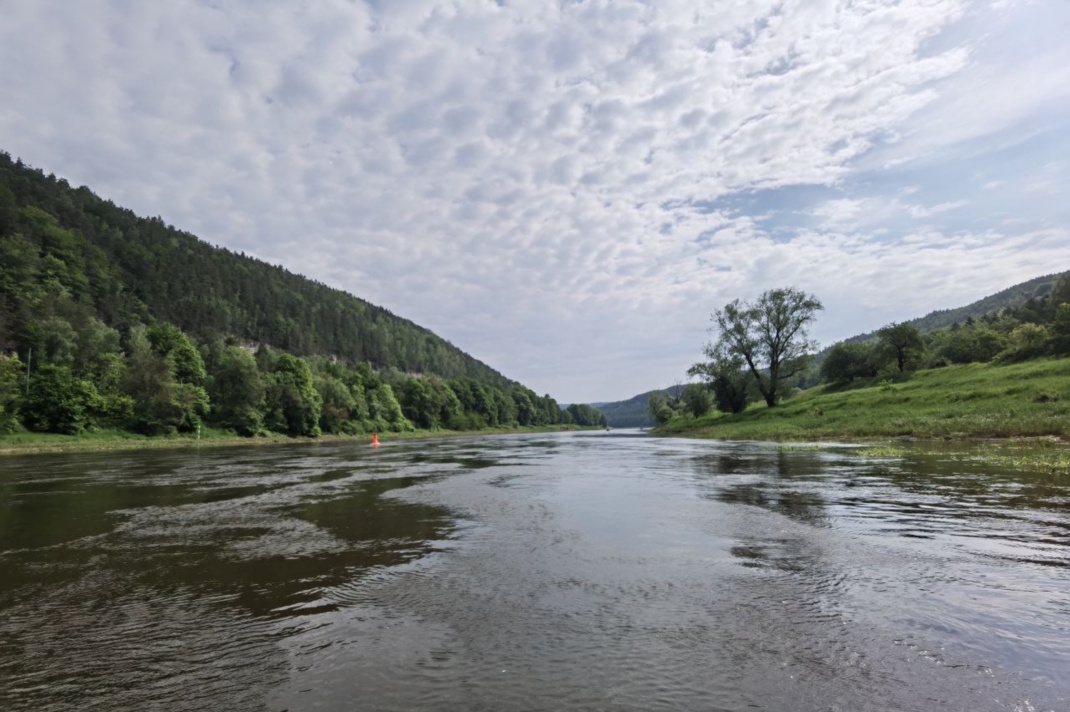
For years, the Czech Republic has been planning a further barrage on the Elbe near Děčín. This plan repeatedly provokes a strong reaction from conservative ministers in Dresden, as they genuinely believe it could somehow restore the navigability of the Elbe on the Saxon side. Ministers such as Saxony’s Environment Minister, Georg-Ludwig von Breitenbuch, were only too happy to endorse the Czech plans on behalf of Saxony, as the state in fact did in July. But this dream of a regulated river is simply without foundation.
There is currently extensive coverage of the Czech Republic’s plans to build a further barrage on the Elbe. Yet barrages represent a significant intrusion into a river ecosystem, whilst offering virtually no benefit to shipping. This is all the more true during the increasingly frequent periods of drought, when the Elbe is now recording historically low water levels and navigation is no longer possible for more than half the year.
BUND Saxony has assessed the minister’s comments on the current debate, which he made in the dpa report ‘Minister sees advantages of an Elbe barrage near Děčín’ dated 17 September 2026. The report stated: “The Czech Republic already has ten barrages and is damming up the water in the Bohemian Basin. […] A more even flow would also lead to a more even supply of water, argued von Breitenbuch.”
The fact is that there are actually 24 barrages and ten reservoirs on the Czech section of the Elbe. However, the barrages simply allow the water to flow through as it arrives from upstream. Only in exceptional cases, and then only to a limited extent, do barrages influence the flow downstream – that is, the volume of water flowing down the Elbe. If barrages were to even out flows, this could already be achieved via the 24 existing barrages in the Czech Republic. However, this is not the case, as BUND Saxony points out.
Instead, regulation takes place via the reservoirs in the upper reaches of the Elbe and the Vltava (the so-called Vltava cascade). These allow the volume of water flowing down the Elbe to be controlled.
A barrage is not a river regulator
The dpa report also included the statement: “If water were to flow more evenly in the Elbe and there were not such large fluctuations as there are now, this could only benefit the river’s ecology.”
Yet this is precisely what will not be achieved by a further barrage, as BUND Saxony points out. The Czech Republic retains a great deal of water in its reservoirs. This is needed, amongst other things, for drinking water supply and agriculture, but above all to dilute industrial discharges during low water levels, so that pollutant limits are not exceeded. For the Elbe on the Saxon side, this naturally means that the river will carry sufficient water to supply the floodplains with ever-decreasing frequency. This also impairs the replenishment of groundwater.
And the BUND corrects another misconception on the part of the minister: a river and its ecosystems need fluctuating water levels; the plants and animals have adapted to this. Stabilising water levels is not beneficial.
The pipe dream of navigability
And then came the statement, which was really just wishful thinking: “The Czech Republic wants to invest 330 million euros and try to keep the Elbe navigable for 300 days a year.”
Either the minister in Dresden is completely ill-advised. Or he is simply ignoring the expert judgement of his staff. For that is precisely what the barrage on the Elbe near Děčín will not achieve. It will not be able to compensate for the lack of rainfall associated with climate change. And certainly not regulate it downstream.
BUND Saxony soberly notes that building a barrage near Děčín will not improve navigability towards Hamburg. Consequently, the actual objective with which the Czech Republic is promoting the new barrage – access to the world’s oceans by ship – will not be achieved.
Navigability on the free-flowing Elbe has deteriorated progressively in recent years, despite decades of intensive construction work on the river. The target minimum navigation depth of 1.40 metres is not achieved on average for over six months of the year. The reason for this is that, since 2014, the Elbe’s water supply has fallen by 28 per cent (low-water study by the International Commission for the Protection of the Elbe, IKSE
).
Hardly any freight transport for the past five years
Commenting on these false promises from the Czech and Saxon sides, Prof. Dr Dr Felix Ekardt, Chair of BUND Saxony, says: “Hardly any goods are transported by boat on the river anymore. Even container transport has been suspended for over five years. In 2026, water levels on the Elbe once again fell below many low-water records. Since records began, the Elbe has never carried as little water as it has this year.
Instead of damming rivers, we must make them more resilient so that they can better cope with future challenges such as rising temperatures and extreme weather events. This requires renaturation to restore natural water reservoirs. This also benefits agriculture.”
And then there is, of course, the Saxon Environment Minister’s rose-tinted dream: “According to Saxony’s Environment Minister Georg-Ludwig von Breitenbuch (CDU), a barrage on the Elbe near Děčín in the Czech Republic will bring the Free State nothing but benefits.”
Yet the exact opposite is true. The Minister ought to know this, too, if he has ever bothered to familiarise himself with river ecology. Barriers deteriorate the water quality of the Elbe, according to BUND Saxony. A dammed river warms up more rapidly. This leads to increased algae growth and a decrease in oxygen levels. Fish die off more quickly. The risk of flooding may also increase. These would be significant disadvantages for Saxony, according to BUND Saxony.
Empfohlen auf LZ


So können Sie die Berichterstattung der Leipziger Zeitung unterstützen:





There is one comment