Dieser Artikel ist auch in deutscher Sprache verfügbar: Zum deutschen Artikel.
Energy, energy sources and their pricing have been a hot topic of conversation for some time now – and not just since the war in Iran. There are constant calls, particularly from business circles, for rapid – ideally immediate – reductions in energy prices, and politicians often respond in a confused manner, as is currently the case with the ‘Tankrabatt 2.0’ scheme.
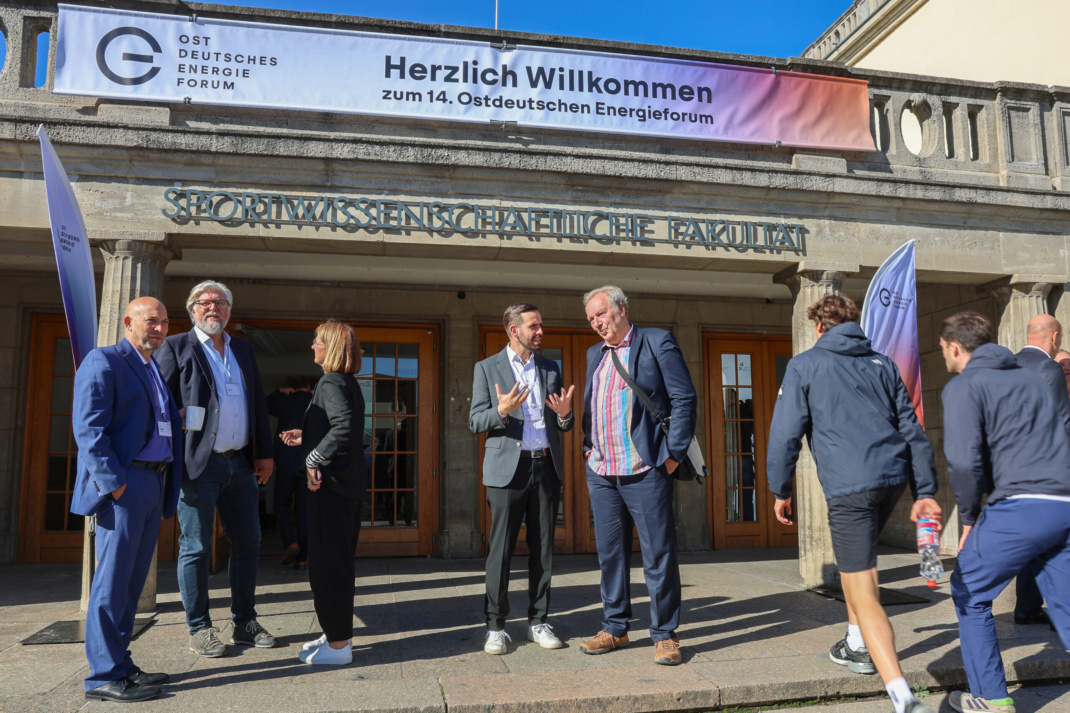
Against this heated backdrop, the Association of Business Organizations in Eastern Germany and Berlin is organizing the 15th East German Energy Forum, which will take place in Leipzig from 30 September to 1 October.
Will we hear nothing but complaints about high energy prices there, or will the focus be on shaping the future of energy supply? We didn’t want to wait until the official press conference and met with the association’s managing director, Lars Schaller, for a chat,
The interview
Mr Schaller, an East German conference on energy issues – at a time like this, one would normally expect to hear mainly complaints about politics. So: fuel is too expensive, energy is too expensive, everything is too expensive in general, it’s all rubbish, we need relief! Is that what we can expect, or does this conference have a different purpose?
We are, of course, using the Energy Forum to set out our position on energy policy, particularly in light of rising energy prices. The trend in energy prices is, naturally, also a challenge for our small and medium-sized enterprises, so there is a need to explain why we require relief in this area. On the other hand – and this has always been the aim of the Energy Forum – it is important to us to bring all parties together around one table: that is, the administration, politicians, academia, small and medium-sized enterprises, and also civil society groups, so that we can work out a solution together. So it lies somewhere in between: we will articulate the demands we have of the political sphere, whilst at the same time bringing all stakeholders together.
The current demands being put forward, for example by the Chamber of Industry and Commerce (IHK) and individual business owners, are for reductions in fuel and electricity prices. As understandable as these are, they are calls for short-term, quick fixes, rather than a long-term energy strategy.
This isn’t something that’s only just begun; we’ve been calling for this strategy ever since the East German Energy Forum was established. We had drawn up various position papers on the subject; naturally, there were always shifts in direction within the Federal Republic. The nuclear phase-out was our main concern at the time; we said then that we believed this would have some impact on the energy system. We needed to take action there. Then came the phase-out of lignite, and now the last nuclear reactor has been taken off the grid. We have lacked a long-term strategy under every federal government, regardless of its political persuasion; no such strategy is in sight. What is currently being envisaged are short-term measures. However, in our view, this misses the mark. We need to take a fundamental look at how to strike a balance between the three objectives of security of supply, economic efficiency and environmental protection.
When we talk about the economy, we must recognize that the supply of fossil fuels – on which a large proportion of our energy supply and almost the entire transport sector depend – has become unreliable. In the current global situation, with the blockade of the Strait of Hormuz and the war in Ukraine, prices are rising and deliveries are being delayed or cancelled. Shouldn’t we be saying that we need to move away from this dependence?
This is precisely the tension that undoubtedly exists between these three components. Alongside the security of supply that goes hand in hand with this, we have all committed to reducing CO₂ emissions – by 2045 under the Paris Climate Agreement – and the German Government’s measures are also set out to be achieved by 2050. It has to be said that we have invested heavily in renewables, and now the whole thing is petering out a bit again. We are becoming increasingly dependent on suppliers in the solar and wind energy sectors; many raw materials and most solar panels come from China. With Meyer Burger, we have lost the last manufacturer of solar modules.
As a representative of the employers’ association, what is your view on the fact that the entire decline of the solar industry was politically driven – people are talking about the ‘Altmaier U-turn’, through which we knowingly made ourselves dependent once again?
So now we are dependent in two respects: on renewables as well as on fossil fuels. With the phase-out of coal-fired power generation, the next step will follow. We have a domestic energy source, however bad it may be for the carbon footprint. When it comes to security of supply, I still regard it as an important factor.
The decline of this sector has hit the Saxon regions of Bitterfeld-Wolfen and Freiberg particularly hard. And that is, of course, something we as representatives of small and medium-sized enterprises must work to address. Naturally, the issue of prices is key – whether we can bring them down through renewables. As an association, we find ourselves caught between two pressures here, because we want to promote renewables and also see them as a sector of the future for Eastern Germany. On the other hand, we recognize the current problems faced not only by energy-intensive companies struggling with high prices.
You mentioned earlier that the forum will bring together representatives from politics, the civil service, business and civil society. Who exactly will be attending?
We have many different representatives from the groups you mentioned. From the Federal Ministry for Economic Affairs and Energy, the Federal Ministry for the Environment, and government representatives from the states of Saxony and Thuringia – that’s the political side. Representatives from the academic world will be coming from HTWK Leipzig and TU Dresden. From the energy sector, there will be representatives from LEAG, VNG, EnviaM, the battery manufacturer CATL in Arnstadt, Stadtwerke Leipzig as the regional energy supplier, and others. As for representatives from the business sector and small and medium-sized enterprises, we have a broad range of participants; amongst others, the President of the Leipzig Chamber of Industry and Commerce will be attending, along with other key contacts from the renewable energy sector and energy-intensive industries.
That sounds exciting. At a forum, discussions take place and thoughts and ideas are exchanged, but no decisions are made. But I assume you want to influence policy, perhaps also towards a long-term energy strategy?
I’m not the only one who’s a bit disillusioned in that regard. I’ve been organizing the forum for 15 years. We’re all disillusioned when it comes to that. We don’t see a long-term strategy. To be honest, you can look from one party to another. I don’t see it.
Final question: why the focus on Eastern Germany?
We’re often asked this question, and we ask ourselves the same thing time and again. Energy policy cannot be viewed solely within an Eastern German context; it must be considered within a German or, indeed, a European context. In fact, there had already been discussions about defining it as a European energy forum or something similar.
However, we said that we have certain conditions in Eastern Germany that open up a number of opportunities for us in the energy sector. We have the land and we have the grids. We can actually make good use of all the assets we have. That is why we have focused on Eastern Germany for the time being – though, of course, it must be said that this was 15 years ago. Back then, there were also other structural conditions in Eastern Germany. As I said, we reconsider every year whether this should remain the case. There are also a wide variety of other energy conferences in Germany, and that is precisely how our focus and our added value came about. So, the reference to ‘Eastern Germany’ in the name is not a criterion for exclusion; it simply arose historically.
Thank you very much, Mr Schaller; we’re sure to learn more details at the press conference.
Conclusion: The business associations of Berlin, Brandenburg-Berlin e.V., Northern Germany, Rostock-Central Mecklenburg, Mecklenburg-Schwerin, Saxony, Saxony-Anhalt e.V. and Thuringia drafted a joint position paper in 2025, in which they defined ten areas of action for an energy policy that supports small and medium-sized businesses. These areas for action remain relevant today; in just over a week’s time, we will know what the current demands are.
Empfohlen auf LZ


So können Sie die Berichterstattung der Leipziger Zeitung unterstützen:


There is one comment