Dieser Artikel ist auch in deutscher Sprache verfügbar: Zum deutschen Artikel.
In 2016, Daniel W. marched through Leipzig-Connewitz with a mob of far-right extremists. At least three people were injured at the time. Today, he works in field production at MDR – with access to internal planning systems. The broadcaster refuses to answer key questions on the matter.
He was present when, on 11 January 2016, between 250 and 300 members of the far-right marched through Leipzig-Connewitz. The group had gathered by prior arrangement; they were dressed in black and had their faces covered, and they attacked houses, shops and cars with axes, iron bars, telescopic batons and wooden slats. Twenty-five flats, shops and pubs were damaged, along with 18 vehicles, causing damage totalling around 113,000 euros.
According to research by the Leipzig city magazine ‘kreuzer’, at least three people were injured. It was sheer luck that things did not turn out worse: a ball bomb that was thrown into a snack bar exploded in a steel sink rather than amongst the gas cylinders standing there, yet it still caused massive damage. In its judgement, the Leipzig Magistrates’ Court stated that a confrontation with local residents was avoided solely because the majority of them were at the counter-demonstration against Legida in the city centre at the time.
Today, Daniel W. works full-time at Mitteldeutscher Rundfunk, in the external production department. He has access to the broadcaster’s intranet and to the systems used to plan productions.
The verdict
On 9 January 2020, the Leipzig Magistrates’ Court sentenced him to one year and four months’ imprisonment, suspended, plus a fine of 2,200 euros payable to the state treasury. The conviction is for breach of the peace; the sentence was determined on the basis of this being a particularly serious case. The judgement has been final since 26 February 2020. The Leipzig Public Prosecutor’s Office confirmed these details at the request of the Leipziger Zeitung; the editorial team has a copy of the anonymised transcript of the judgement.
The court regarded his confession as a mitigating factor, as it spared the court a two-day hearing of evidence and the need to re-examine witnesses from Connewitz. He had no previous convictions, and his role in the offence was minor – according to the court, it could be proven that he did no more than ostentatiously march alongside the crowd. He fulfilled the conditions within the specified time frame, and the sentence was remitted in April 2022. When determining the fine, the court took into account not only his maintenance obligations but also the fact that his job was at risk as a result of the proceedings.
At the time of the offence, he was working as a project manager at Media Mobil GmbH, a subsidiary within the MDR group of companies. His employment with the broadcaster is therefore not a move from outside the organisation, but a transfer within the corporate structure.
The broadcaster’s response
The Leipziger Zeitung put sixteen questions to MDR on 26 August, followed by a further five on 4 September. None were answered. A spokesperson merely stated on 4 September:
“Convictions for criminal offences of this nature are no longer included in a police certificate of good conduct after a period of five years. The convicted person is therefore considered to have no previous convictions. In this respect, MDR can no longer take a previous conviction into account as a negative factor in the recruitment process beyond the period provided for by law.”
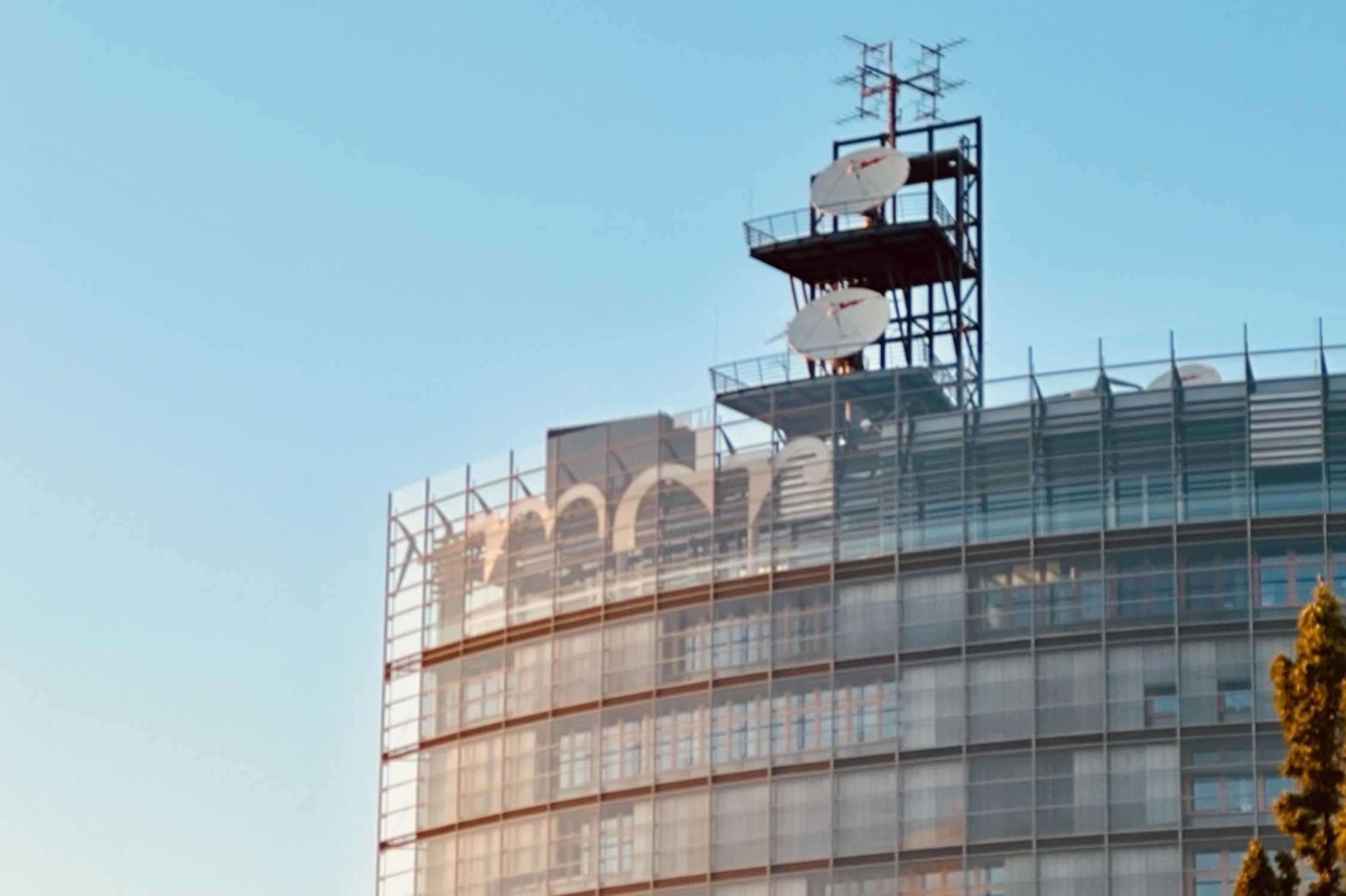
MDR headquarters in Leipzig. Photo: Marco Brás dos Santos
This account is incomplete. The Federal Office of Justice, which maintains the Federal Central Register, confirmed to the Leipziger Zeitung upon enquiry: for a sentence of this severity, the five-year period is extended by the duration of the custodial sentence, and it begins on the day of the first conviction. Five years become six years and four months. The conviction would therefore only be removed from the criminal record on 9 May 2026.
Even more important is the second sentence. The fact that an entry no longer appears on the criminal record does not mean that the conviction may no longer be taken into account. The law grants the convicted person a right to remain silent – they may describe themselves as having no previous convictions. This does not result in a prohibition on employers taking the conviction into account; that only takes effect once the conviction has been expunged from the register, which in this case will occur in 2036 at the earliest. The Federal Office puts it as follows: the right to remain silent does not mean that the conviction, whilst still on record, may no longer be taken into account until it is expunged.
Furthermore, the trial was reported on publicly in 2020, including in this newspaper.
MDR did not need a certificate of good conduct at all to find out about Daniel W.’s conviction.
According to information from the Leipziger Zeitung, his probationary period ended on 31 August 2026. The broadcaster has not disclosed when the employment relationship began or when the decision to appoint him was made. In response to an enquiry which referred to the relevant regulations and offered an opportunity to correct the record, MDR replied on 17 September that it had nothing further to add to its response of 4 September.
What happens at MDR
MDR’s External Production department coordinates technical matters: which camera goes where? Which microphone for which shoot? To do this, it needs an overview of the broadcaster’s productions. According to accounts from within the broadcaster, this access extends right down to individual programmes – right down to the question of who is meeting whom, when and where. Where editorial teams also store contact details, these are also held in MDR’s systems.
There are two accounts circulating regarding the scope of this access. One states that he had no access to sensitive data. The other claims that employees, who normally should not have access either, were nevertheless able to access certain data with just a few clicks. MDR has failed to respond twice to questions regarding the access authorisation policy.
What is stored there is not just filming schedules and staff details. These are people who provide MDR with information – about the far right, about the authorities, about their own lives. Anyone who speaks to an editorial team assumes that their name will not leave the organisation. A person from the broadcaster gives an example: the contact details of a queer activist, entered by colleagues from the current affairs department who may never have given the matter a second thought.
The neo-Nazi march on 11 January 2016 in Connewitz was directed against precisely this section of the city’s society.
There are various voices from within the organisation: “My sense of security has been severely undermined.” And: “I wonder why the advertised post wasn’t filled by someone else.” The people saying this do not wish to be named. They face consequences under employment law.
No one is reporting a specific incident. The concern centres on the possibility – and on the fact that no one within the organisation can allay these fears, because no one is disclosing access rights.
Two people working for MDR have independently confirmed to the Leipziger Zeitung that they no longer upload sensitive data to the internal systems. A third account suggests that there are others who are doing the same – a consequence of the internal debate surrounding Daniel W.
No one is responsible
The Broadcasting Council, the broadcaster’s supervisory body, stated in response to an enquiry on behalf of its chairperson that it is not responsible for personnel matters concerning staff on collective agreements. The enquiry had not been about this, but rather whether the body had been informed, whether it considered the independence of reporting to be compromised, and how it oversees the subsidiary companies. A follow-up enquiry reiterating these points and requesting that it be forwarded to the Chair of the Administrative Board also remained unanswered.
However, the MDR’s compliance policy, approved by the Director-General, stipulates that the Director-General must inform the Chair of the Board of Directors if there is a suspicion of significant breaches of rules or the law. The policy expressly defines as ‘significant’ any circumstances associated with reputational damage and public impact.
The same compliance policy states that MDR’s Compliance Department is not responsible for the broadcaster’s subsidiaries and associated companies. Nor does the Staff Code of Conduct apply to them. Consequently, neither of these applied within the group during the period in which Daniel W. was employed by Media Mobil.
This should have changed with his direct appointment. The Compliance Service Instruction applies to all permanent staff at MDR, as does the Staff Code of Conduct. The latter commits staff to the values of the Basic Law and states that there is no place for anti-Semitism, racism or exclusion within the broadcaster. Under the compliance guidelines, all staff members are required to undergo training on compliance and the Code of Conduct.
In response to an enquiry from this newspaper, the ARD answered precisely those questions which the MDR had refused to answer, citing data protection. The systems are not provided centrally; each broadcaster operates its own instances. There is a common minimum standard for data classification, and each organisation has its own role-based and authorisation frameworks.
Whistleblower protection is ensured through technical and organisational measures in accordance with the General Data Protection Regulation; special precautions are in place for investigative editorial teams, in some cases in physically separate infrastructures.
According to ARD, there is no network-wide survey of cases such as this; reports are handled confidentially within the respective broadcasters. According to the broadcaster’s account, there is also no committee dealing with issues sensitive to source protection. Individual departments deal with such matters – from an IT security perspective. There had been no discussion of this matter amongst the member broadcasters for a long time, as none wanted to admit to having a security breach in comparison with the others.
When asked whether the ARD Executive Board had been informed of the incident, the ARD replied with a single word: No.
Our questions to MDR
Submitted on 26 August 2026, deadline 28 August. On 4 September, MDR did not answer any of them, citing data protection and privacy rights.
Regarding the selection process
1. What procedure was followed to fill the post? Please state the recruitment period, the number of applications received and the number of interviews conducted.
2. Was the application deadline extended? If so: for what reason, by how many days, and how many applications were received during the extension?
3. Who was involved in the selection decision — at departmental management, senior departmental management and executive management levels?
4. Was MDR aware of the conviction at the time of recruitment? If so: through which channel, and how was it assessed? If not: Why not, given that Mr […] had been employed for years by a wholly-owned subsidiary of MDR and that the proceedings had been reported on publicly?
5. Are MDR and DREFA company employees under a duty to report ongoing criminal proceedings? Was such a duty fulfilled in this case?
6. Are there regulations that treat relevant convictions or anti-constitutional activities as grounds for refusing employment? Were they applied?
7. What role did the staff council and the compliance department play?
8. How does MDR assess the fact that a conviction of a comparable severity in the Saxon judicial service led to suspension and, in the legal trainee programme, to the imminent termination of training, whereas at MDR it led to permanent employment?
Regarding the position
9. What are Mr […]’s duties, powers of authority and places of work?
10. To which systems does he have access – in particular the MDR intranet, ARD IntranetRESY, and planning and scheduling systems? Does this access also include the ability to make proposals and/or view productions outside the External Production department?
On the protection of sources and informants
11. Are the names, contact details or schedules of informants, protagonists and interviewees recorded on the MDR intranet/ARD intranet and in the planning systems?
12. How is the role and authorisation framework structured? Can employees in the operational management team access editorial source data? Are there provisions for purpose limitation, logging and regular authorisation reviews?
13. Can MDR envisage a situation where permanent and freelance staff would now refrain from entering sensitive data into the systems? What conclusions does MDR draw from this?
14. Was MDR’s data protection officer involved in the matter? Was a risk assessment carried out in accordance with Article 32 of the GDPR?
To the editorial team
15. An MDR employee told us that his sense of security, as well as that of colleagues who are aware of the relevant personal details, is “extremely compromised”. How does the management assess employees’ concerns regarding their personal safety and the independence of their reporting?
16. Have the management, the works council and the management board been made aware of the matter? Was the Broadcasting Council informed?
Enquiry dated 4 September 2026, deadline 16 September.
MDR replied on 17 September, stating that it currently had nothing to add to its response of 4 September.
17. On what basis does MDR cite a period of five years? Was Section 34(3) of the BZRG taken into account? Who within the organisation carried out the assessment?
18. Was MDR aware of the conviction independently of a certificate of good conduct? How was this taken into account in the selection process?
19. When did the employment relationship commence, when was the selection decision made, and how long was the probationary period?
20. Questions 11 to 14 concern systems, not individuals. Why does data protection prevent the disclosure of information about the organisation’s own system architecture?
21. Is the MDR aware that staff members refrain from recording informant data?
Empfohlen auf LZ


So können Sie die Berichterstattung der Leipziger Zeitung unterstützen:



There is one comment