Dieser Artikel ist auch in deutscher Sprache verfügbar: Zum deutschen Artikel.
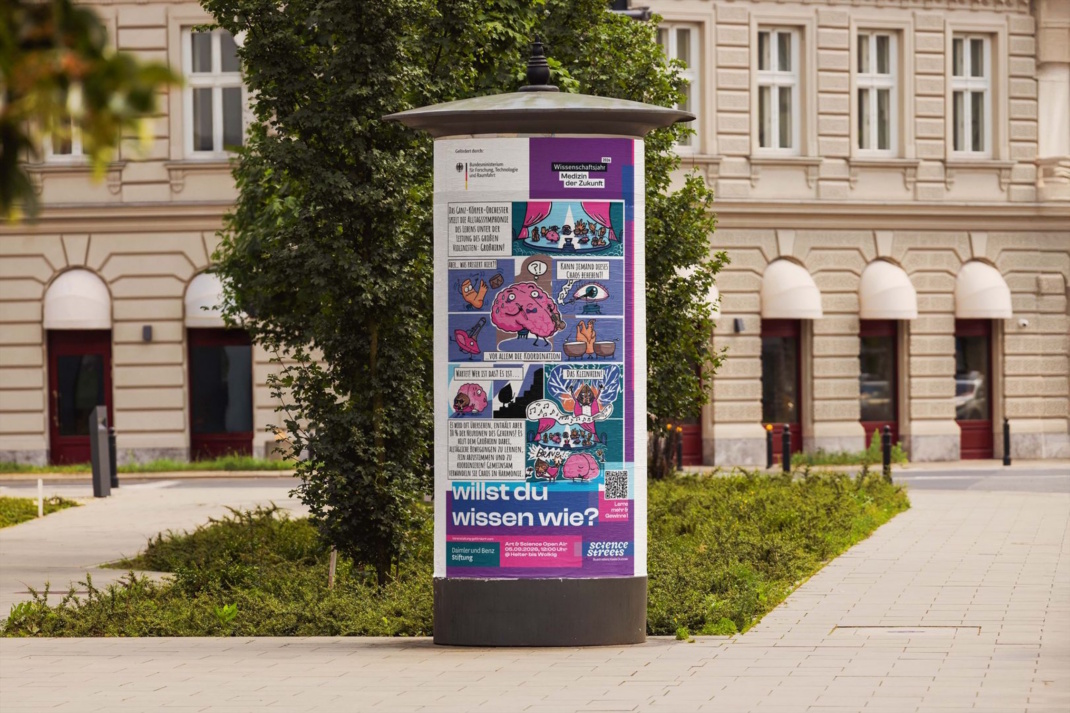
Most people in Leipzig are completely unaware that there is a Max Planck Institute for Cognitive and Neural Sciences in the city. Yet this is where researchers are studying the organ that enables us humans to form a picture of the world – our brain. From 1 August, this otherwise very low-key research will be attracting attention on Leipzig’s streets for the first time. From 1 to 30 August 2026, the ‘science streets’ project will be showcasing neuroscientific topics on advertising hoardings in and around Leipzig.
Laura Mayer, who is studying geography at the University of Leipzig and has also created one of the illustrations for the campaign, is the project’s artistic director.
Through comics, the ‘science streets’ project aims to make complex research accessible throughout Leipzig. At bus stops, on advertising columns, on public transport in Leipzig and on the S-Bahn trains in Central Germany, eleven colourful comics will show how brain research is shaping our lives and the medicine of tomorrow.
It combines scientific findings with vivid images. The focus is on questions relating to the brain in all its facets, from how it works, through the interaction of hormones and ageing processes, to the potential for the medicine of the future. Those interested can delve deeper into the topics via QR codes: these lead to free interviews with researchers, background information and further digital content.
The project is intended as a contribution to science communication and was developed over several months by researchers from the Max Planck Institute for Cognitive and Neural Sciences and the Max Planck Institute for Human Development, in collaboration with eleven illustrators.
Bringing scientific findings into everyday life
“Science communication often reaches mainly people who are already interested in science – we wanted to change that,” explains Agata Patyczek, who is the scientific director of “science streets” and is completing her PhD at the Max Planck Institute for Cognitive and Neural Sciences. Laura Mayer, a student at the University of Leipzig, is the project’s artistic director and adds: “By using advertising spaces, we bring scientific insights into everyday life and facilitate unexpected encounters.”
Events to get to know the project
One opportunity to meet the researchers and illustrators behind the comics is the “Art & Science Open Air” event at the “Heiter bis Wolkig” cultural café on 5 September 2026. In addition, as part of the ‘Familienfestspiel’ at Leipzig Town Hall on 26 September 2026, the project members are inviting children to discover how the brain works and to create their own science comics.
The ‘science streets’ project is funded by the Federal Ministry for Research, Technology and Space (BMFTR) as part of the Year of Science 2026 – Medicine of the Future.
Empfohlen auf LZ


So können Sie die Berichterstattung der Leipziger Zeitung unterstützen:


There is one comment