
Autumn is a time when the passing of time becomes visible. That’s why, alongside a look back, there’s also a return here today. Chanson legend Mireille Mathieu bids farewell, but is set to return after all. We are reminded of the courage of Spanish women, Leipzig’s Start-up Night looks to the future, the focus is on the little ones, without whom there is no future – and in the state parliament, the collective will of the people is on the table.
Mireille Mathieu’s farewell before the farewell
Tear-jerking moments guaranteed: French chanson singer Mireille Mathieu is performing at Leipzig’s Gewandhaus today at 8 pm. And she is bidding farewell. The 80-year-old is presenting her programme ‘Goodbye my Love, Goodbye! – The Finale of the World Farewell Tour’.
Mathieu, who was born in Avignon on 22 July 1946 and celebrated
her 80th birthday this summer, has been one of France’s most
internationally renowned performers for six decades. She grew up in
modest circumstances and looked up to Édith Piaf from an early age.
After winning a singing competition in her home town, she made her
decisive breakthrough in 1965 on French television with her cover
of Piaf’s “Jézabel”. The singer was just 19 years old at the time. 
1966 also marked the beginning of her special relationship with East German audiences: Mathieu performed at the Friedrichstadt-Palast in East Berlin even before she gave her first concerts in West Germany in 1967. On both sides of the Wall, she reached a wide audience with French chansons and German-language pop hits. Among her best-known German songs are ‘Hinter den Kulissen von Paris’, ‘An einem Sonntag in Avignon’, ‘Akropolis Adieu’ and ‘La Paloma ade’.
The singer has a special connection to Leipzig – or rather,
Leipzig to her: on 31 December 1970, Deutsche Fernsehfunk broadcast
a ‘Gala Evening with Mireille Mathieu’ from the Kongresshalle
am Zoo
. The production is regarded as the first colour stereo broadcast
by East German television. That was a long time ago.
And because the most beautiful farewells are those that don’t
seem quite so final, Mireille Mathieu will – oops – be returning to the Gewandhaus
again in the autumn of next year. Perhaps one day someone will find
the suitcase she’s had standing in Leipzig for decades.
For anyone who couldn’t get a ticket for today, this farewell in instalments is a blessing, as tonight’s concert is sold out – barring any returned or unused tickets.
As Trude Herr sang so beautifully in 1987: “One never leaves quite completely.” When Mireille Mathieu comes to sing ‘Goodbye’ once more next year, it will already have been 40 years since then.

With a special connection to Leipzig: Mireille Mathieu says “Goodbye” today. Just a little bit… Photo: Michael Schöne
Women in the Civil War
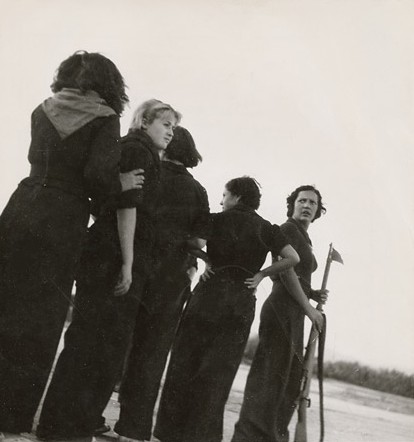
We look back to a time when the term ‘girl power’ was not yet in common use, but the organised women’s movement was already making history. Today at the Capa-Haus (Jahnallee 61), the focus is on the women’s organisation ‘Mujeres Libres’ during the Spanish Civil War. Historian Vera Bianchi will speak from 7 pm about the anarchist women’s movement, which campaigned in the 1930s for education, economic independence and social equality.
Mujeres Libres was founded in Spain in April 1936. Its members sought not only to open up better educational and career opportunities for women, but also to enable them to participate independently in politics. In doing so, they opposed patriarchal power structures, which also existed within the anarchist movement.
During the Spanish Civil War, the activists organised, amongst other things, educational programmes, vocational training schemes, childcare and social services. Members of the Mujeres Libres also took part in the resistance against the troops of the future dictator, Francisco Franco.
The historian Vera Bianchi has conducted academic research into the women’s movement and published her findings, amongst other works, in the book *Feminists in the Revolution: The Mujeres Libres Group in the Spanish Civil War*. The event takes place in the year marking the 90th anniversary of the start of the Spanish Civil War, which broke out in July 1936.
The Capa-Haus is situated in the immediate vicinity of the Angerbrücke tram stop and can be reached from Leipzig Central Station via tram lines 3, 7 and 15. There are no dedicated car parks at the Capa-Haus.
On the Loss of Species
Species extinction is accelerating. More and more species are being added to the international Red List. Between 2006 and 2025, their number rose from around 16,100 to more than 48,600. According to estimates by the Intergovernmental Science-Policy Platform on Biodiversity and Ecosystem Services (IPBES), around one million animal and plant species worldwide are threatened with extinction.
Today, the Botanical Salon at the Botanical Garden is addressing this global issue. Under the title ‘What we are currently losing. Making species extinction tangible’, the artist Clara Rueprich and the historian and writer Udo Grashoff are presenting their artistic and literary project ‘Abwesen’. Through films, texts and installations, they explore the disappearance of species and landscapes, examining the question of what traces this disappearance leaves behind and how it can be perceived.
The loss of biological diversity weakens the resilience of ecosystems and jeopardises their ability to adapt to environmental changes. More than three-quarters of the world’s cultivated food plant species rely, at least in part, on animal pollination, meaning that the decline in pollinators also threatens our food security.
Rueprich is a visual artist who studied in Dresden, Bordeaux, Nuremberg and Leipzig. In 2006, she completed a Master of Fine Arts at Chelsea College of Arts and Design in London. Her works have been exhibited in Budapest, Leipzig, Berlin, Bonn and London, amongst other places.
Grashoff is a historian and writer; he studied biochemistry, history, German studies and comparative literature. He completed his PhD in 2006; his research focuses on the history of the GDR, particularly on social and political taboo subjects such as suicide and treason. In addition to two collections of poetry, he published the book *Raumschiff Erde* in 2022, which explores the history of environmental awareness in Germany in the 19th and 20th centuries.
The event begins at 6 pm at the Botanical Garden (Linnéstraße 1). Admission is free.

Good reasons in Leipzig
A business idea can give rise to a company that develops new technologies, improves existing services and, last but not least, creates jobs. Such start-ups are particularly important for a region’s economic development. The Leipzig Start-up Night today will showcase which ideas and young companies in the Leipzig region are particularly impressive.
The event begins at 5.30 pm in the Main Lecture Theatre of the Faculty of Sports Science on the Jahnallee campus. Visitors can find out about various start-up projects at the ‘Market of Opportunities’. From 7.00 pm, awards will be presented in four categories. A total of 15,000 euros in prize money is up for grabs. Six finalist teams will present their business ideas in short live pitches. The audience will then vote to decide the winner of the Ideas Prize, worth 5,000 euros.
The Start-up Prize is worth a further 10,000 euros, and its winner will be selected by a panel of experts. Companies founded between 1 January 2024 and 30 June 2026 and based in Leipzig or the districts of Leipzig or North Saxony are eligible for this award. The Ideas Prize, on the other hand, is also open to founders whose business concepts have not yet been implemented.
In addition to the two cash prizes, the honorary awards ‘Ten Years After’ and ‘Lifetime Achievement’ will be presented. These recognise long-standing entrepreneurial achievements and the lifetime’s work of prominent entrepreneurs. The names of this year’s winners will therefore only be announced during the course of the event.
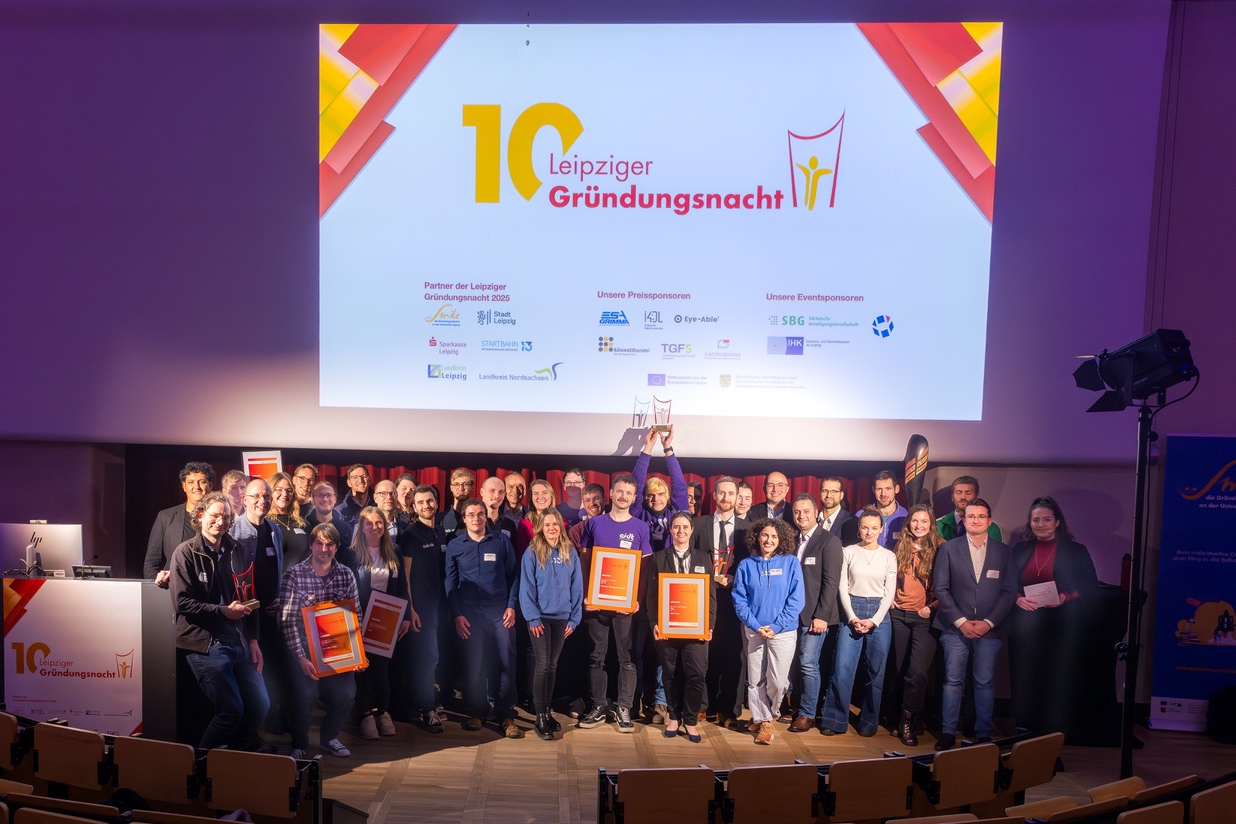
Last year’s winners. © Swen Reichhold
As far as we are concerned
They are an essential element of democratic participation. Petitions give citizens the opportunity to initiate political decisions and to critically scrutinise government action. They enable democratic participation even between elections and bring the concerns of the public directly to Parliament.
Today, the Petitions Committee of the Saxon State Parliament is convening for its next meeting. The official agenda comprises eight items. One of these is devoted to ‘discussion of publicly submitted petitions’.
Among the citizens’ concerns currently documented on the official petitions portal is the initiative ‘Safeguarding heritage conservation in Saxony – preserving the unity of archaeology’. It was submitted by Dr Thomas Westphalen of the Landesverein Sächsischer Heimatschutz (Saxon Association for the Preservation of Local Heritage) and has received 4,592 signatures. The petition opposes the planned merger and integration of Saxony’s heritage conservation authorities into the State Directorate, as well as the separation of the State Museum of Archaeology in Chemnitz from the State Office for Archaeology.
Also scheduled for a hearing is the petition ‘Universities at their limit: investment instead of austerity’ by Franziska Kossatz from the Student Council of TU Dresden. It has 4,111 co-signatories. The initiators are calling for improved basic funding for universities, additional investment in infrastructure, fewer fixed-term contracts and compliance with existing target agreements.
These demands are of particular significance in view of the Free State’s budget planning for 2027 and 2028. The Parliament has compiled an overview of petitions currently received by the State Parliament ONLINE HERE.

Licence notice: The photograph WOMEN IN THE SPANISH CIVIL WAR is by Gerda Taro and is made available for free use on Wikimedia Commons via THIS LINK. The photograph has not been edited in any way.
Empfohlen auf LZ


So können Sie die Berichterstattung der Leipziger Zeitung unterstützen:





There is one comment