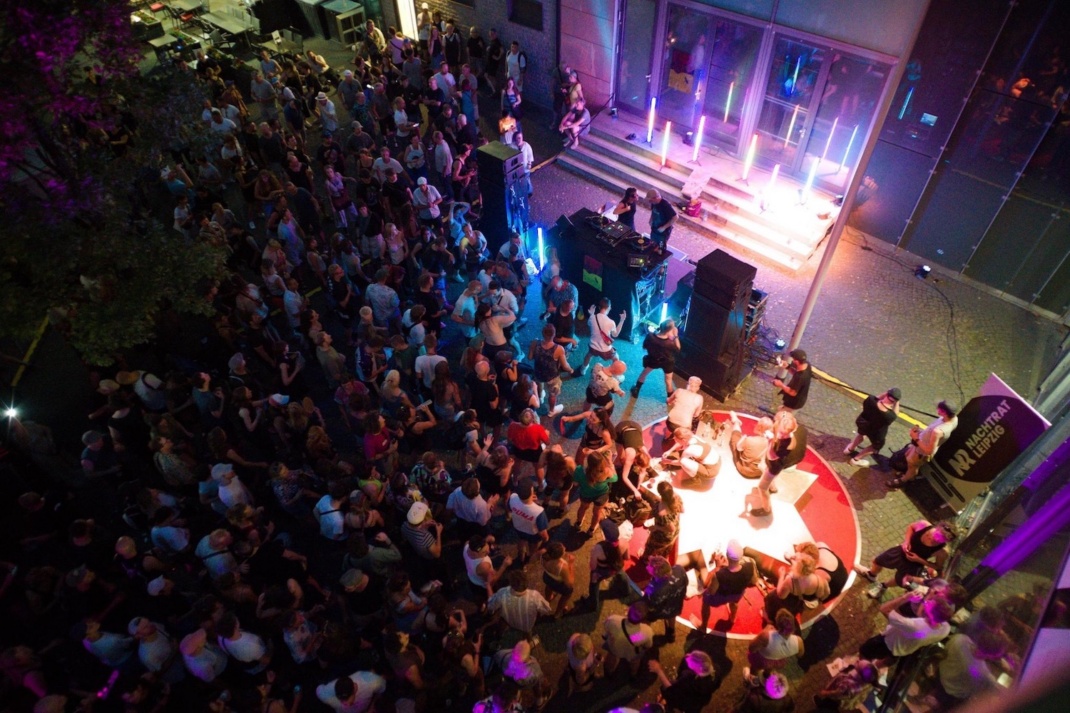
A rave right in the heart of Leipzig city centre: on 4 September, for the second time, the open-air rave will take place in the Museumskarree, in the cosy shade of the Museum of City History and the Museum of Fine Arts (MdbK), between Böttchergässchen and Katharinenstraße. Having served last year as an extraordinary accompanying programme to the 90s exhibition, the dance event could well become a permanent fixture in the years to come. Why here of all places? We spoke to the organisers – Anne Rauschenbach, Sylva Dörfer and Tim Rood – about rave culture and this year’s programme, and about why it’s worthwhile to breathe new life into places that don’t (yet) have much to do with the ‘scene’.
The rave in the Museumskarree, right in the city centre, is taking place for the second time this year. What can visitors expect?
TR: Last August, we organised the ‘Remember 90s Rave Culture’ event here in the Museumskarree as part of the 90s exhibition. The event was a collaboration between the City History Museum and the Leipzig NachtRat. Everything was new and exciting back then – and perhaps a little improvised too (laughs). This year, the Museum of Fine Arts (MdbK) is on board as a partner.
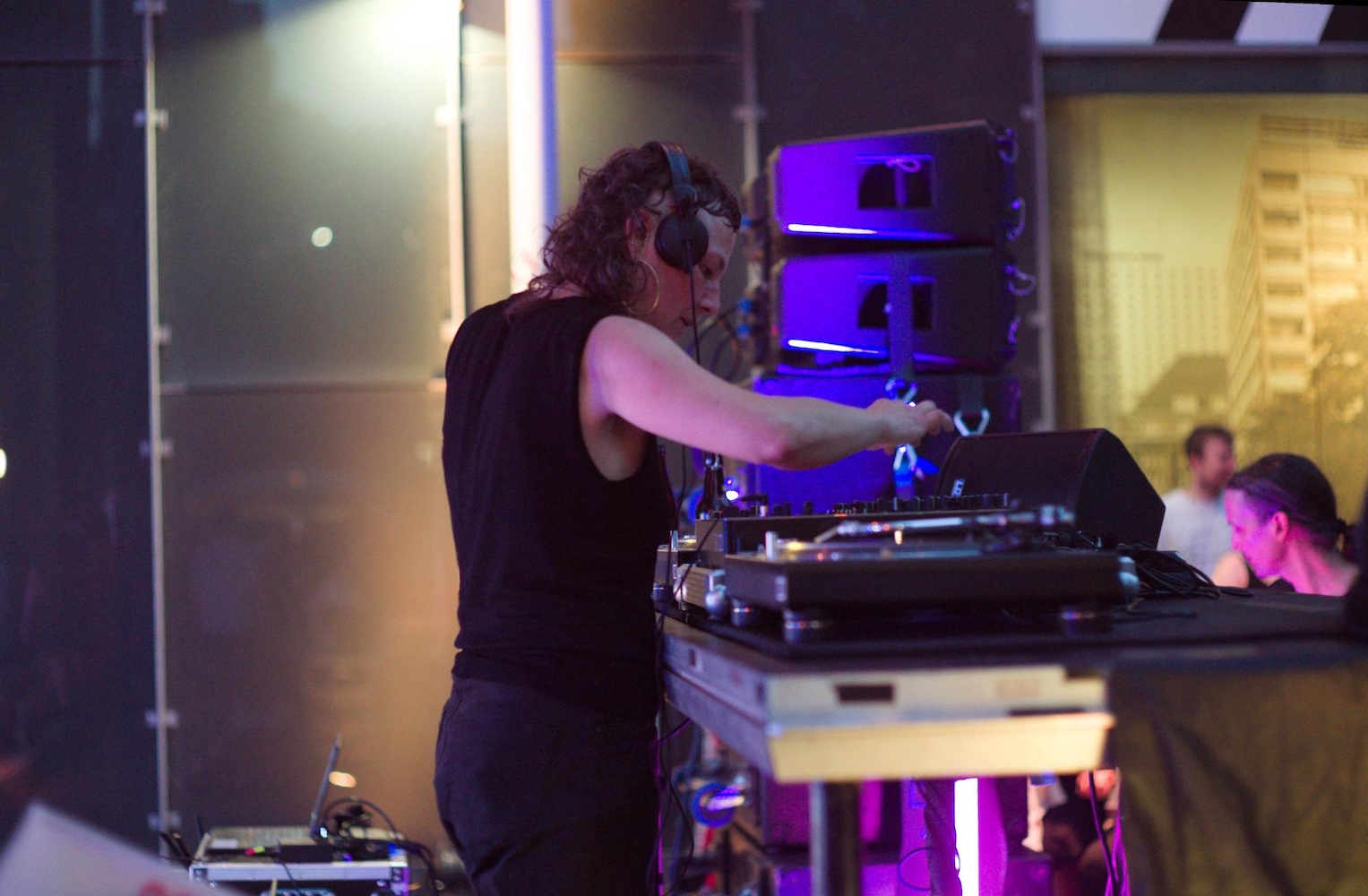
The packed Museumskarree at the 90s rave in the summer of 2025 – following this successful premiere, the event will return for its second edition on 4 September. Photo: Eva Lusch
SD: In doing so, we’re further opening up the Museumskarree to the urban space and also taking up the MdbK’s guiding principle: to foster new connections and create space for exchange, participation and shared experiences.
AR: We want to make this open-air rave in the heart of the city centre a regular fixture – independent of the museums’ exhibitions. This space here is easily accessible to everyone. We also see it as an opportunity to provide a space for marginalised groups – what we can offer, for example, is the DJ booth.
This year, we’ve handed over the curation of the music programme to fem*vak, which is also part of the NachtRat. There will be an all-FLINTA* line-up. Drag shows are also included in the programme – particularly in light of the attack on the CSD in Berlin, this holds special significance for us. It’s about visibility – not just in niche venues, but also in places where it isn’t (yet) seen as normal, such as right here in the city centre.
As was the case last year, the event is also intended to give members of the NachtRat the opportunity to present their work. There will be information stands run by Livekommbinat, the Awareness initiative, the Drug Scouts and others.
Did it take a lot of persuasion to get the rave back here, right in the middle of the museum buildings?
TR: No. The work at the museum is, shall we say, perhaps a bit more ‘set in its ways’. But with last year’s rave, which was really well received, we were perhaps able to convince one or two members of staff of our concept. We received nothing but positive feedback, and the organisation ran smoothly. I do, of course, hope that we can build on this in the coming years.
What makes this venue special for events of this kind?
AR: Open spaces are becoming scarcer, particularly in the city centre – which is why we’re keen to make the most of the space that’s available. Perhaps it’s also possible to introduce people who’ve had little exposure to it so far to rave culture. At the moment, there’s a trend towards commercialising the ‘rave’ concept. We could offer an alternative to that.
What we naturally have to bear in mind here, right in the city centre, is that the safety requirements are stricter. That’s understandable, especially following recent events – the rampage in Leipzig, the attack on Berlin’s CSD. This has, of course, further heightened our awareness of the issue.
TR: It must be said, however, that the risk level here on site is not considered particularly high, not least because access to the inner courtyard is very difficult. Naturally, though, we have drawn up a security plan. There will be security and awareness staff on hand. At the same time, it’s important to us not to turn this place into a ‘fortress’.
AR: If people want to meet openly and on equal terms, it seems, unfortunately, that a security plan is needed to support that. For us, however, the focus is quite clearly on the rave, revitalising this venue and having fun.
TR: One of the main reasons we’re organising the rave here is, of course, to bring together people from all sorts of backgrounds. We clearly want to reach the ‘experienced’ rave audience, but also our traditional museum visitors and people who might just happen to stumble upon the event whilst out in the city centre. We also hope this will help break down prejudices.
SD: The Museumskarree is also increasingly being perceived as a public space for art and social interaction. The installations ‘Frühling’ by Nina Schuiki and ‘Tropfen auf Stern’ by Maix Mayer have provided important impetus for this. With the rave and the Fête de la Musique, we’re creating two special occasions each year to bring the space to life together with local stakeholders, artists and the city’s diverse community.
What will be different this year?
AR: This time, instead of a talk before the Rave, there’ll be a free DJ workshop. The workshop will take place from 3 pm to 4 pm and will be led by Rethaex and Fissy Dub from equalize e.V. The organisation regularly offers such workshops for FLINTA* people and champions diversity in club culture. On 4 September, the event will be open to everyone – aged 12 and over, with no registration required. Of course, after just one hour you might not be quite ready for the DJ booth, but you’ll learn the technical basics. You can build on that.
TR: Weebz from the Hitness Club will be handling the visuals, whilst the “Boytunten” from Flamboyish and drag queen Rashida have been invited to put on two drag performances between the DJs. It’s going to be brilliant! There’ll also be tattoo stalls. We’ve invited the Tattoo Kiosk and Studio Flux to take part.
SD: In addition, as part of this event, the museums are offering creative hands-on activities with street chalk and glitter for the first time.
How did the collaboration between the three organisers come about?
TR: The division of tasks developed quite naturally. This time we’re also receiving support from the L-Group and the district budget. This has opened up a whole new range of possibilities. We have a cooperation agreement between the three organisers. Livekommbinat Leipzig, to which the NachtRat is affiliated, is the event organiser. We’re working with Leipzig Openair/SocHop again this year. That worked really well last time.
Then, of course, there are tasks such as drawing up a safety plan, clarifying technical requirements and drafting contracts.
AR: In principle, the event is a prime example of how so-called high culture and so-called subculture can work together. This is evident simply in the way we work; that’s where the organisations differ. We can really learn a lot from one another. For example, the technical management team at the MdbK briefed us on the necessary safety precautions and emergency procedures. I myself had had little experience with such issues until now.
There are also, in some cases, significant differences in external communication and social media presence – in my work for the NachtRat, the tone is rather relaxed and a rave is just a rave. For the museums, it’s an event outside their usual operations and requires a different approach to engaging the audience. It’s great to combine these different working and living environments. You could say that rave culture is really brought to life here.
Incidentally, there have been collaborations like this before – do you remember, for example, the ‘Audio Invasion’ at the Gewandhaus? That was also a crossover between classical music and electronic pop and club culture.
Do you think there’s still room for improvement when it comes to collaborations like that?
AR: Yes, definitely. We’d certainly like to see the major cultural institutions become even more open to the alternative scene. But the truth is also that: There are also reservations within the scene itself – or let’s say, a fear of engaging with so-called high culture. So we’d be delighted if both sides were to open up even further.
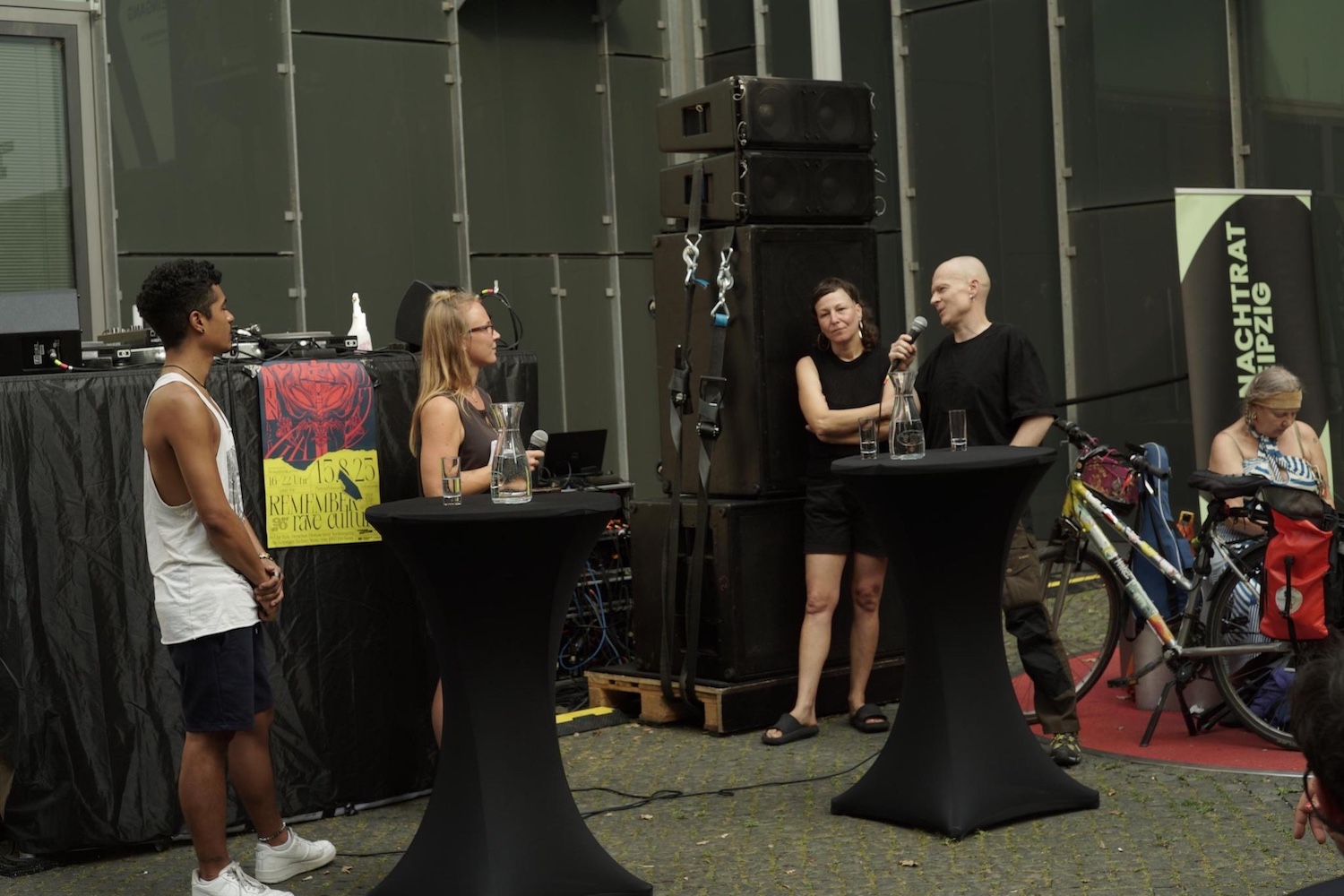
The packed Museumskarree at the 90s rave in the summer of 2025 – following this successful premiere, the event will return for its second instalment on 4 September. Photo: Eva Lusch
TR: In principle, my role here at the museum is precisely to organise such collaborations and enable more people to get involved. This means bringing the museum into the wider community and vice versa. Joint projects of this kind can reflect different perspectives and bring them closer together. I think that, particularly in light of the current political situation and looking to the future, it will become increasingly necessary to enter into collaborations, work together and build networks.
SD:
We want to continue focusing on the inclusion of marginalised groups in the future. Perhaps next year we can attract even more partners and strengthen our work on inclusion and mental health. We could also envisage organising a sober rave at some point. In any case, the aim is to offer a space here for people ‘from the scene, for the scene’. Why should we put ‘star DJs’ from all over the place on stage here, when there’s already a diverse scene of local artists in our city? We want to approach raves in a more grassroots way and make them accessible to as many people as possible.
TR: I’d add: ‘From the scene WITH the scene’. Of course, we can’t prevent our event from being too ‘mainstream’ for some people – the venue itself ensures that. Nor is it meant to be a scene-specific event. We’re aiming for a shared, non-commercial party with our museum audience, people from the rave scene, and all dance enthusiasts – or those who want to become one – from Leipzig’s wider community.
One final note: anyone outside our group who’d like to organise something here in the Museumskarree is warmly invited to do so and is welcome to get in touch!
Empfohlen auf LZ


So können Sie die Berichterstattung der Leipziger Zeitung unterstützen:




There is one comment