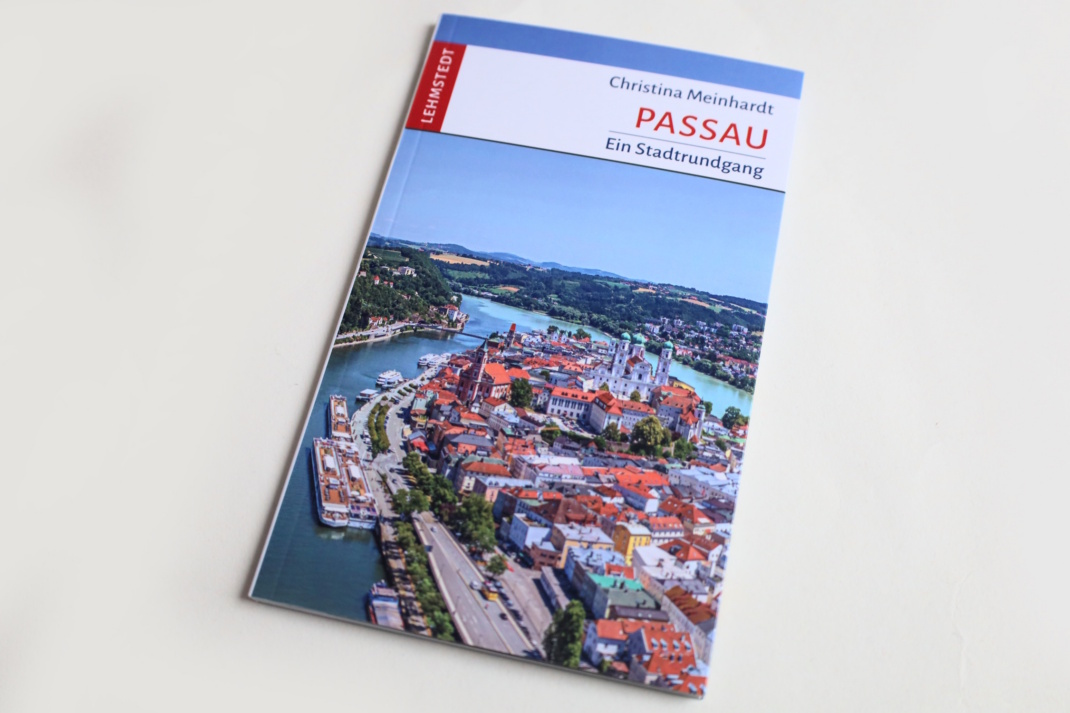
Water, water, water. In Passau, almost every path leads to the water – to the Danube, the Inn or the Ilz. Sometimes the water simply flows into the city of its own accord, flooding the picturesque streets of the old town. In several places, the highest water levels from past floods are marked on the walls of the houses. Passau lives with the water. It has done so for over 2,000 years, ever since the Romans were here, gazing grimly across at wild Germania.
With Christina Meinhardt, you can explore the ‘City of Three Rivers’ in a short and sweet one-day tour. You don’t need to pick a day when it’s 30 degrees, nor one when the river is in flood. Rather, choose a gentle summer’s day when the old town’s alleyways are pleasantly shaded and you can explore Höllgasse, Bräugasse and Residenzplatz at a leisurely pace. After all, life here usually moves at a slightly slower pace. More leisurely. The city is shaped by its long history as a bishopric, even if, architecturally speaking, you tend to see only the last 400 years. A major city fire played a not insignificant role in this.
The foundations run deeper. And anyone with a passing familiarity with the *Nibelungenlied* will know that the legendary poet of the *Nibelungenlied* most likely lived at the court of the Bishop of Passau, and that the travelling party making its way to King Etzel’s court made a special stop here. Before they met their bloody doom. Revenge can be so absurd.
But today, of course, there is nothing left to remind us of the time of Bishop Wolfgang von Erla, who was probably the patron behind the *Nibelungenlied*. Perhaps a few (more recent) paintings in the Old Town Hall, which can be viewed in the Great Council Chamber.
Between rivers
In the first part of the tour, you essentially walk in a wide arc around St Stephen’s Cathedral, which towers over the city, even though you don’t reach it until stop no. 24, after passing the Executioner’s House, Niedernburg Abbey and the Dreiflusseck. This is the point – in fact, an artificially raised one – from which you can best view the confluence of the Danube and the Inn.
And it raises the usual conundrum: why, from this point onwards, the river is no longer called the Inn but the Danube. This, of course, has to do with the actual volume of water (the Danube is significantly deeper) and with the distance the waters of the two rivers have already travelled.
From here, you can also see the much smaller Ilz flowing in, right next to the Veste Niederhaus, which once belonged to the bishop’s Veste Oberhaus. However, you can visit Oberhaus, but not Niederhaus. And Oberhaus will be of interest to die-hard rebels, as this is where the bishop always fled whenever the citizens of Passau rebelled – for example, because they wanted imperial freedom for their city. But they simply couldn’t get rid of the bishop.
Christina Meinhardt has included the whole complex of Oberhaus, Niederhaus and Ilzstadt as a sort of bonus at the end of the tour. For anyone who’d like to linger a few more days in such a pleasant town nestled between the rivers.
On the Roman side
A trip across the Inn to Innstadt is part of the itinerary. It’s a part of the programme you shouldn’t miss if you’re genuinely interested in the history of Passau or Castra Batava, as the Romans called it. For on the other side of the Inn lies not only the Mariahilf pilgrimage church, with its copy of the miraculous image ‘Mariahilf’ by Lucas Cranach the Elder, but also the Boiotro Roman Fort Museum, where the history of the Danube Limes comes to life. The excavated remains of the Roman fort can also be seen here.
And once you’ve passed the Severin Gate (part of Passau’s old city walls) and St Severin’s Church, you’re in for a truly wonderful pedestrian experience as you cross back over to the old town via the Fünferlsteg, built in 1916. A footbridge that the citizens of Passau financed themselves and dutifully paid tolls on for decades, until the city of Passau finally deigned to take the footbridge under its authority. Pedestrians weren’t really taken seriously even back then.
And yet it’s precisely from a pedestrian’s perspective that these old towns are best appreciated. This also applies to the grandeur or missteps of architectural structures, because once you’ve passed the relatively new university campus, the final stop on the tour takes you, of all places, to the Neue Mitte. With modern buildings, which are, of course, open to debate. Are they a success? Or did the client and architect simply have one too many when they signed the contract?
You never really know. But you can sense it when, after a long, lovely stroll through the city, you end up in a place like this – whether you feel at home there or have that nagging feeling that perhaps you’d rather hurry over to the old town’s narrow streets and find a cosy little pub, perhaps even one with a view of the river, to watch the centuries drift by over a glass of wine.
Christina Meinhardt, *Passau*, Lehmstedt Verlag, Leipzig 2026, 7 euros.
Empfohlen auf LZ


So können Sie die Berichterstattung der Leipziger Zeitung unterstützen:




There is one comment