Dieser Artikel ist auch in deutscher Sprache verfügbar: Zum deutschen Artikel.
There are a number of hurdles to overcome when it comes to neighbourhood electricity distribution, as electricity cannot simply be distributed from a small-scale generator with a PV system to a small consumer next door via a simple cable running through the property. – Under the amended Energy Industry Act (EnWG), the energy generated must first be fed into the local distribution grid, and the electricity consumer draws the electricity from the grid. The electricity is therefore settled in the accounts, including electricity tax and grid charges. Consequently, one of the more than 800 grid operators and the state also profit from this.
– For neighbourhood electricity supply, contracts must be concluded between the two or more parties: one contract for the supply of electricity (supplier) and one for the shared use of the system and for the costs per kilowatt-hour (kWh) consumed (consumer).
– As neighbourhood electricity supply must not guarantee a full electricity supply in accordance with the Energy Industry Act (EnWG), a further electricity supply contract must be in place to ensure electricity is supplied via the general grid if the neighbour is unable to supply electricity.
– As a technical requirement for this electricity supply, the partners must have smart electricity meters that measure the direction of electricity flow every 15 minutes, known as smart meter gateways.
– Flexible electricity tariffs are required for the use of smart meter gateway electricity meters, so that consumption is possible during periods of high demand with low electricity prices and during periods of high demand with high electricity prices, and so that electricity consumption can be managed in line with electricity costs. These digital electricity meters allow consumers to take advantage of periods when electricity prices are lower. This also helps to absorb any excess supply in the grid; in other words, the grid could be better managed by the grid operator, thereby stabilising it.
Electricity metering systems
a) Existing stock – analogue black electricity meters with a rotating disc (Ferraris meters). The analogue black electricity meters with a rotating disc (Ferraris meters) are gradually being replaced by new digital meters.
b) Modern metering equipment – there are digital electricity meters that do not send or receive data. These can be recognised by a digital display on which only the meter reading can be viewed. Unlike analogue meters, modern metering devices record consumption alongside the actual usage time and do not simply tally up the total consumption.
A maximum of 25 euros gross per year may be charged for the operation of a modern metering device, regardless of consumption.
c) Intelligent metering systems (abbreviated to iMSys) – Smart Meter Gateway – a communication module is added to the digital electricity meter (b). This communication module enables the meter to be integrated into a communication network and data to be transmitted securely. The smart metering system (c) can therefore, unlike a modern metering device (b), both send and receive data. This means that the meter reading can be transmitted automatically (remote reading). It is also possible to receive price or tariff signals via the smart metering system.
Annual price caps for smart metering systems from 2025 (mandatory installations and optional equipment) according to information from the Consumer Advice Centre as at 25 June 2025
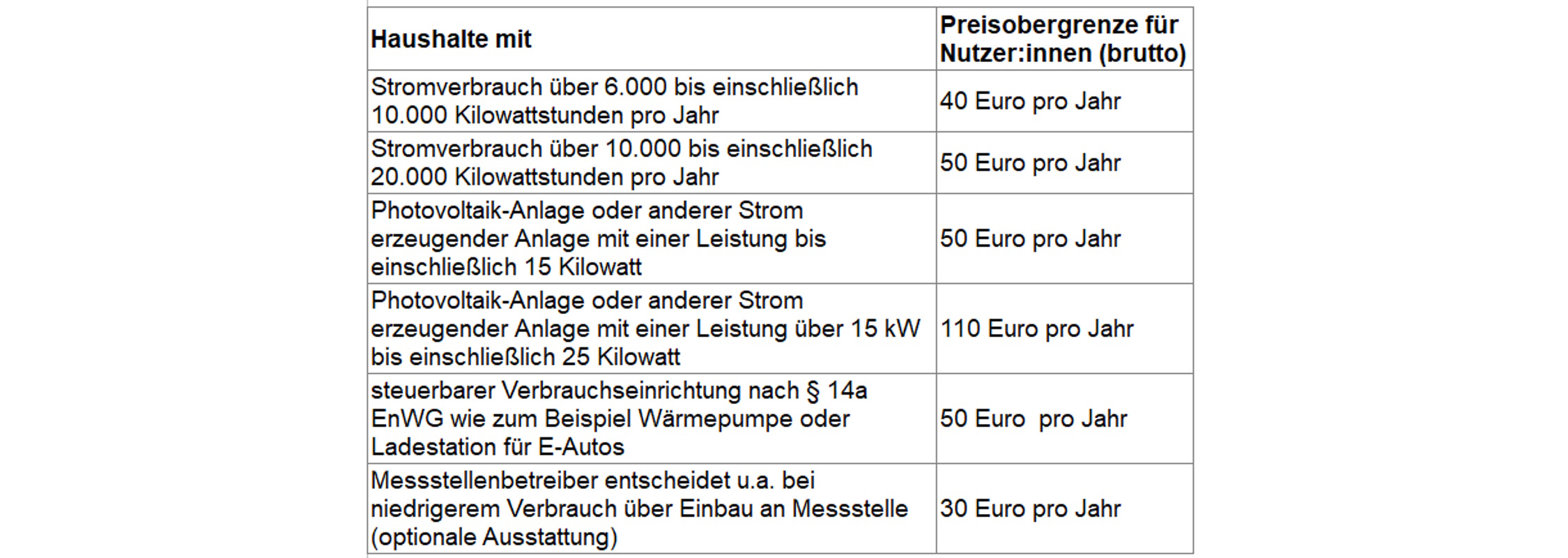
Note regarding rows 3 to 5 of the table:
For controllable consumption devices, an additional €50 gross per annum is payable under Section 14a of the Energy Industry Act for the installation and operation of a control device. This also applies to photovoltaic systems or other electricity-generating installations with an installed capacity of more than 7 kilowatts.
In the event of early installation of a smart metering system, the metering point operator may charge a one-off additional fee of up to 100 euros in accordance with the Metering Point Operations Act (MsbG). However, this does not constitute a price cap. Furthermore, in cases where installation is optional (consumption below 6,000 kWh; system capacity less than 7 kW), the metering point operator may also charge an additional annual fee. The legislator considers a fee of no more than 30 euros to be reasonable. Again, this is not a price cap.
It should be noted that retrofitting the existing meter cabinet can be expensive if it needs to be modified to accommodate the installation of modern metering equipment or a smart metering system. This can quickly result in additional costs of up to several thousand euros.
When using smart meters, these installation costs must be taken into account to determine whether the installation will be covered by the potential savings from lower electricity costs.
Prices for smart metering systems (smart meters) in Leipzig must be requested from Netz Leipzig GmbH at https://www.netz-leipzig.de/messstellenbetrieb
– Prices and further information on metering point operation – Price list for the primary metering point operator –, followed by several price lists for connection network operators, connection holders and connection users – whoever is supposed to be what.
As is, unfortunately, often the case, a laborious search is required and the price overview is confusing and complicated. It is only comprehensible to a specialist. There is no concise summary that would be accessible to the layperson and that would explain the key parameters in a way that is reasonably easy to grasp. But that is probably not the intention.
According to information from Netz Leipzig GmbH, meter installation/removal without power measurement will cost a one-off gross fee of €80.00 in 2026. The provision of load profile data on request (individual provision of hourly meter readings at hourly intervals) costs between €30 and €68 depending on the system and is contractually bound to Netz Leipzig.
Germany is lagging behind
The term ‘smart meter’ is frequently used in Germany as an alternative term for the intelligent metering system. Ultimately, the term refers to any type of meter that communicates, i.e. sends and receives data. It would also make sense in Germany to allow simple devices connected via Wi-Fi. Other European countries – some of which have smart meter coverage of nearly 100 per cent, such as Spain or France – show that Germany is lagging behind in digitalisation in Europe.
As with any device that transmits data via radio or cable, an intelligent metering system is fundamentally vulnerable to attack by individuals and organisations with criminal intentions. For this reason, the law imposes stringent requirements on the security of metering point operators’ software and hardware. These operators must demonstrate, through certification by the Federal Office for Information Security (BSI), that they meet the legal requirements.
To date, just under 6 per cent of all households in Germany have been fitted with smart meters. The take-up rate must be increased as a matter of urgency – to enable the growing use of renewable energy, to stabilise the grid through the intelligent use of surplus electricity (electricity consumption and storage), and to address electricity shortages (supply of electricity from storage facilities).
A direct financial benefit from these devices is only possible when combined with a dynamic electricity tariff. With these tariffs, the price per kilowatt-hour changes throughout the day – depending on prices on the electricity exchange. The aim is to create incentives so that private households, too, shift their consumption to times when, for example, there is plenty of renewable, cheaper electricity available.
As not every electricity consumer wishes to deal with these smart metering systems or is familiar with them, energy service providers (ESPs) are available to offer advice: These are external, independent service providers. ESAs are commissioned and paid by the end consumer to obtain and analyse the metering data (meter readings or customer data) from the metering point operator, in order to advise customers on potential savings or changes in behaviour.
Understandably, this service also costs a portion of the potential savings, given the fluctuating electricity prices.
Metering point operators
The default metering point operator is usually your local network operator – that is, the company that installs, operates and maintains the electricity meters. The network operator is not the same as the electricity supplier. You can find out who the metering point operator is from your electricity bill; in Leipzig, it is Netz Leipzig GmbH. In addition, there are competing operators offering the same services for digital meters.
Since 2025, metering point operators have been legally obliged to install smart metering systems (‘smart meters’) within four months for small consumers:
– Households with high electricity consumption of over 6,000 kWh per year,
– households with electricity-generating installations (for example, photovoltaic systems) with a rated output of more than 7 kilowatts,
– households with a controllable consumption device, such as a heat pump or a charging station for an electric car (wall box)
Outside the above-mentioned households, the metering point operator ultimately decides on the installation of a smart metering system.
In theory, you can always switch from your default metering point operator to another, competitive one. As a tenant, you are also free to switch metering point operators. In practice, however, such a switch usually involves an additional service, such as taking out a dynamic electricity tariff. Competitive metering point operators – unlike the default providers – are not, however, bound by statutory price caps.
Since 2021, however, it has been possible, under certain conditions, for this right of choice to be transferred to the landlord. For this to happen, the building must be fully equipped with smart metering systems, and landlords must ensure that not only electricity but at least one other form of energy – such as gas, district heating or heating – is metered via the smart metering system.
Furthermore, affected tenants must not incur any additional costs compared with the previous system of separate metering points. Tenants, in turn, can require landlords to obtain various bundled offers every two years.
The third part of this series, to be published tomorrow, will focus on dynamic electricity tariffs.
Empfohlen auf LZ


So können Sie die Berichterstattung der Leipziger Zeitung unterstützen:



There is one comment