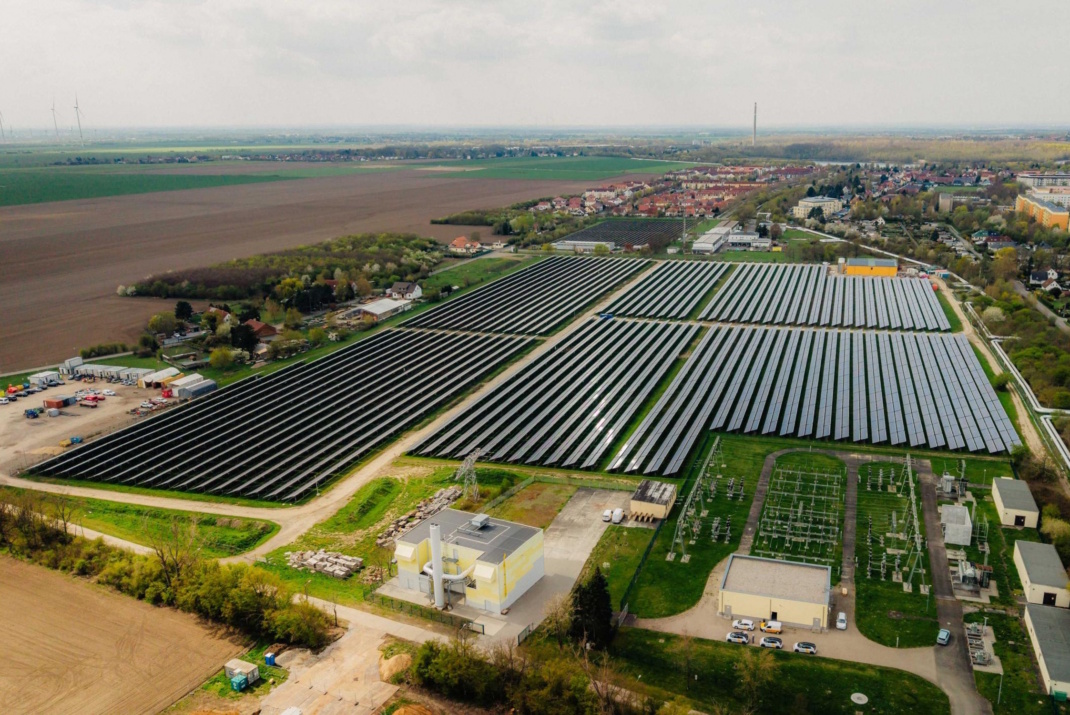
“We’ve done it! Germany’s largest solar thermal plant is complete,” announced Stadtwerke Leipzig. Construction began in January 2024, and commissioning is now underway. Following the first feed-in to the grid, the plant will enter continuous operation this summer and supply climate-friendly heat to the local district heating network. Leipzig Stadtwerke and its partner, Ritter XL Solar, are relying on state-of-the-art technology and a particularly nature-friendly approach to managing the site. The project was launched on 17 June.
“Leipzig and its municipal utility company are a driving force in ensuring security of supply that is in harmony with climate protection. Whether it’s the expansion of the municipal district heating network, the clever use of waste heat from Leuna for Leipzig, or the field of solar thermal energy, Leipzig is leading the way and setting an important example beyond the region,” says Sebastian Scheel, Saxony’s State Secretary for Economic Affairs, Labour, Energy and Climate Protection.
“The new Leipzig West solar thermal project demonstrates how renewable energy and biodiversity conservation can be combined,” says Leipzig’s Climate Mayor, Heiko Rosenthal. “To achieve Leipzig’s climate protection targets, we are driving forward a climate-neutral electricity and heat supply that relies on state-of-the-art combined heat and power plants and the expansion of renewable energies – from wind power and photovoltaics on municipal buildings to the use of solar energy for district heating.”
A step towards security of supply
Karsten Rogall, Managing Director of Leipziger Stadtwerke, emphasizes: “For us, sustainability means considering and advancing security of supply and climate protection in tandem. The new plant is further proof of this. It enables us to increase the share of renewable energy in our district heating system.”
In summer, the plant supplies up to around 20 per cent of Leipzig’s heating requirements daily; over the course of the year, the average is around 2 per cent. “We are proud of this state-of-the-art plant, which, as a further building block in a robust portfolio, is now contributing to Leipzig’s heating transition and thus complementing our energy mix,” says his fellow managing director, Dr Maik Piehler.
Leipzig’s municipal utility company is investing around 40 million euros in the project, of which around 16 million euros is funded by grants.
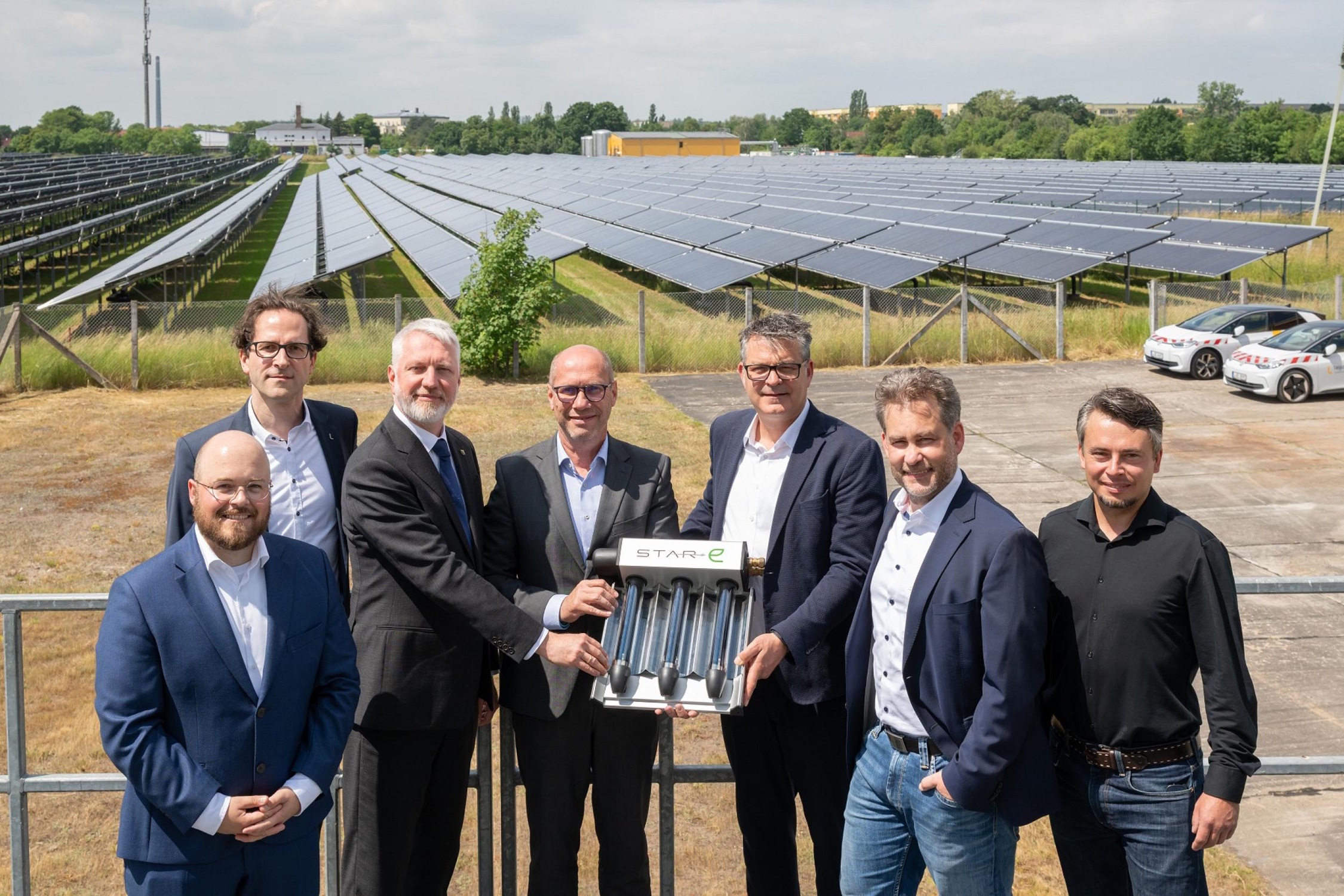
Germany’s largest solar thermal plant was officially commissioned in Nahmen on 17 June (from left to right): Erik Jelinek (Project Manager, Leipziger Stadtwerke), Dr Maik Piehler (Managing Director, Leipziger Stadtwerke), Sebastian Scheel (Saxon State Secretary for Economic Affairs, Labour, Energy and Climate Protection), Karsten Rogall (Managing Director, Leipziger Stadtwerke), Matthias Johler (Managing Director of Ritter Solartechnik), Moritz Ritter (Chairman of the Advisory Board at Ritter Solartechnik and President for Solar Thermal Energy at the German Solar Industry Association), Guido Wimmer (Project Manager at Ritter XL Solar). Photo: Leipziger Gruppe
“Given the recent momentum in the energy markets, the future of energy in Germany must be a mix in which renewables play an increasingly significant role. Solar energy plays a key part in this,” says Moritz Ritter, Chairman of the Advisory Board at Ritter Solartechnik and President for Solar Thermal Energy at the German Solar Industry Association.
“We have already completed several large-scale projects – from Potsdam to Mühlhausen and Greifswald. This, however, is on a whole new scale. It is the fourth-largest solar thermal plant in the world to feed into a district heating network – and the largest in Germany. It will remain the largest in Germany for years to come. I am convinced that the concept, modelled on the Leipzig example, could prove useful throughout Germany.”
Matthias Johler, Managing Director of Ritter Solartechnik – the company behind the Ritter XL Solar brand – emphasises the efficiency of the technology used: “A state-of-the-art plant has been built in Leipzig’s westernmost district. Here, we are relying on our most advanced smart system: an algorithm controls the system as efficiently as possible. The technology measures the solar radiation in the collector field and adjusts the flow rate of the water being heated in the collectors accordingly.”
The less sunshine there is, the more slowly the water flows so that it can heat up. The vacuum collector also works like a thermos flask – hot on the inside, cold on the outside.
Space for a flock of sheep
In future, the water – which reaches temperatures of up to 110 degrees – will be channelled through the nearby district heating pipes to customers in Leipzig.
“This location is ideal because the site orientation is good, because the pipes already run right nearby, and because existing sites, such as our Leipzig-West CHP plant, are in the immediate vicinity,” says Stadtwerke project manager Erik Jelinek. Once construction is complete, nature will reclaim the space beneath the collectors, he emphasises. The majority of the site will then consist of unsealed areas, flowering meadows, fruit trees and mixed hedges. To ensure the vegetation grows naturally beneath and between the collectors, a flock of sheep will be brought in.
Matthias Johler: “From our experience, we can say that rabbits, hares, hedgehogs, insects and birds will also find a home here. Renewable energy and space for nature – the two come together here.”
Empfohlen auf LZ


So können Sie die Berichterstattung der Leipziger Zeitung unterstützen:



There is one comment