Dieser Artikel ist auch in deutscher Sprache verfügbar: Zum deutschen Artikel.
Church buildings are a feature of many villages. They are known as landmarks, the centre of the village or points of reference. These places of worship are of great significance in terms of architecture, art history and regional history. This time, we are focusing on the impressive church in Müglenz, part of the municipality of Lossatal near Wurzen – and on Leipzig’s composer Richard Wagner.
The Protestant church in Müglenz is a Baroque hall church in the district of Müglenz, part of the municipality of Lossatal near Wurzen in the district of Leipzig, Saxony. With its tall church tower, it is a defining feature of the village’s skyline and belongs to the parish of Thallwitz-Lossatal in the Leipzig church district of the Evangelical Lutheran Church of Saxony.
History and Architecture
A previous building on the site was destroyed by a lightning strike in 1765. The new church was built between 1766 and 1774 to plans by J. G. Nacke of Dahlen. Of particular note is the Gothic-style ribbed vault, which was constructed at that time.
Restoration work was carried out in 1874 by Hugo Altendorff, during which the building was given a Neo-Gothic design; further restoration took place in 1911 (exterior) and between 1973 and 1989.
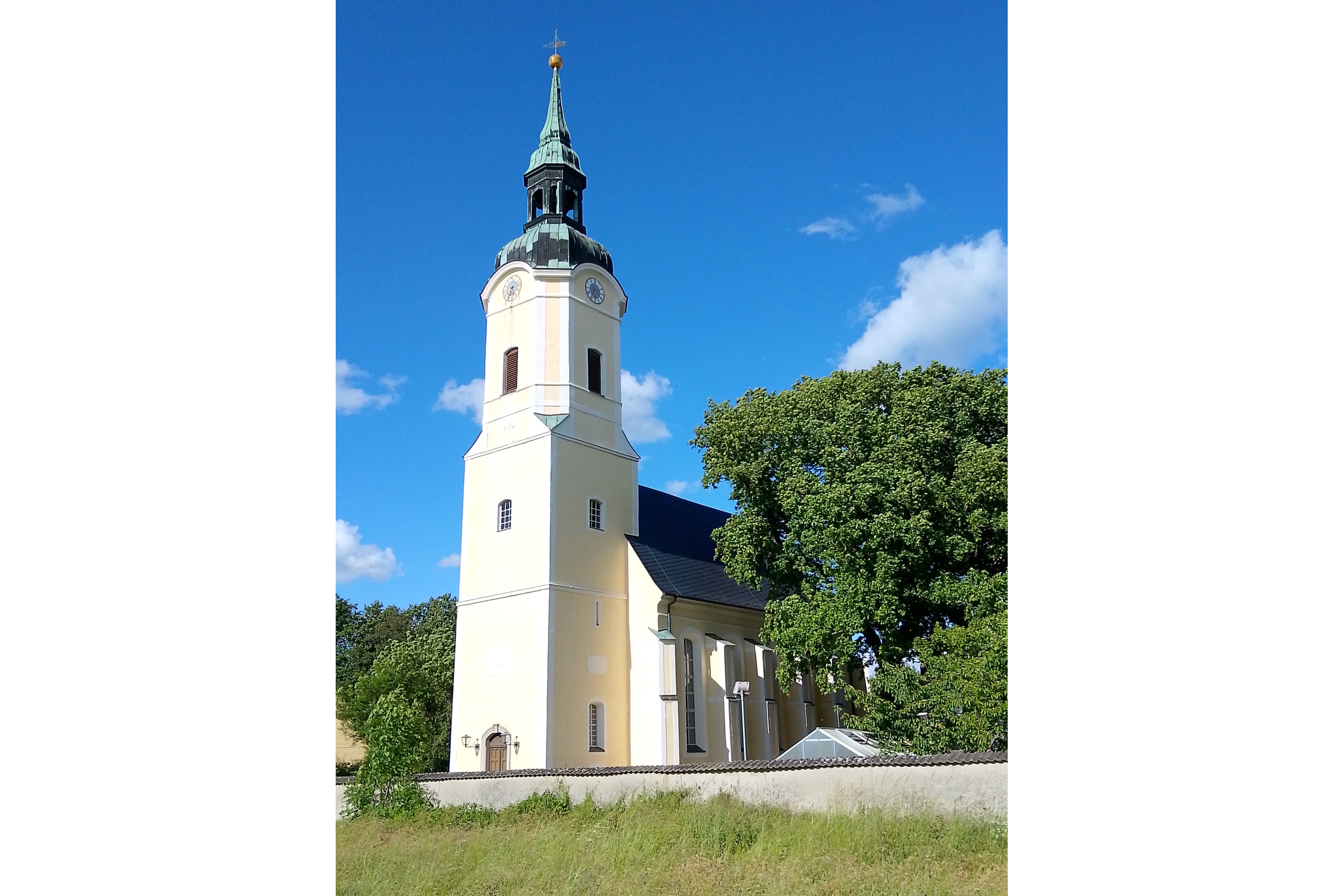
Müglenz Church. Ghostwriter123, CC BY-SA 4.0, https://commons.wikimedia.org/w/index.php?curid=195354110
The building is a plastered rubble-stone structure with a convex gable, Gothic-style buttresses and basket-arch windows. The sacristy and the lord’s box are situated on the north side.
The slender west tower, with a square ground floor plan and an octagonal upper storey, is unusually tall; it is crowned with a hipped roof, a lantern, a finial and a weather vane.
Above the portal on the west side are the coat of arms of the von Bünau family and an inscription reading ‘H.v.B. 1774’.
Interior
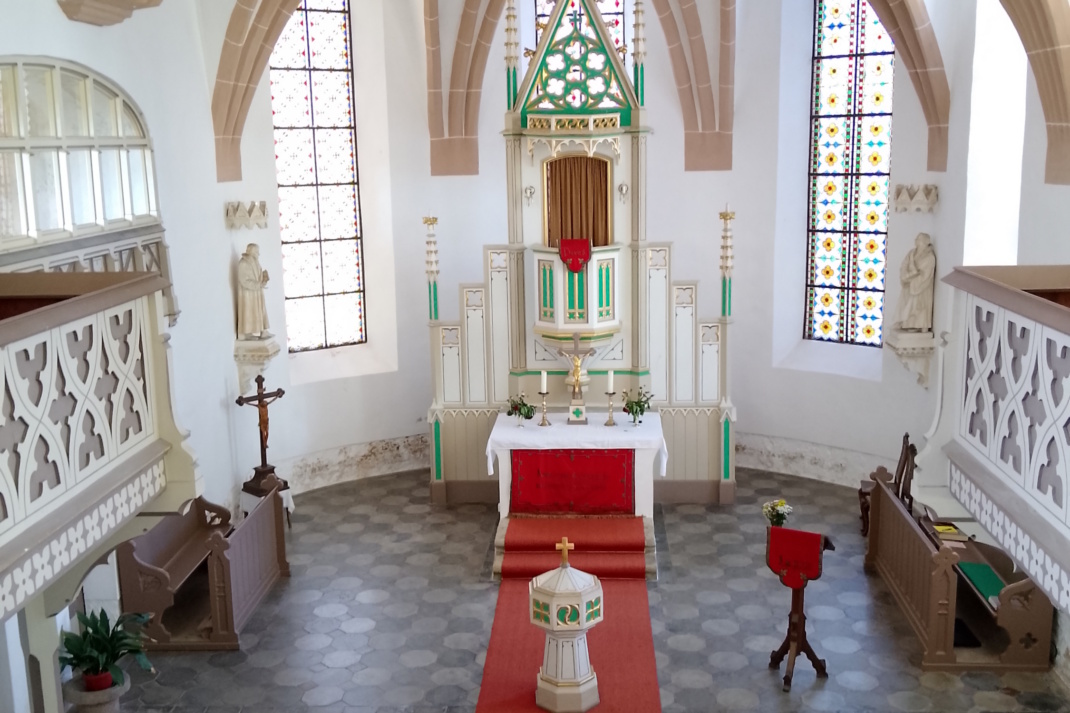
The interior is characterised by its Neo-Gothic décor. Inside, the chancel ends in a five-eighths apse; the regular ribbed vault in the nave and chancel is decorated with painted foliage and bears the inscription ‘J. G. Nacke, master mason in Dahlen/1768’.
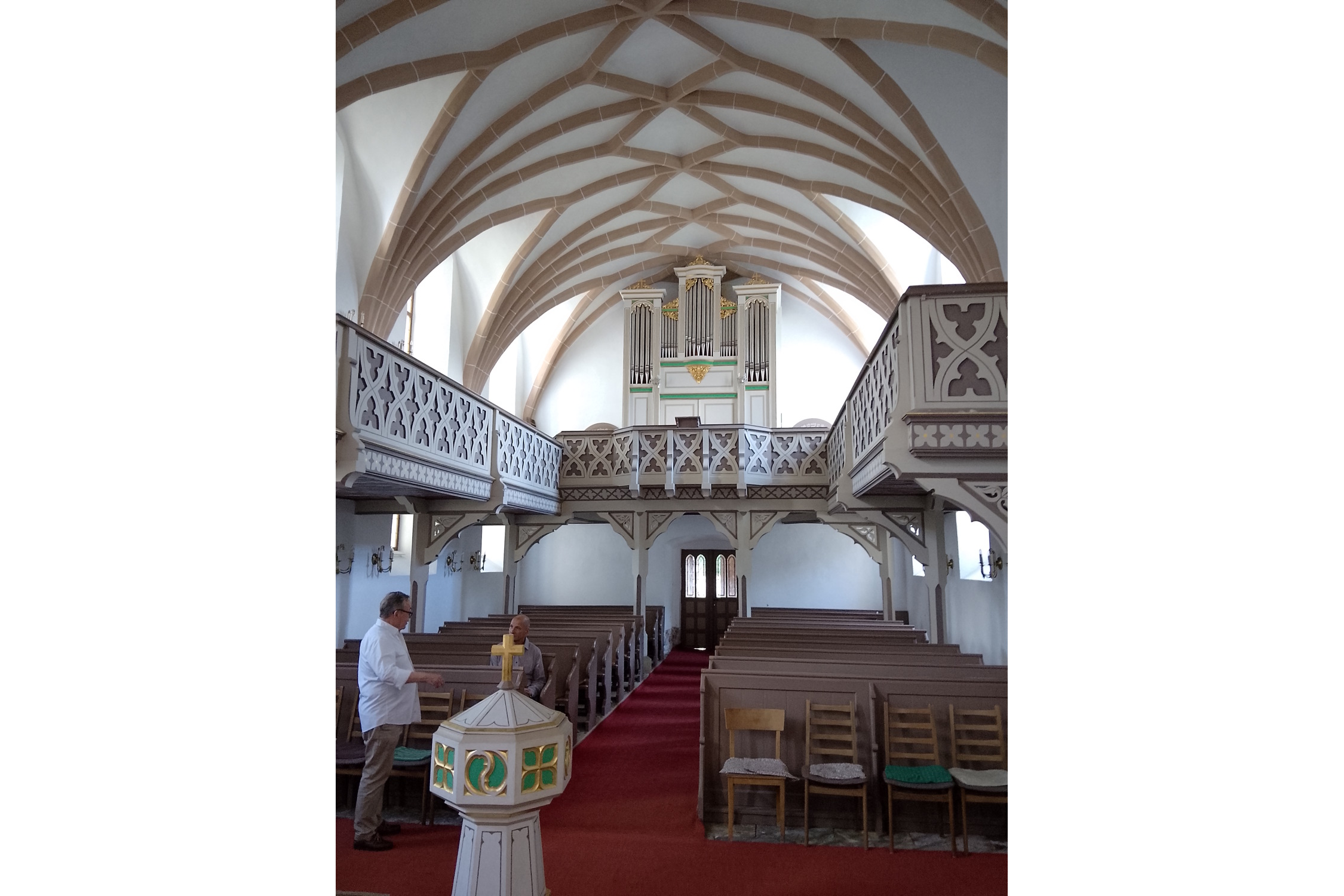
View of the gallery and organ. Ghostwriter123, CC BY-SA 4.0, https://commons.wikimedia.org/w/index.php?curid=195354116
Galleries are built into three sides of the church. The sacristy is vaulted with a groined vault. The lord’s box opens onto the chancel via a basket-handle arch. The chancel features three stained-glass windows dating from 1874.
Preserved from the previous building are the remains of a wooden crucifixion group from the early 16th century, depicting Christ and Mary, and a flat baptismal font, presumably medieval, made of Rochlitz porphyry.
A sandstone funerary monument commemorates Heinrich von Bünau (d. 1711) and his wife Rahel (d. 1729) with two large inscription cartouches. Above and below these are the coats of arms of the von Werther, Bünau and Hessler families.
Organ
The organ was built in 1864 by Emil Wiegand of Witznitz near Borna. Wiegand learnt his craft from the famous organ builder Urban Kreutzbach in Borna. The instrument has 13 stops across two manuals and a pedalboard.
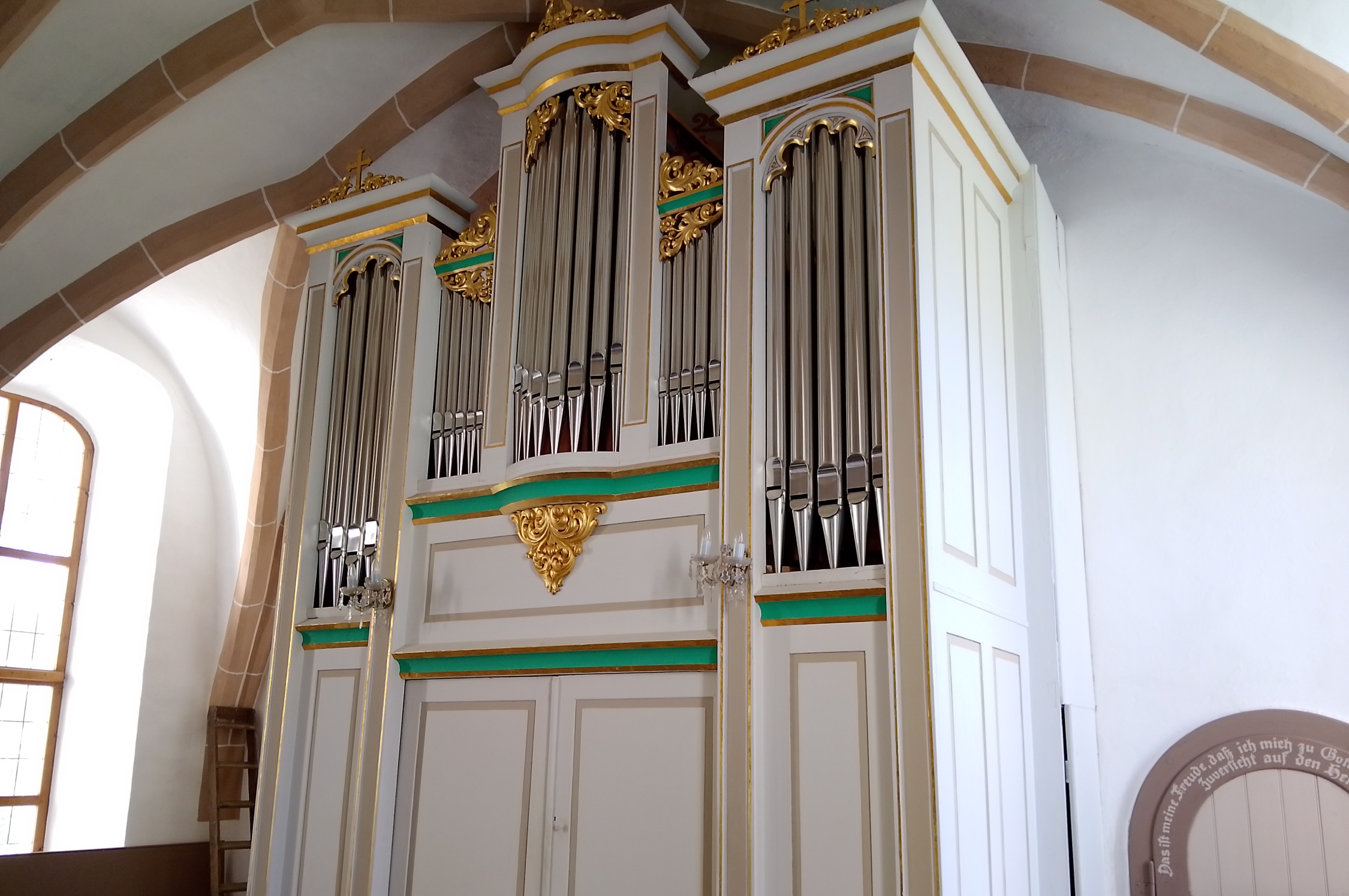
Wiegand organ. Ghostwriter123, CC BY-SA 4.0, https://commons.wikimedia.org/w/index.php?curid=195354119
Bell tower
Since 1919, the peal has consisted of three cast-steel bells with the tones d’, f’ and as’; they were manufactured by the Bochumer Verein, which was renowned far beyond Germany’s borders for its steel bells.
The previous bronze bells had to be handed over during the First World War as part of the so-called ‘metal donation’ for armaments purposes.
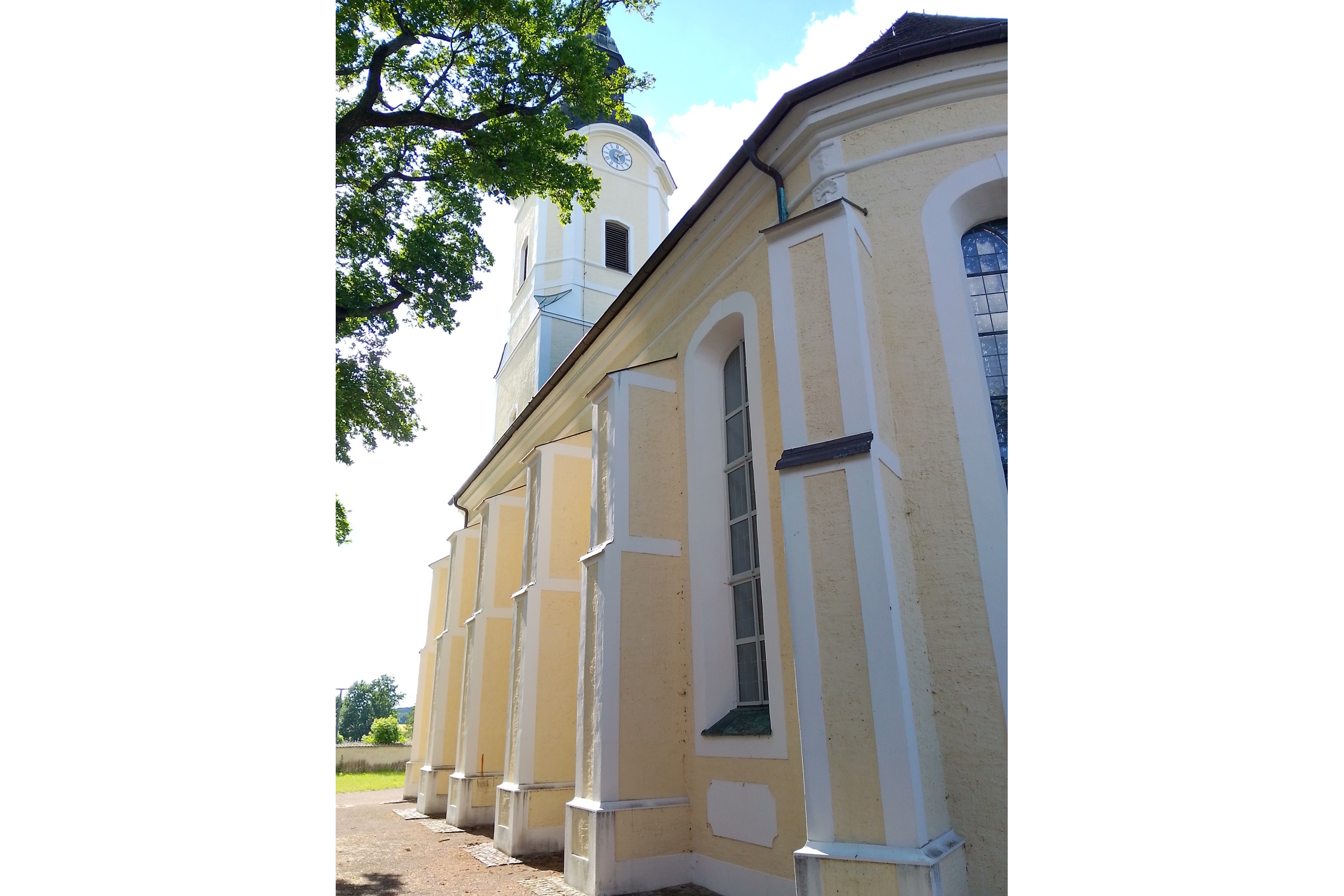
Side view. Ghostwriter123, CC BY-SA 4.0, https://commons.wikimedia.org/w/index.php?curid=195354112
Samuel Wagner, Gottlob Friedrich Wagner – and a major donation
At the former cantor’s house directly in front of the church, a commemorative plaque honours Gottlob Friedrich Wagner, Richard Wagner’s grandfather – it was installed to mark the tribute to Richard Wagner in the GDR in 1963 and bears the following inscription: “Gottlob Friedrich Wagner, the grandfather of the great composer Richard Wagner, was born here on 18 February 1736”.
In October 2001, Müglenz Church received a major donation of 200,000 Deutschmarks from opera director Wolfgang Wagner and the performers at a charity concert held as part of the 2001 Bayreuth Festival, which was used to restore the organ and the church windows.
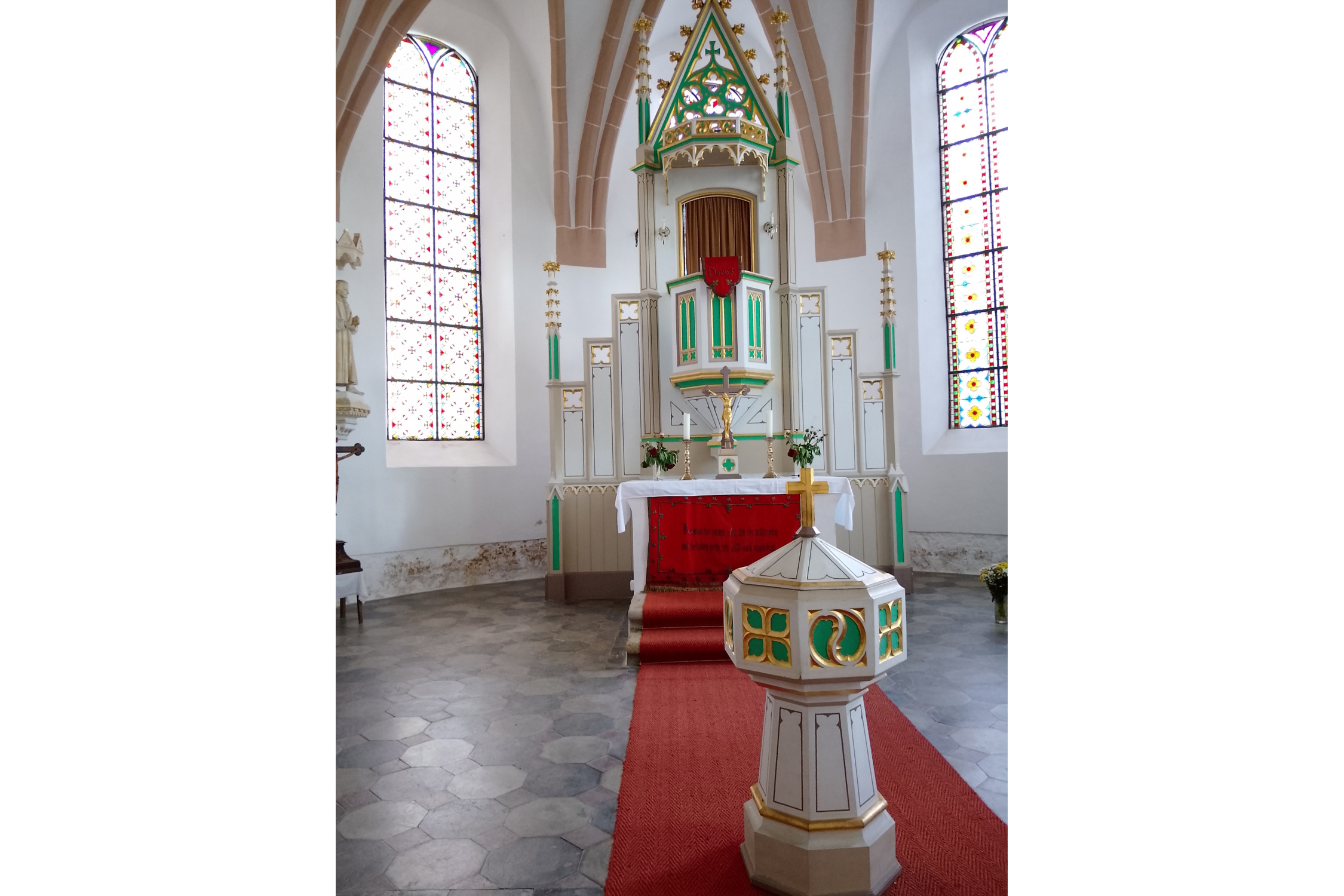
Pulpit altar and baptismal font. Ghostwriter123, CC BY-SA 4.0, https://commons.wikimedia.org/w/index.php?curid=195354115
The reason for this was that the church was the place of work of the cantor, organist and schoolmaster Samuel Wagner (1703–1750), Richard Wagner’s great-grandfather, and that the neighbouring cantor’s house was the birthplace of Gottlob Friedrich Wagner (* 18 February 1736), Richard Wagner’s grandfather. Müglenz is therefore regarded as a ‘Wagner town in Central Germany’.
Recent history
In early May 2024, a charity concert was held in Müglenz Church in aid of the Bärenherz Children’s Hospice in Leipzig. Maria Prudenskaya, a soprano with Berlin’s ‘Staatsoper unter den Linden’, performed with pianist Andrey Diakov as part of the ‘Klangraum Kirche’ concert series. The proceeds for the hospice totalled 1,620.50 euros.
Coordinates:
51° 24′ 9.6″ N, 12° 50′ 4″ E
Müglenz Church on Wikipedia:
https://de.wikipedia.org/wiki/Dorfkirche_Müglenz
Empfohlen auf LZ


So können Sie die Berichterstattung der Leipziger Zeitung unterstützen:





There is one comment