Dieser Artikel ist auch in deutscher Sprache verfügbar: Zum deutschen Artikel.
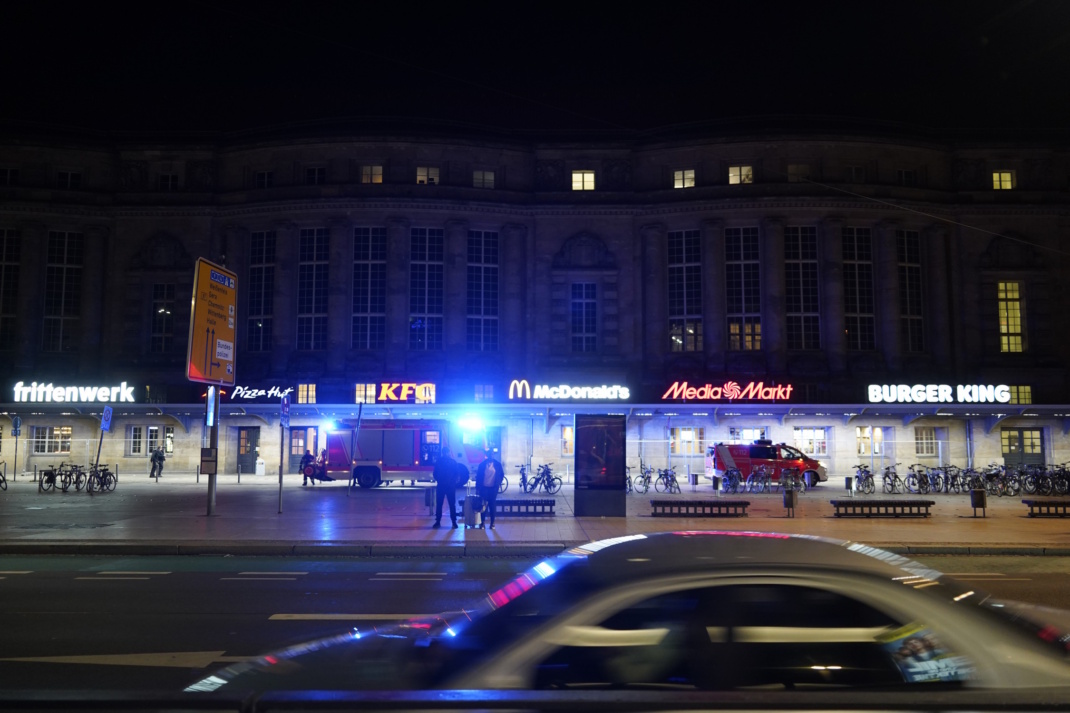
Everything is interconnected – rising rents, the housing shortage and the homelessness in Leipzig that is becoming increasingly visible to everyone. And many of those who have become homeless can be seen outside the main railway station. Yet there, in a heated debate, they are merely portrayed as a problem.
In the words of City Councillor Juliane Nagel: “In recent months, there have been reports and discussions – some of them highly alarmist – about the security situation at Leipzig’s main station. Yet the social crises that are concentrated there, as in other major cities, have been overlooked.”
In fact, Leipzig developed a prevention plan for this some time ago. This prevention plan, part of the ‘Safety in the Station District’ (SiBa) research project from 2021, includes numerous proposals for shaping the environment to improve the quality of life for those using the area, alleviate social hardship, strengthen social infrastructure and better organise networks. These networks include not only regulatory bodies but also social organisations.
When the so-called ‘Quattro patrol’ – comprising the Federal Police, the State Police, Deutsche Bahn’s security service and the city’s public order service – was presented in February 2026, it was explicitly stated that the aim was also to offer support and utilise links to social services.
“Accounts from people in social distress and from social services stand in contrast to this,” Juliane Nagel therefore noted in a city council question on this topic. “There are reports of an increasingly aggressive atmosphere towards people in distress and of more difficult circumstances for social work on the ground.”
Daily wet cleaning
These ‘Quattro patrols’ also appear to be working, as the Public Order Office notes in its response: ‘As part of the Quattro patrols, reaching out to people in difficult life situations is a key focus of our operations. In doing so, the city’s support services are also highlighted, presented and distributed in written form via leaflets. The collection of data on the individuals concerned serves to create a ‘referral form’ as part of the exchange of information with the Social Services Department. Through the Social Services Department, individual support services can now be offered to specifically identified people via the street workers.”
But, as Juliane Nagel points out, “how can we ensure that the needs of economically disadvantaged and homeless people who spend time in the vicinity of the station – or even sleep there – are given due consideration in the context of public order policy?”
Well: It simply cannot be done without conflicts, as the Public Order Office ultimately admits: ‘In accordance with the provisions of the Police Ordinance on Public Safety and Order in the City of Leipzig, and whilst taking into account the interests of socially vulnerable individuals, measures under public order law will only be taken if they serve to protect the individual (health, hygiene, etc.) and do not impair operational processes or the technical facilities at or within the main station. Furthermore, there must be no disruption, nuisance or hindrance to the movement of people or transport flows.
To maintain cleanliness and hygiene, DB AG and EB Stadtreinigung Leipzig carry out extensive and costly cleaning work on a daily basis. This includes the daily wet cleaning of the outdoor areas along the front of the building, including the façade and the pavement. The waste left behind on a daily basis includes urine, faeces, vomit, liquid residues, hygiene products, etc.”
The lack of toilets
But of course there are reasons for this, which the city is also aware of. And which the Public Order Office also addresses in its response: “As part of proposal VII-DS-09871-NF-01 ‘City-wide Implementation Concept for Public Toilet Facilities in the City of Leipzig’, the City Council resolved in 2025 to expand the existing facilities in the vicinity of Leipzig’s Promenade Central Station by adding further toilet facilities (open-air urinals and semi-permanent toilet facilities). These facilities in public spaces outside the station building will be free to use and managed by the municipal enterprise Stadtreinigung Leipzig.
Work has been underway since mid-2025 to establish the new operational division within Stadtreinigung Leipzig. At this stage, no firm dates can yet be given for when the individual sites will become operational. The implementation of these measures is currently still undergoing the necessary tendering, planning and consultation processes.
The City of Leipzig is working flat out to ensure that, by the end of 2027, all the locations specified in the council resolution can be equipped with the planned additional sanitary facilities and brought into operation.”
But what is the situation now? Are there absolutely no facilities available for the homeless?
“For homeless people, whether or not they have a substance abuse problem, the toilet facilities at the railway station mission are already available free of charge from Monday to Friday, 9.00 am to 6.00 pm, and on Sundays from 1.30 pm to 6.00 pm,” replied the Public Order Office.
“Through the daily work of street social workers, these services are regularly promoted on the ground. The walk from the entrance area of the Westhalle to the railway station mission is approximately 300 metres and takes about 4 minutes on foot. Many people who spend time outside the main entrance areas of the main station every day are familiar with the station mission, as free coffee and donated food are distributed there.”
Classical music as a welcome?
But what about the 2018 transfer of the right to manage the covered municipal outdoor areas of the main station to DB regarding the presence of homeless people or other vulnerable groups?
And that’s where it gets complicated. Even though the Public Order Office emphasises: “The agreement between the City of Leipzig and DB-Station & Service AG was signed in January 2020 and came into force from that date.
This also transferred the right to manage the premises to the covered areas around the entrance areas of the main station. Monitoring and cleaning activities, as well as security measures for travellers, commuters and visitors to the main station, have been stepped up. The aim is to improve the quality of the visitor experience and the appearance of the historic station building.
Access and use are not restricted and are available to everyone within the framework of the law. Order, cleanliness and safety in these areas are particularly important. It is not the presence of people, but their behaviour that particularly shapes the appearance of the entrance areas.”
As if the two could be separated. But they cannot. And anyone entering the main station is confronted with the sound system in the outdoor areas of the two station concourses, which is distressing not only for the homeless people staying there.
“As this is DB property, this area is not subject to the provisions of the SächsStrG or the City of Leipzig’s Special Use By-law,” states the Public Order Office in its response. “With regard to conflict management, emergency care, prevention services, etc., there has been no (negative) feedback on this matter from those involved directed at the Public Order Office.”
No survey was carried out
Well, Juliane Nagel wanted to know more about this. But the truth is: nobody was surveyed on the matter. The Public Order Office itself confirms this, albeit in a rather odd way: “We are not aware of any survey on this matter. In the context of reports from members of the public regarding conditions at the main station, there was also some positive feedback on this form of welcoming travellers. It was viewed positively as a cultural offering from Leipzig, the city of music.
Socially vulnerable individuals who regularly spend time there have not yet expressed any negative views about the musical performances during our checks and prevention initiatives.”
A welcome “cultural offering from the musical city of Leipzig”? Anyone who loves classical music experiences this kind of noise pollution merely as an imposition and as a jarring and loud attempt to deter anyone wishing to linger under the canopy of the main station. This kind of noise pollution – or rather, harassment – has nothing to do with the enjoyment of classical music.
Empfohlen auf LZ


So können Sie die Berichterstattung der Leipziger Zeitung unterstützen:




There is one comment