
Dieser Artikel ist auch in deutscher Sprache verfügbar: Zum deutschen Artikel.
The thermometer in Leipzig read up to 42.5 degrees in the shade during that remarkable week at the end of June, when the heat even caused the grout between the tram tracks to melt, bringing tram services to a standstill for days. And such temperatures will become more common in Leipzig in future. That is certain. This year in particular, climate change is demonstrating what it means when ever more energy is building up in the atmosphere. And this was not the only impact of the heatwave in Leipzig, as a response from the Office for Environmental Protection to an enquiry from the Green Party now details.
“The recent heatwave has also made it clear in Leipzig that climate adaptation is not just a strategic issue, but an urgent matter of public service provision. The now complete breakdown of LVB tram services due to heat damage – particularly to the joint sealant on tracks and points – as well as the strain on the air-conditioning systems in the trams and the concurrent pressures on the water supply highlight the vulnerability of key urban infrastructure,” the Bündnis 90 / Die Grüne parliamentary group outlined the problem in its urgent question.
“With its Heat Action Plan 2024–2026
, Leipzig has adopted important initial steps, including communication measures, drinking fountains, sunshades and protective services for particularly vulnerable groups. However, the recent heatwave has shown that we cannot rely on isolated measures alone; rather, the city must continue to develop its climate adaptation strategy in a systematic, binding and tangible manner. The next report on the progress of implementing the council resolution is not due until after the summer (September 2026). According to the latest information, the climate change adaptation plan is due to be available by the end of this year.
The strain placed on public transport and the water supply in particular highlights that protection against heat is also a matter of ensuring the functionality of core urban systems. The next heatwave could hit us in July or August, so it would be advisable to take short-term precautions.
Against this background, timely, reliable and comprehensive information from the administration is required.”
Lessons for the hot season
The hot week in June was followed by several weeks in July and August with temperatures well above 30 degrees Celsius. However, these weeks largely coincided with the school holidays and therefore did not have such a significant impact on everyday life. Nevertheless, a city like Leipzig must learn to cope with long and intense heatwaves in future.
However, even with these record-breaking heatwaves, the Office for Environmental Protection had already noted the consequences this had for life in Leipzig. The list provided by the Office in its response is long and, of course, not exhaustive. Yet even a selection of it shows just how many areas of public services in Leipzig were directly affected by the heat.
A selection of the consequences of the heat
From Sunday (28 June 26) to Monday (29 June 26), there was a significant increase in the number of patients attending A&E departments. Patient numbers at the municipal St. Georg Hospital on 29 June were up by around 20 per cent.
There were more call-outs for the ambulance service, with an increase of 20% to 30% during the specified period of extreme heat; in some cases, this was also linked to the LVB service disruption (e.g. in Grünau, five medical transports of people waiting at tram stops).
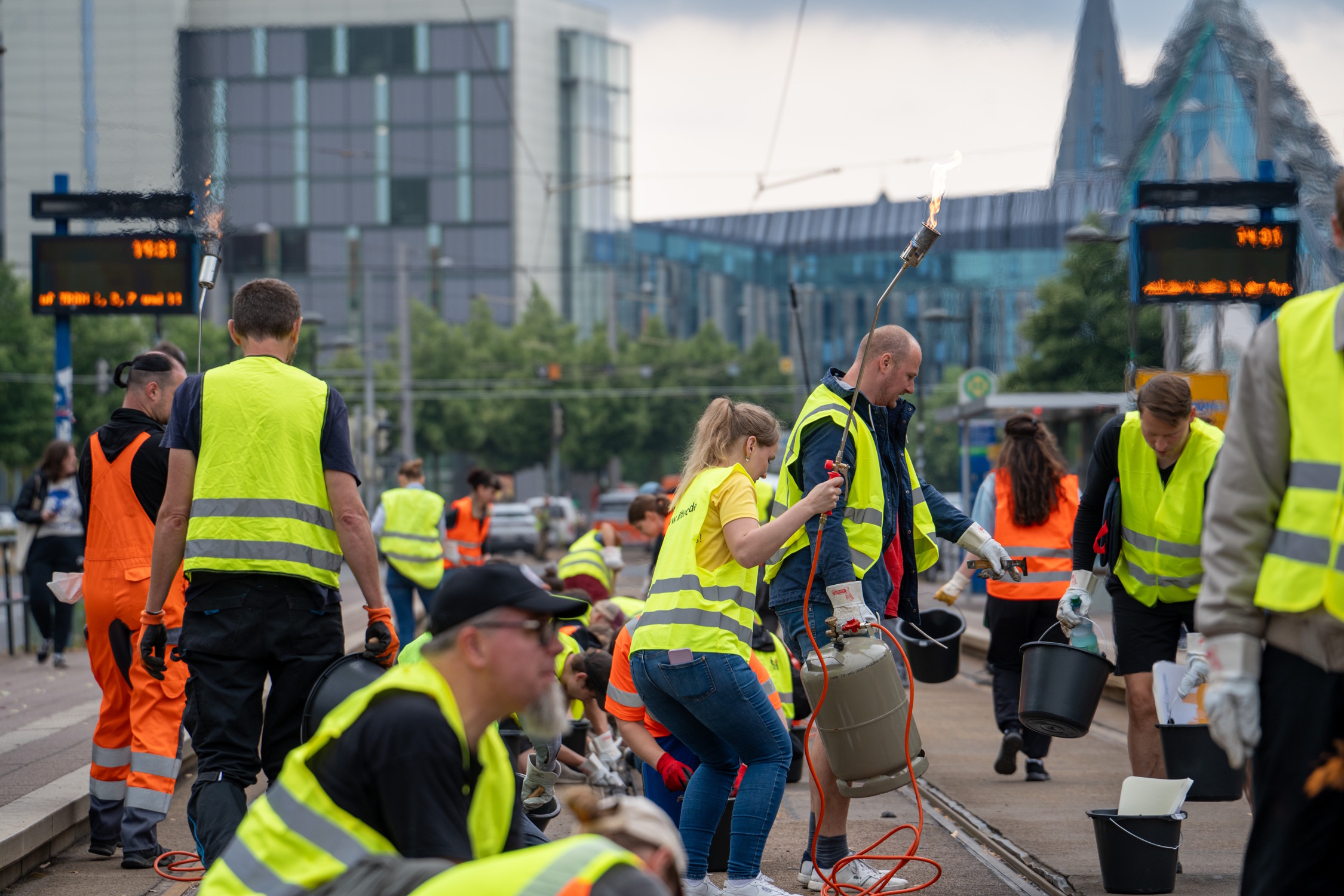
LVB staff and volunteers removing the joint sealant at Augustusplatz. Photo: Ferdinand Uhl
And the liquefied joint sealant was visible to everyone on the LVB’s trackwork. Points and sections of track were partially stuck together or clumped. Around 180 trams were affected by the consequences for several days. Safe operation of the tram network could no longer be guaranteed, which is why regular tram services across the entire LVB network had to be suspended.
The city’s green spaces suffered well beyond the record-breaking heatwave week: some lawns and meadows are showing clear signs of drought. In some cases, heat damage was also observed to built infrastructure, such as paving slabs at Lindenauer Hafen.
The effects on the city’s green spaces only become apparent later
There were isolated instances of broken branches in the city forest. In the Rosental in particular, the Environmental Protection Agency warned of falling branches. However, the actual effects of the heat, the intensity of solar radiation and possible drought stress situations will only be possible to assess conclusively in the coming weeks. This is because, based on experience, damage such as leaf scorch, premature leaf fall, drought stress or loss of vitality can occur with a time lag.
Individual trees and particularly stressed locations – such as heavily sealed, exposed or confined street spaces – are significantly less able to cope with extreme heat. Here too, the impact of the weather on tree vitality can only be assessed at the end of the year. But one thing is already clear: the early onset of this extreme heatwave is atypical and is therefore leading to a greater overall strain on the trees.
As for Leipzig’s watercourses, no marked change in water levels had (as yet) been observed as a result of the heatwave over the hot weekend. However, this changed significantly in mid-July (as at 14 July 2026): “The weekly analysis of flow rates at Saxony’s gauging stations shows that the number of stations experiencing low water levels (flow rate below MNQ(year)) has increased significantly compared with the previous figures (7 July). On the morning of 14 July, a flow rate below the MNQ(year) was recorded at 83 (55 per cent) of the 147 gauging stations analysed. At a further 20 (13 per cent) gauging stations, the MNQ(year) was almost reached.”
The Connewitz lock therefore had to be closed in mid-July due to low water levels.
The heat stress also took its toll on the animals, causing them to show signs of exhaustion. Numerous common swifts were taken in at the wildlife park’s rescue centre, exhibiting severe symptoms of exhaustion due to the heat stress. Wildvogelhilfe Leipzig reports that over 700 common swifts crashed due to the heat.
Water and energy
With regard to the drinking water supply, Leipzig Waterworks recorded unusually high daily and weekly peaks in water consumption, but there were no supply bottlenecks. The water supply is secured by the independently operated ‘sources’ of Leipzig’s drinking water system: groundwater at the Naunhof waterworks site, bank seepage and groundwater at the Canitz/Thallwitz waterworks site, as well as supplementary supplies from the Elbaue-Ostharz GmbH long-distance water supply. According to the Office for Environmental Protection, this has made an important, supplementary contribution to maintaining the security of supply in Leipzig over the past few days.
Recorded daily figures for water fed into the network between 22 and 28 June 2026 averaged 129,500 m³/d; with a maximum daily peak of 132,700 m³/d – the highest figure recorded to date.
The energy supply has also come under greater strain. The technical infrastructure of Netz Leipzig was affected by significant temperature fluctuations; however, according to the Office for Environmental Protection, the effects have so far been managed at all times.
Impact on tourism and the city centre
The DEHOGA reported a mixed picture: some businesses with well-shaded outdoor areas, cool interiors or brisk evening trade were able to benefit to some extent. At the same time, the persistent heat led in many places to considerable strain on guests, staff, operational processes and profitability. Particularly affected were: lunchtime business, afternoon events, and establishments without adequate shade or cooling. Many guests postponed their visits until the evening, arrived later, stayed for shorter periods, or avoided travelling through the sweltering city centre altogether.
Whilst demand is rising for outdoor seating, beer gardens, cold drinks, light meals, non-alcoholic options and climate-controlled venues, this is offset by higher costs for cooling, ventilation, energy, ice, water, technical maintenance and stock storage. Cold chains, cold stores and beverage logistics are also under greater strain.
In the hotel sector, guests’ expectations regarding air-conditioned rooms, sleeping comfort and reliable transport are also rising. Here, too, a key issue is the accessibility of the city centre: if trams are cancelled due to the heat, or if pavements, stops and squares become extremely hot, this has a direct impact on the catering, hotel and retail sectors, as well as on events and tourism. During periods of extreme heat, guests make very last-minute decisions about whether to come into the city at all, how long to stay and which attractions to visit.
Across the city centre, there were significant declines in turnover and footfall compared with similar periods. The suspension of public transport services had – and continues to have – truly catastrophic consequences, with footfall falling by approximately 50 per cent on Saturday. Shopping centres outside the city centre have, to some extent, benefited comparatively due to air conditioning and free parking, though they have also recorded declines, partly due to the suspension of public transport services.
Time to act
It is quite evident that Leipzig’s supermarkets – some of which were affected by the failure of their refrigeration systems – were not included in the survey. Leipzig’s care homes were also excluded from the survey.
But even this selection makes it clear just how much Leipzig’s infrastructure was stretched to its breaking point. And that the city is still far from being prepared for a heatwave in which tropical temperatures dominate the urban area for weeks on end.
Empfohlen auf LZ


So können Sie die Berichterstattung der Leipziger Zeitung unterstützen:





There is one comment