
Dieser Artikel ist auch in deutscher Sprache verfügbar: Zum deutschen Artikel.
At first he pretended to be interested in buying the goods – but then he simply tried to snatch them. The police have now arrested the suspected repeat offender. Harkortstraße will remain closed to traffic for longer than expected – due to reckless behaviour! And: 39 years ago today, a State Council resolution brought an end to the death penalty in the GDR. The LZ summarises what was important in Leipzig and beyond on Friday, 17 July 2026.
Police catch suspected robber
In the last two weeks alone, the Leipzig police had reported two cases of a robbery scam in Plagwitz. In each instance, a young man had used the Kleinanzeigen platform to express an interest in buying technical devices, such as an iPhone. However, when he met the unsuspecting sellers, he simply tried to steal the goods from them. In one case, he succeeded after threatening the victim with a weapon-like object. In the second case, a scuffle broke out with the rightful owner, who managed to successfully defend his mobile phone against the robber.
The police have now put a stop to these activities. They were able to arrest a suspect, aged just 20, yesterday, as they announced today. The provisional arrest had been ordered by the Leipzig Public Prosecutor’s Office, as the robbery investigation unit suspected that the man might abscond. His flat in the west of Leipzig was searched by court order. Among other things, blank prescriptions and stamps from medical institutions were found. The suspect, who apparently has further offences to his name in addition to the two robbery charges, is now in prison on remand.
Construction delays on Harkortstraße
Everything was actually due to be completed on 7 August, when Harkortstraße was to be reopened to traffic. However, that is no longer going to happen. As the City of Leipzig announced today, the works will take two weeks longer, meaning that unimpeded travel from the Ring to Dufourstraße will not be possible until 21 August. The reason given for this is reckless behaviour. At the cycle route junction with Beethovenstraße, the barriers originally put in place were repeatedly pushed aside by unauthorised persons – a safety risk!
As a result, the ongoing construction work by the waterworks – which involves, amongst other things, laying new pipes – has already had to be modified slightly. And to ensure that the resurfacing work, due to begin next Monday, can be carried out safely, this work will now be divided into two separate construction phases:
In the first phase, pedestrians and cyclists will be directed together along a combined footpath and cycle path running alongside the construction site as far as Lampestraße. There, Harkortstraße can be crossed safely. At the same time, construction work will take place across the entire junction area from Harkortstraße to Straße des 17. Juni. Once the junction has been completed, the construction site will move on. During this phase, pedestrians and cyclists will once again be able to cross Harkortstraße directly at the junction with Straße des 17. Juni as usual.
Calendar entry: 39 years ago, the GDR announced the abolition of the death penalty
By a resolution of the State Council, the GDR declared the death penalty abolished on 17 July 1987 – surprising many of its citizens, who until then had not even known that it still existed at all. This move was driven by the country’s desire to enhance its international standing and by the forthcoming visit of Head of State and Party Leader Erich Honecker to the Federal Republic of Germany.
In the GDR, death sentences could be imposed for offences including murder, Nazi crimes and espionage; executions were initially carried out in Dresden, and from 1960 onwards in a strictly cordoned-off section of the prison in Leipzig’s Südvorstadt district. From 1968 onwards, the state replaced the guillotine with the ‘unexpected point-blank shot’, in which the executioner fired a bullet into the back of the condemned person’s neck. The practice of execution was treated as a state secret: death certificates and places of death were falsified, those executed were cremated as nameless ‘anatomical specimens’, relatives were left in the dark, and farewell letters were not handed over.
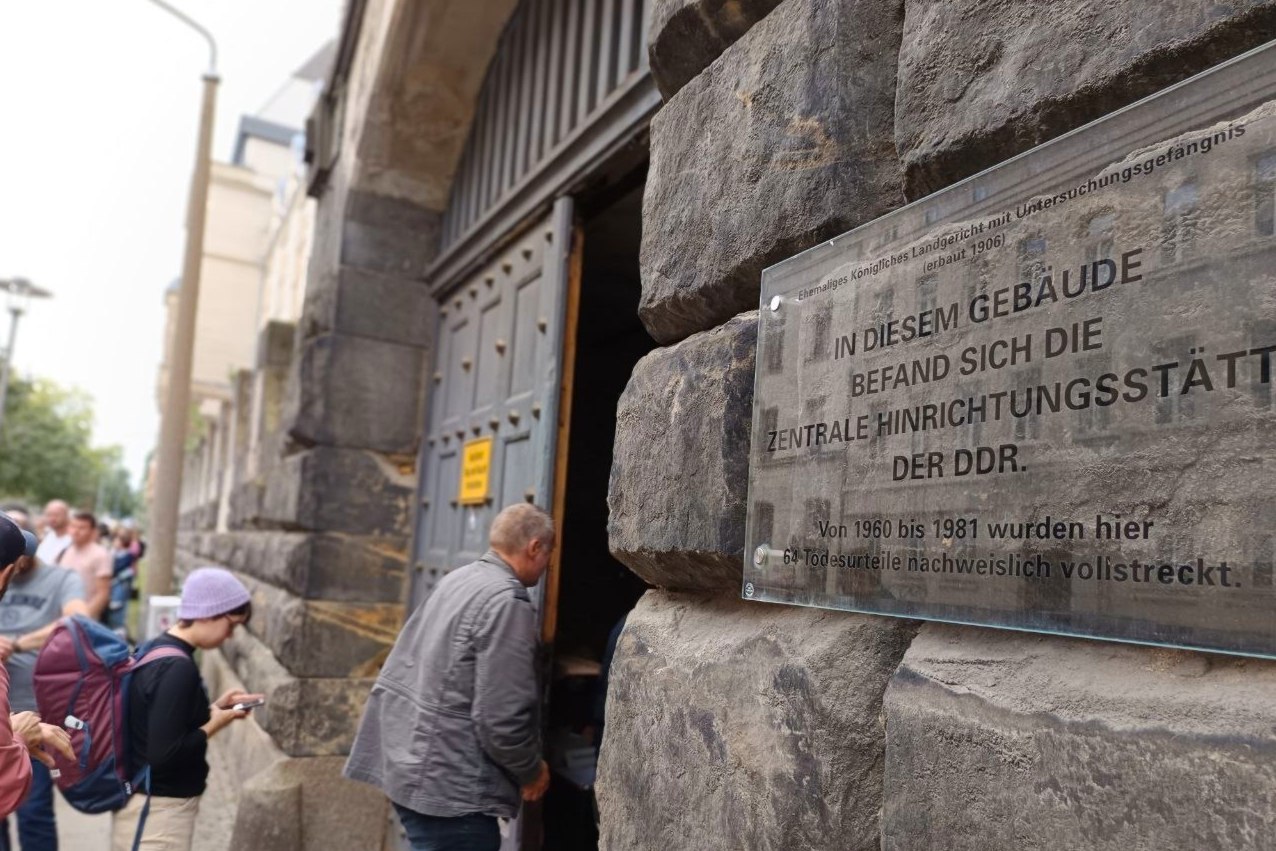
The former GDR execution site in Leipzig’s Südvorstadt district, where people were secretly executed between 1960 and 1981, has so far only been open to the public on sporadic occasions, such as here during Open Monument Day in September 2025. Photo: Lucas Böhme
According to current research, the GDR executed more than 160 people between 1949 and 1981, including murderers and Nazi criminals. However, despite the indisputable gravity of their crimes, these people were convicted in trials that failed to meet the standards of the rule of law and were politically motivated.
From the 1970s onwards, GDR courts imposed the death penalty only rarely. Yet there was still no mercy for dissidents within their own ranks: In June 1981, six years before its formal abolition, the judiciary carried out an execution on German soil for the last time. A bullet struck Stasi officer Werner Teske, who had been convicted by a military tribunal of alleged espionage and desertion. In 1993, the decision was quashed; the public prosecutor’s office later brought charges against two GDR lawyers involved, as the death sentence would not have been permissible even under the law in force at the time. The Federal Republic of Germany had already abolished the death penalty when the state was founded in 1949.
What the LZ reported on today:
Nature conservation at the Bagger in Thekla: Nothing further will happen here before 2029
Hello Leipzig: This is how Friday 17 July 2026 kicks off the weekend
Elbland: The long shadow of Nina’s family history and a conciliatory ending in Hostinné
What else was important:
In the first 19 hours since its release, what is probably today’s most hotly debated song has already racked up over 310,000 views on YouTube. “Keine Angst” is the title of the track by Antilopen-Gang member Danger Dan. He had originally intended to present the piece – which is over seven minutes long – together with pianist Igor Levit on 21 July during the anniversary edition of the satirical programme “Die Anstalt”. However, ZDF withdrew the invitation at short notice. The broadcaster viewed the song, which explicitly calls for resistance against right-wing extremism, as a potential incitement to violence.
CDU parliamentary group leader Jens Spahn is also facing calls for his resignation from within his own ranks. He and his party had previously spoken out clearly against the legalisation of surrogacy in Germany. Now, however, Spahn and his husband have announced that they have become parents. Interestingly, the child was carried to term by a surrogate mother in the USA. Spahn defends this decision.
The Dresden Higher Regional Court (OLG) has sentenced NSU supporter Susann Eminger to two years’ suspended imprisonment. The woman, believed to be a close friend of Beate Zschäpe, has been found guilty of supporting a terrorist organisation and, in one instance, of aiding and abetting a serious case of armed extortion. The Federal Public Prosecutor’s Office had originally sought a four-year prison sentence, whilst the defence had pleaded for an acquittal. Eminger herself did not comment on the allegations.
Empfohlen auf LZ


So können Sie die Berichterstattung der Leipziger Zeitung unterstützen:




There is one comment