Dieser Artikel ist auch in deutscher Sprache verfügbar: Zum deutschen Artikel.
Number 12 on the list of candidates so far for the office of mayor of Leipzig is finally a woman once again, bringing the proportion of women among the candidates to 1/6, or around 16.7 per cent.
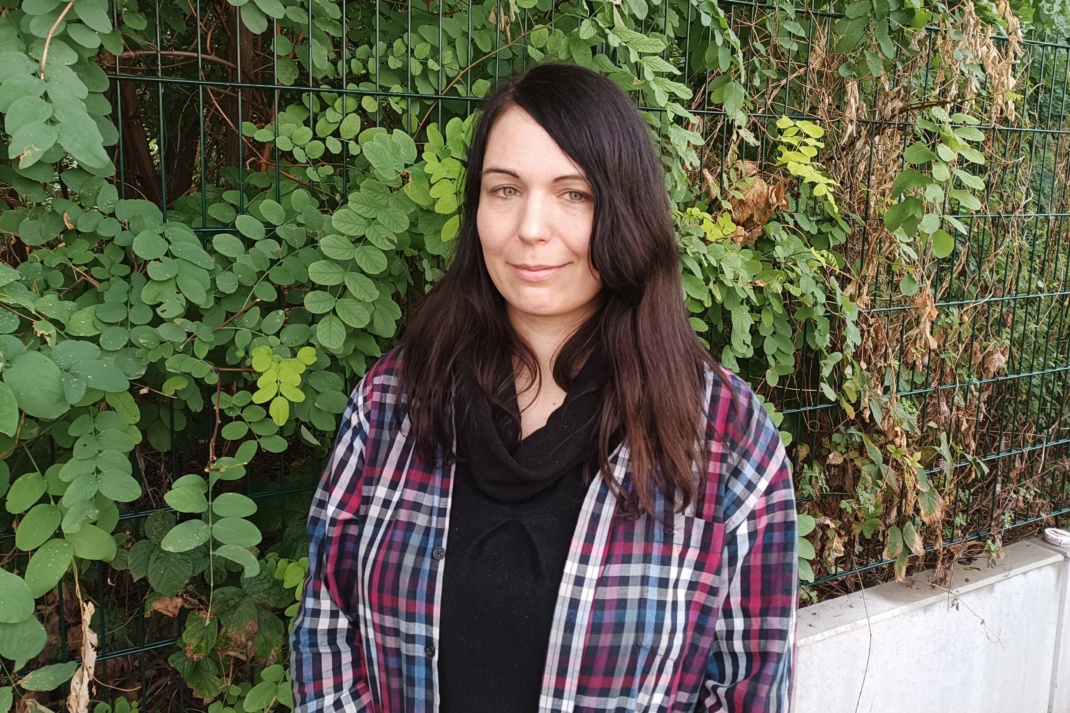
On 22 August, Anne Giulia Giermann was confirmed as a candidate for the mayoral election at the nomination meeting of the Pirate Party’s Leipzig district branch. Anne Giermann was born in Lusatia, moved to Leipzig in 2011 to study and has made her home here ever since. She holds a Master’s degree in Medieval and Modern History from the University of Leipzig and has worked in recent years as a fellow for Teach First Germany in primary schools. She has recently taken up a role at the office of the Free Faction in Leipzig City Council.
We met Anne Giermann after the nomination meeting and asked her about her candidacy.
Disclosure: The author is a member of the Pirate Party and is active in the Leipzig district branch. As the author and Anne Giermann have known each other for some time, the conversation was conducted using the informal ‘you’ form.
Anne, you were nominated today by the district branch as a candidate for the mayoral election. The Pirates aren’t very well known – what do they actually stand for?
The Pirate Party was founded in 2006, with a focus on digitalization. The aim was, and still is, to achieve a just and fair digitalization process that prioritizes the common good. We have since broadened our range of issues. The Pirates campaign for fair education and for culture to be accessible to all. In general, accessibility and transparency are important to us. We also champion social issues such as an unconditional basic income and free public transport, and of course climate and environmental protection.
You want to stand for the office of Lord Mayor, initially as one of two women among 12 candidates – what would your key priorities be?
A key priority would be the switch to open-source software in the administration. I’m not the only one who views our dependence on Microsoft very critically, and I also see potential for savings given our budgetary situation. The issue is also relevant in terms of data protection. At present, the City of Leipzig’s data is in the hands of a US corporation rather than in our own hands. That is why open-source software in the administration would be a key priority for me. Then, of course, transparency in politics.
The City of Leipzig is already doing quite a lot right in this regard. City Council debates are streamed. All motions and so on are publicly accessible via the Council information system. But there are still a great many hurdles and barriers preventing people from keeping themselves fully informed about political developments in the city. There is certainly still room for improvement. Last but not least, another key priority for me would be climate action and biodiversity conservation in the city. The climate crisis and the associated biodiversity crisis pose a massive threat to us. At the same time, climate action and biodiversity conservation also offer the opportunity to promote innovation and save money in the long term. Everything we invest in climate protection now will save us huge costs in the future.
The mayor’s remit is a very complex area. You’re responsible for everything in the city – from A for ‘waste management’ to Z for ‘access routes’. The economy is an issue that arguably dominates everything else. What are your ideas on the subject of the economy?
When it comes to the economy, I’m particularly concerned about energy costs, which place a burden not only on citizens but also on businesses in Leipzig. My aim would be for us, as a city, to promote decentralized renewable energy. Energy costs are no longer such a major problem if you generate your own energy using a solar panel system on your own roof.
Furthermore, we need to address the skilled labour shortage. We have enormous potential for innovation in Leipzig, thanks to the university and the universities of applied sciences. However, we face the problem that we do not have jobs for many highly qualified people. As a result, these skilled workers are leaving. I recently completed the Teach First fellowship. My former fellow fellows are highly qualified people who are well-educated, but are searching in vain for a good job here locally. If we lose skilled workers in the long term because they see no future here, then that’s a problem for the city.
Furthermore, we mustn’t view Leipzig’s economy solely through the lens of large companies. The many smaller businesses – in the skilled trades, retail, manufacturing and other sectors – are hugely important for the city. This is where digitalization using open-source software comes into play; many smaller businesses that pay their taxes here also operate in this sector.
Assuming you were to become Lord Mayor, what would your priorities be in the first 100 days?
In fact, I’d throw myself straight into open source in the local government administration, because I’ve found that digitalization – and especially digitalization based on open source – is a very, very tough nut to crack. You have to stick at it tenaciously and have staying power. That’s why I’d tackle that straight away as my first priority.
One last question – I’ve asked the others this as well: the election is in 2027, and the term of office ends in 2034. If you were to become Lord Mayor, what would have changed by 2034?
In any case, we would no longer be dependent on Microsoft, and we would have saved a fair bit of money as a result. We’ll have been able to invest this in local infrastructure – schools and public transport, among other things, would be key here. The climate protection situation will also have improved by then. We’ve currently lost a huge amount of green space in Leipzig – which also serves as recreational areas for the city’s residents. I’ve taken steps to reverse that trend. So Leipzig will be a fair bit greener by then.
Anne, thank you for the interview.
The field of candidates for the office of Mayor of Leipzig is filling up; we’ll be speaking to the candidates again as the election campaign enters its crucial phase.
Empfohlen auf LZ


So können Sie die Berichterstattung der Leipziger Zeitung unterstützen:





There is one comment