Dieser Artikel ist auch in deutscher Sprache verfügbar: Zum deutschen Artikel.
Is the glass half full or half empty? It always depends on your perspective. Take, for example, the ban on the conversion of residential property in Leipzig, from which the Left Party group on the Leipzig City Council had expected far more. Such a ban has been in force in Leipzig since 1 September 2024. It is intended to prevent the conversion of residential property into holiday lets and to tackle long-term vacancy.
With the end of the two-year transition period on 1 September 2026, owners of flats where the property has been misused (short-term lettings exceeding 12 weeks a year or vacancy for more than 12 months) must submit a permit or return the flats to residential use.
The Left Party parliamentary group has now raised enquiries regarding the end of the transitional period. According to a response from the Office for Housing and Urban Regeneration
, the Left Party considers the results to be, at the very least, mixed: Since the enactment of the by-law prohibiting the misuse of properties, 1,336 reports from members of the public regarding such misused flats have been received, of which 1,050 relate to holiday lets or short-term rentals and 287 to vacant properties.
The Left Party now reports that only 86 flats have been returned to the housing market. A total of 722 fall under the transitional protection scheme. In these cases, either residential use must now be restored or authorisation for the current use must be provided.
It should be noted, however, that this transitional protection ended on 1 September.
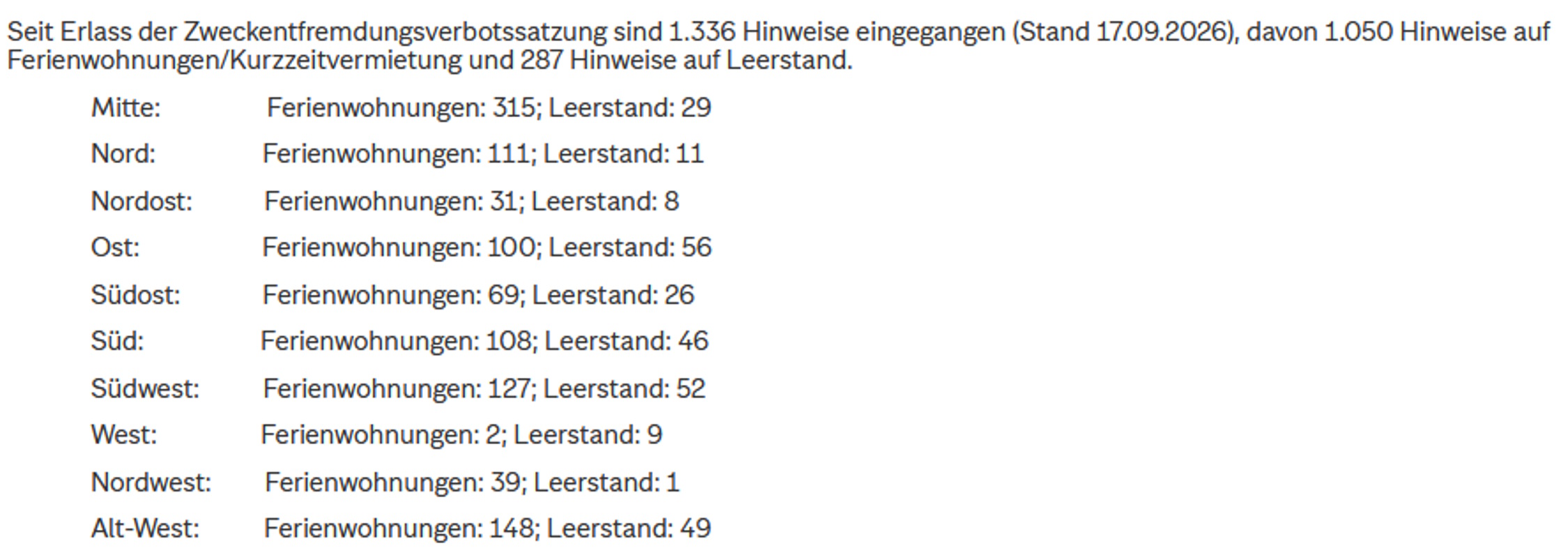
The reported cases of flats being used for purposes other than residential by district. Graphic: City of Leipzig
The Office for Housing Construction and Urban Regeneration describes the situation regarding these 722 flats as follows: “Those entitled to the flats had to provide credible evidence by the end of the transitional protection period that the flat had been returned to residential use, or to apply for a permit valid beyond 1 September 2026.
All authorised persons who had not independently registered with the AWS by 1 September 2026 received a notice of hearing and were requested to provide evidence (e.g. notice of termination for the relevant dwelling(s); a valid tenancy agreement showing that the property has been re-let for residential purposes; in the case of owner-occupation, a registration certificate confirming the registration of the main or secondary residence and, where applicable, proof of payment of the second-home tax). Should the required evidence not be submitted in full or by the deadline, it is intended to issue an order requiring the property to be used for residential purposes in accordance with Section 10 of the ZwEVS.”
And what is the current situation?
“To date, an application for continued use for short-term letting, even after 1 September 2026, has been ; in 67 cases, proof of residential use has already been provided again; and in 556 cases, no evidence or insufficient evidence of resumed residential use has yet been submitted.”
The 86 flats identified by the city can therefore be counted as residential accommodation that can be reused: “As a result of the reports received and negative decisions in the application process, 86 flats have been returned to the housing market. The recovery of residential accommodation is usually achieved during the administrative proceedings, even before an administrative offence is reported. In 54 cases, an order to use the property for residential purposes pursuant to Section 10 of the ZwEVS was required. In addition, 7 cases were reported as administrative offences to the Central Fines Authority.”
One suspects that, in this case too, many property owners are playing for time, counting on the city simply not having enough staff to process the unresolved cases in a timely manner.
We need inspection staff
“1,336 reports from the public show that the problem exists and that the people of Leipzig are keeping a very close eye on things. The fact that, to date, just 86 flats have been returned to residential use is a sobering figure given the dramatic shortage of affordable housing,” state the two city councillors from the Die Linke group on Leipzig City Council, Dr Elisa Gerbsch and Juliane Nagel, who are dealing with the issue, state.
“We urge the city to take a consistent approach to transitional protection and to return misused residential property to the severely strained housing market. After all, for 556 flats, there is as yet no evidence – or only insufficient evidence – that they have been restored to residential use.”
However, it is also clear that anyone wishing to effectively enforce the ban on misuse of property needs the necessary staff to do so. It is unacceptable that thousands of reports are received, yet the administration lacks the capacity to follow them up consistently.
“We need an increase in staff numbers rather than cuts in the housing sector,” emphasise Gerbsch and Nagel.
“The Free State must also finally do its bit. Leipzig needs stricter legislation on misuse of property. Vacant properties must not only become a problem after a year, nor must holiday let use only become an issue after three months. The neglect of residential property and predominantly commercial use must be classified as misuse of property. The City Council has already passed a resolution to this effect on our initiative. Now it is Saxony’s turn. Above all, we urgently need the new registration and data reporting requirements for holiday let platforms such as Airbnb – the city needs this data to effectively identify misuse of property and take targeted action against it.”
The Free State is dragging its feet
The state government’s dithering over the creation of precisely the legal basis that would enable the city to exchange data directly with Airbnb was also noted very critically by the Office for Housing and Urban Development in its response: “At present, Saxony lacks a state-level legal basis for implementing the EU Regulation and the Short-Term Rental Data Exchange Act. This is not expected until mid-2027. Subsequently, Leipzig’s by-law prohibiting misuse of residential properties will need to be amended.
The introduction of a registration procedure and the associated regular data exchange with platforms such as Airbnb will, for the first time, provide a reliable, property-specific data set. This will make it possible to prove, beyond doubt, breaches of the by-laws and, consequently, administrative offences. Consequently, in future, reports from the public regarding holiday let properties will no longer be the main source of information or the trigger for inspections.
Furthermore, the work will be greatly facilitated by the data on the provider and the occupancy rates of holiday let properties. It is also expected that the number of unreported cases to date is very high and that numerous new cases will come to light through the data – cases which have not yet emerged either through reports from the public or through proactive action by providers (e.g. regarding transitional protection).’
This presumably also means that there are more than the 1,336 flats being misused in Leipzig, as reported by members of the public.
Empfohlen auf LZ


So können Sie die Berichterstattung der Leipziger Zeitung unterstützen:




There is one comment