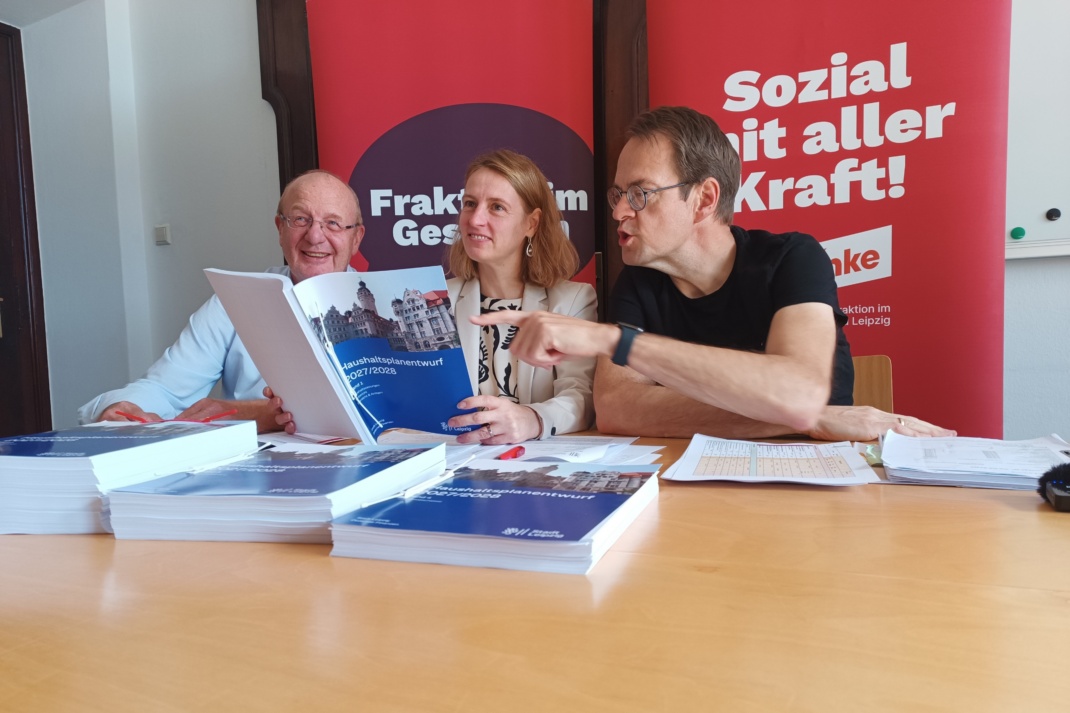
Leipzig’s city coffers are largely empty; the city has to finance many services through cash-flow loans, and the mayor responsible for finance has presented an austerity budget. Naturally, none of this is a reason for the political groups on the city council to table their amendments to the 2027/28 two-year budget. The deadline for submissions passed last week, and on 28 September, the Die Linke political group presented its amendments to us.
In his introduction, Steffen Wehmann, Die Linke’s finance expert, outlined a number of challenges. The following point was particularly interesting: “Even if the city of Leipzig, from a conservative perspective, were to do everything it is supposed to, it would not be possible to balance the books. Not even by cutting all discretionary tasks, nor even by cutting a large proportion of the mandatory tasks.”
This means that the federal and state governments commission services without contributing financially. Wehmann comments: “In the social sector and in the area of child and youth welfare alone, as at 30 December 2025, there are 925 million in delegated tasks that are not refinanced – and that is just from these two areas. If the city of Leipzig had that sum, it would still have plenty of other problems, but it would at least have more than achieved a balanced budget.”
None of this – including the wealth tax discussed later – is of any help at present. However, it highlights the challenges facing the budgetary policies of the federal government, the state and local authorities; this is not just an issue for Leipzig.
The Left Party shares this view, and Franziska Riekewald said: “Let’s hope, then, that there will somehow be a change in thinking on this. Until that happens, we will focus on the budget as the figures currently stand.” The discussion then turned to the details of the parliamentary group’s motions.
Seven strategic motions
Among the 24 amendments are seven that are of particular importance to the parliamentary group. Franziska Riekewald introduced them. The Left wants to ensure a little more social justice and “cushion, to some extent, the impact of what has rained down on the citizens of Leipzig in recent years, with various price rises, inflation and so on and so forth.”
1. LeipzigPass MobilCard: The city wishes to increase prices by two euros per month; The Left wishes to retain the old prices. This will cost one million euros in the operating budget for each of the years 2027 and 2028.
2. Early Years Education Strategy: Under the heading ‘Maintaining the Early Years Education Strategy – Providing special support for nurseries with specific needs’, the parliamentary group is calling for the measures under the Early Years Education Strategy to be continued. This concerns 10 nurseries in priority areas, comprising 5 municipal nurseries and 5 privately run nurseries. The cost of the necessary staff at the privately run nurseries amounts to 925,000 euros per year. Staffing for the local authority nurseries – a total of 15 full-time equivalents – is to be provided through the redeployment of posts. In addition, operating costs are to be increased by 50 euros per child, amounting to 50,000 euros per year.
3. Increase and index-linking of funding for clubs and associations by the Social Services Department: This concerns clubs and associations that are primarily active in the areas of basic welfare, older people, people with disabilities, the homeless, and protection against violence. Index-linking the funding by 2.5 per cent is intended to cover rising costs and prevent reductions in services or even the discontinuation of programmes. Annual cost: 946,700 euros.
4. Strategic land acquisition programme: “It should be possible to acquire specific plots of land for blue-green infrastructure, for example for nature-based leisure activities and playgrounds, to enhance high-quality green spaces, or for compensatory planting following construction works.” The Left is requesting 2.5 million euros annually for this.
5. Investment planning for public infrastructure: The city of Leipzig needs ‘contingency plans’, however absurd that may sound. When the federal government or the EU launch additional funding programmes and put them out to tender, there is usually too little time to carry out planning for construction works. Given the dilapidated state of the city’s infrastructure, participation in such funding programmes is urgently needed. 10 million euros per year is to be allocated for this purpose. That sounds like a lot, but the money is not even enough to plan the ‘Südsehne’ project.
6. Safeguarding neighbourhood libraries: Leipzig has 14 neighbourhood libraries, which are vital centres for cultural education and social participation. Under the consolidation measures in the 2027–2031 Budget Structure Plan, 7.37 full-time equivalents (FTE) are to be cut from these libraries. The Left Party believes this jeopardizes their operation and that closures are a real threat. The parliamentary group is calling for the cuts to be reversed and, consequently, for all neighbourhood libraries to be preserved.
7. Lunches at childcare centres: The text of the motion reads: “From 1 January 2027, the City of Leipzig shall provide all children attending childcare centres in the city with a free, healthy lunch every day – on days when the centres are open and providing care.” This is a matter close to the heart of Die Linke; indeed, Sören Pellmann had already taken up this demand – albeit also for schools – during the federal election campaign. Nevertheless, it is important that children in childcare centres receive a healthy meal.
Why free of charge? This provides tangible relief, particularly for parents whose income is just above the poverty line.
Why for everyone? On the one hand, it avoids the bureaucratic hassle of registration; on the other, The Left wants to prevent social divisions from becoming visible as early as nursery school. Franziska Riekewald put it this way: “But it’s also about not stigmatizing children from low-income families. It’s about every child getting a free lunch and not having to say: ‘Here’s my voucher, and now I’ll get a coupon with which my child can collect their lunch. And parents who are well-off simply don’t need a voucher; instead, it’s obvious that they’re the rich parents.”
The annual cost amounts to 13 million euros, making this the largest item among the strategic motions.
How is this to be funded?
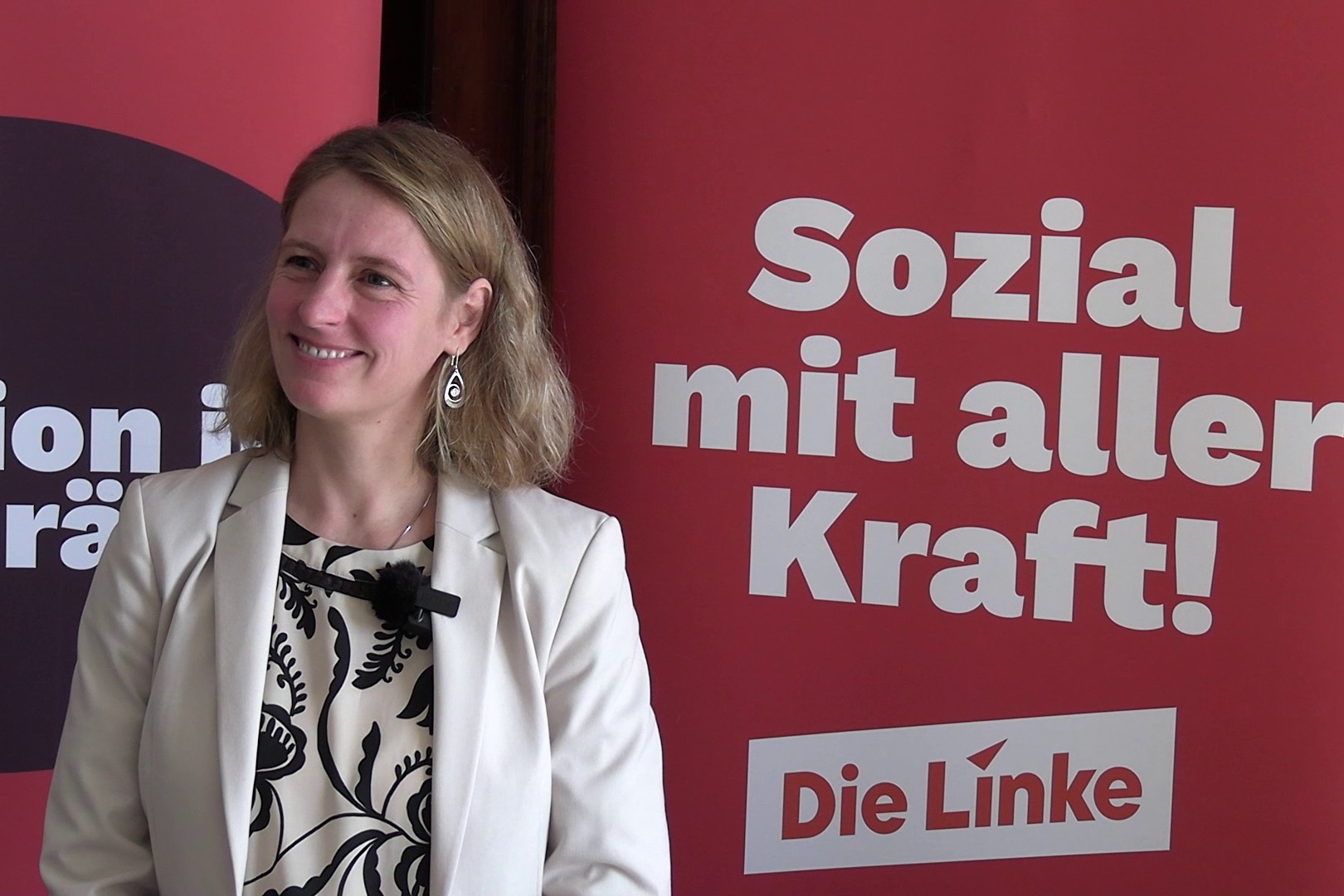
Franziska Riekewald in conversation. Photo: Thomas Köhler
The source of funding specified for the strategic proposals is “an increase in the trade tax base in accordance with VIII-HP-20208”. This is also a budget proposal from Die Linke, which states: “The trade tax base will rise by €25 million to €525 million for the 2027 financial year and by €50 million to €550 million for the 2028 financial year.”
What makes Die Linke so optimistic that trade tax revenue will rise by such an amount? Sören Pellmann comments: “We have now submitted the motion; we will be able to provide current figures once the tax figures for 30 September – in a few days’ time – are available. The figures we are expecting suggest that we are well above that level.”
The Left rules out any increase in nursery fees; Sören Pellmann does not see a majority in the City Council in favour of this either. The Left has signalled its support for property tax C.
We asked the parliamentary group leader, Franziska Riekewald, for a brief statement on the motions.
Conclusion: We have presented 7 out of 24 budget motions here; the eighth concerns an increase in the trade tax base. The other motions are also of interest; among them is one calling for the reversal of staff cuts in the staffing plan. In total, the motions amount to around 30 million euros for 2027 and 40 million euros for 2028. We will find out in December how much of this makes it into the city budget.
Empfohlen auf LZ


So können Sie die Berichterstattung der Leipziger Zeitung unterstützen:




There is one comment