Dieser Artikel ist auch in deutscher Sprache verfügbar: Zum deutschen Artikel.
There are districts in Leipzig where tall, old trees line the streets. In others, the sun beats down on unshaded pavements. As a result, these neighbourhoods get particularly hot during scorching summers like the one in 2026. In August, BUND Leipzig therefore submitted a residents’ enquiry asking about the extent of tree canopy cover in Leipzig’s neighbourhoods. The Department for Urban Greenery and Waterways provided a very detailed response. The figures supplied also held a surprise.
The urban tree canopy cover describes the percentage of ground area shaded by tree crowns at a height of 2.5 metres or more. The degree of canopy cover has a major impact on the thermal conditions in built-up areas. Scientific studies recommend at least 30 per cent for a healthy environment in which to learn, work and live, explains BUND, highlighting this by no means insignificant factor in keeping the city cool during the summer.
With a total canopy cover of 22.6 per cent (measured in 2025), the city of Leipzig lies well below the recommended level. This was revealed by a residents’ enquiry submitted by BUND to Leipzig City Council. The proportion of shaded area varies considerably across the individual city districts. In Zentrum Ost, it is just 8.43 per cent. By contrast, districts with a high proportion of woodland, such as Schleußig, have a high canopy cover of 47.55 per cent.
From Connewitz to Zentrum-Ost
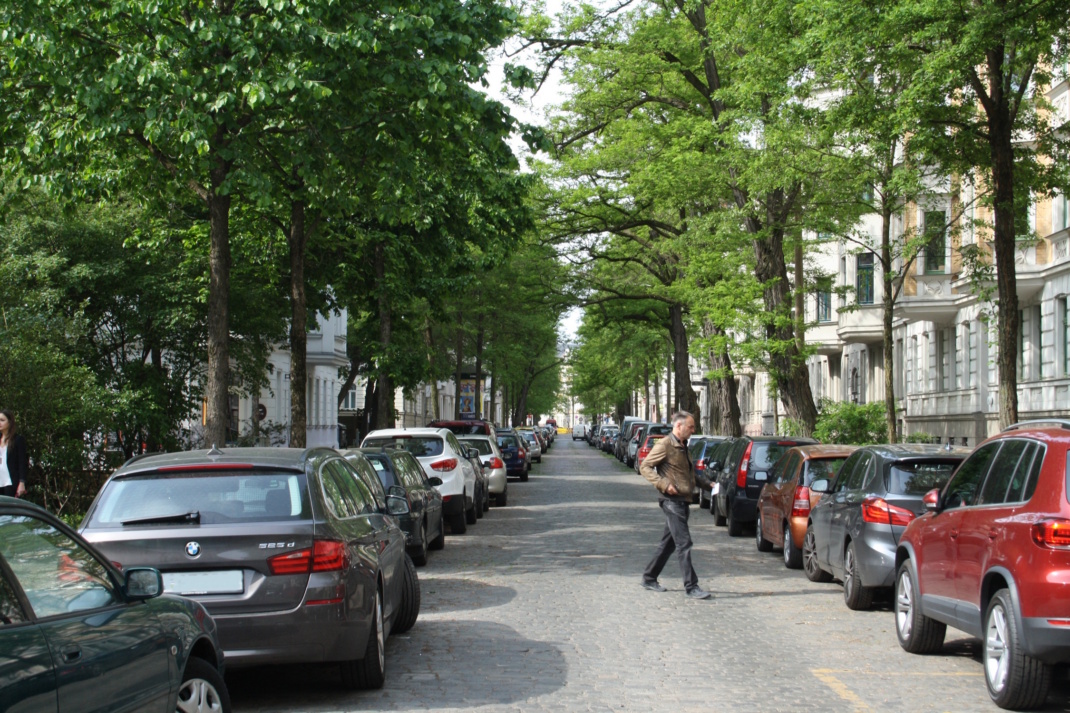
And yet Schleußig – which, for example, boasts well-shaded avenues such as Könneritzstraße and Brockhausstraße – is not even the frontrunner in Leipzig. The top spot is actually held by Connewitz, with a canopy cover of 61.16 per cent (where the neighbouring floodplain forest is likely to play a significant role), followed by Wahren with 53.22 per cent. There, too, the neighbouring floodplain forest plays an important role.
Meanwhile, a district such as Zentrum-Ost, with 8.43 per cent, is an outlier even by Leipzig standards. The only districts with lower figures are Seehausen (8.00 per cent) and Althen-Kleinpösna (7.02 per cent).
This table shows the figures for the individual districts of Leipzig.
Tree loss due to drought
According to BUND Leipzig
, the main cause of low canopy cover is the massive loss of trees in recent years. A construction boom, heat and drought have led to massive tree losses in recent years. BUND Leipzig estimates that at least 38,000 large trees (trunk circumference of 30 cm or more) have been felled in the Leipzig urban area – excluding woodland – since 2009.
This figure is based on information provided by the city administration to BUND regarding recorded felling for the years 2009 to 2016, and, from 2017 onwards, on an analysis by Deutsche Umwelthilfe (DUH), published in the ‘Hitzecheck 2026’.
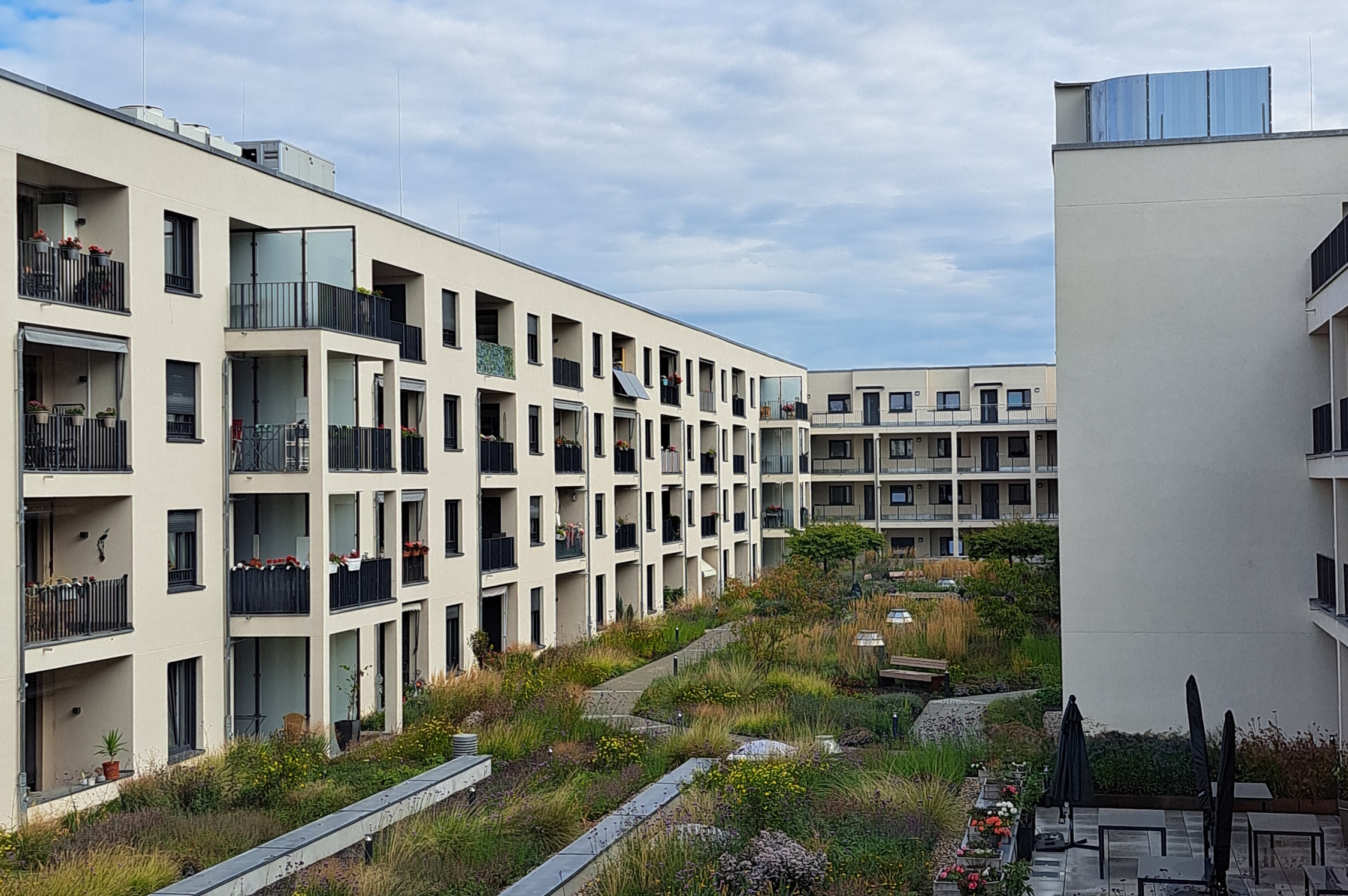
New-build with underground car park – but no space for large trees. Photo: Elke Thiess
“The lack of tree canopy cover is a self-inflicted problem,” states Elke Thiess of BUND Leipzig. “With a building policy that disregards the consequences, the city has deprived itself of a protective shield that is essential for the health and quality of life of Leipzig’s residents – and even vital for vulnerable groups on days of extreme heat.”
Urban trees are systemically important infrastructure
Alongside elements of blue-green infrastructure such as green roofs and façades, water bodies and open spaces, a high level of tree canopy cover is considered one of the most effective factors in combating urban overheating. BUND Leipzig is therefore calling for: “Urban trees and tree canopy cover must finally be recognised by Leipzig City Council and its decision-makers as an important part of public services, and decisions must be made accordingly!”
Heat protection costs money. A lack of heat protection costs a great deal of money, according to BUND Leipzig. Not only in terms of infrastructure repairs (e.g.
LVB joint sealant), but also in the health sector and the economy, due to lost production and learning.
“It is therefore of little help when representatives of city council groups repeatedly prioritise car parks over tree planting,” continues E. Thiess of BUND. “It is precisely the sheer number of cars parked on the streets that contributes to tropical nights through heat radiation.” BUND therefore demands: “Put an end to clientele politics! Act responsibly in the interests of the general public!”
The 3-30-300 rule should become a target for urban and construction planning
Leipzig City Council’s scope for action is limited by federal and state legislation, as well as tight finances. BUND Leipzig is well aware of this. Nevertheless, the council retains planning sovereignty in principle, meaning it has decision-making authority over the use of land. The city council and the administration should consistently use these powers to promote climate-resilient urban development. The prerequisite for this is political will.
“Municipal programmes, such as the road construction concept, the town square programme, the greening by-law, etc., are important and do have an impact, but they come too late and are far too slow,” notes BUND Leipzig. “New trees – far too few of which are being planted – only develop a crown large enough to provide adequate shade after decades.
The 3-30-300 rule, developed by urban forestry scientist Prof. Dr Cecil Konjinendijk, is a recognised guideline for town planners. It states that 3 trees should be visible from every building, at least 30 per cent of a neighbourhood should be shaded by tree canopies, and the distance from any flat to the nearest park or woodland should not exceed 300 metres. “After all, it is not just the degree of canopy cover that is important, but also its distribution across the urban area.”
However, BUND does not merely highlight the city’s scope for action. This is because, particularly in the case of new-build projects, all vegetation on the building site often has to be cleared. And once construction is complete, there are often landscaped courtyards where – as shown in the photo – not a single tree provides even the slightest bit of shade. Not to mention any contribution to biodiversity.
Meanwhile, the city is spending a great deal of money to compensate for the loss of trees and gradually plant new trees along streets that lack shade.
Information on tree planting in Leipzig can be found here.
Empfohlen auf LZ


So können Sie die Berichterstattung der Leipziger Zeitung unterstützen:





There is one comment