Dieser Artikel ist auch in deutscher Sprache verfügbar: Zum deutschen Artikel.
Church buildings are a feature of many towns and villages. They are recognised as landmarks, the heart of a community or points of reference. These places of worship hold great significance in terms of architecture, art history and regional history. This time, we are looking at a church in Leipzig with an eventful past – and new ideas for the future.
St Mary’s Church in Stötteritz is an Evangelical Lutheran church in the Stötteritz district of Leipzig. It was built in 1702–03 as a single-nave hall church in the Baroque style, making it the oldest building in the original village. Inside the listed church is a triptych created around 1480 in the circle of Hans Pleydenwurff, which is regarded as the most significant work of late-Gothic panel painting in Leipzig.
Present-day appearance and surroundings
St Mary’s Church, in Leipzig’s South-East district, stands on the northern side of a rectangular, tree-lined square, bounded to the north by Oberdorfstraße, to the east by Dorstigstraße, to the south by Sommerfelder Straße and to the west by Lochmannstraße. The church building extends from west to east (east-facing); the tower and entrance are situated to the west.
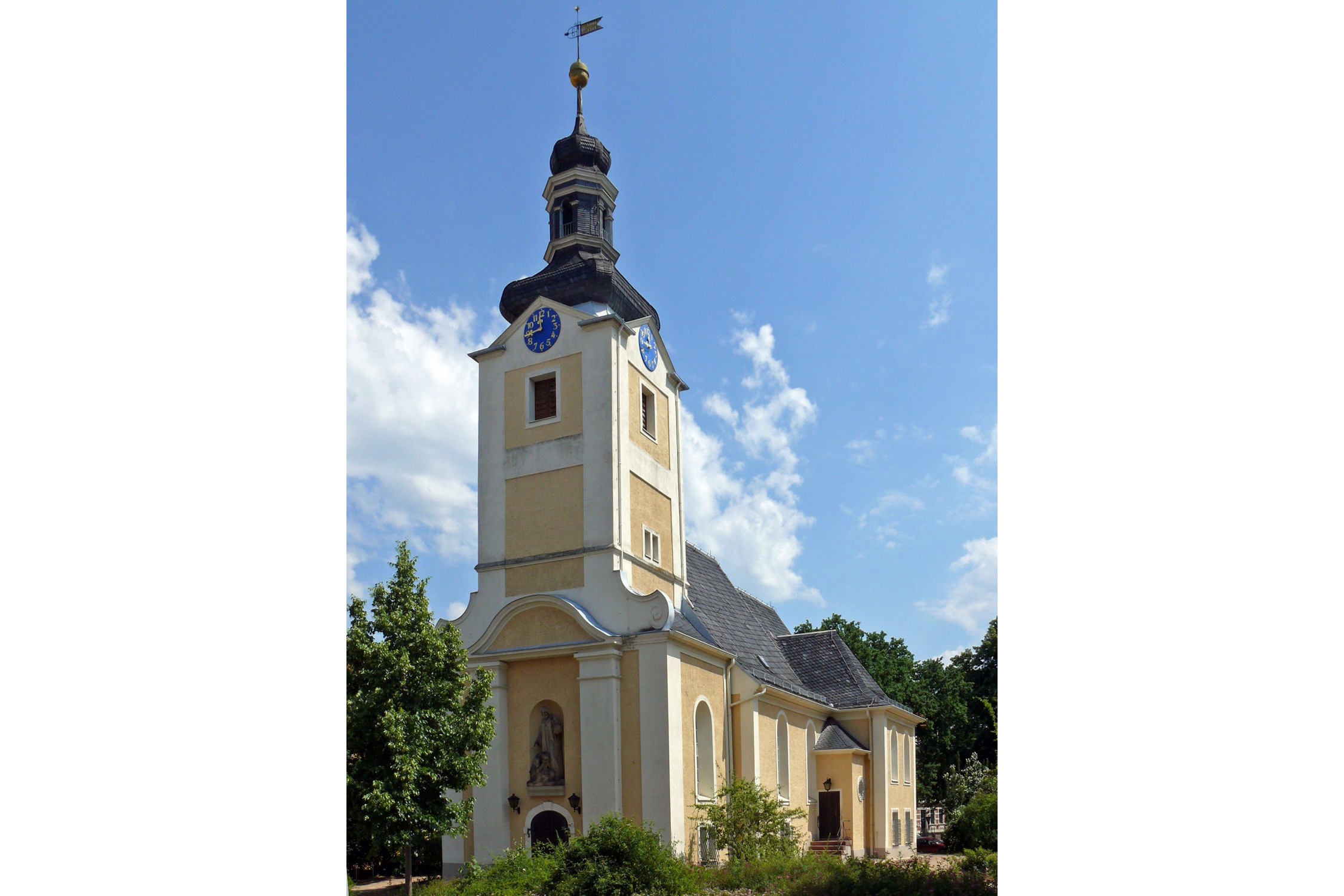
St Mary’s Church, Stötteritz. MOdmate, CC BY-SA 3.0, https://commons.wikimedia.org/w/index.php?curid=4198216
Directly to the north of the church stand the buildings of the former Stötteritz Lower Manor, including its manor house, built between 1780 and 1790 in the Baroque style, which today houses a residential facility for people with psychosocial needs. The areas bordering the church square to the east, south and west are built up with multi-storey tenement blocks dating from the late 19th and early 20th centuries.
History
St Mary’s Church was built in 1702 and 1703 on the site of a smaller medieval village church. There were two main reasons for constructing the new church: firstly, the old church had fallen into disrepair. As a result, the bells, for example, had to be stored in the churchyard. Secondly, the population had grown towards the end of the 17th century due to an influx of new residents, as documented by the construction of new residential buildings along Lange Reihe around the year 1700.
In this situation, the existing church proved to be too small, which is why the lords of the two Stötteritz manors initiated the construction of a new building. As the funding for the church could not be secured from parish funds and the landowners’ contributions alone, the local population was asked for support.
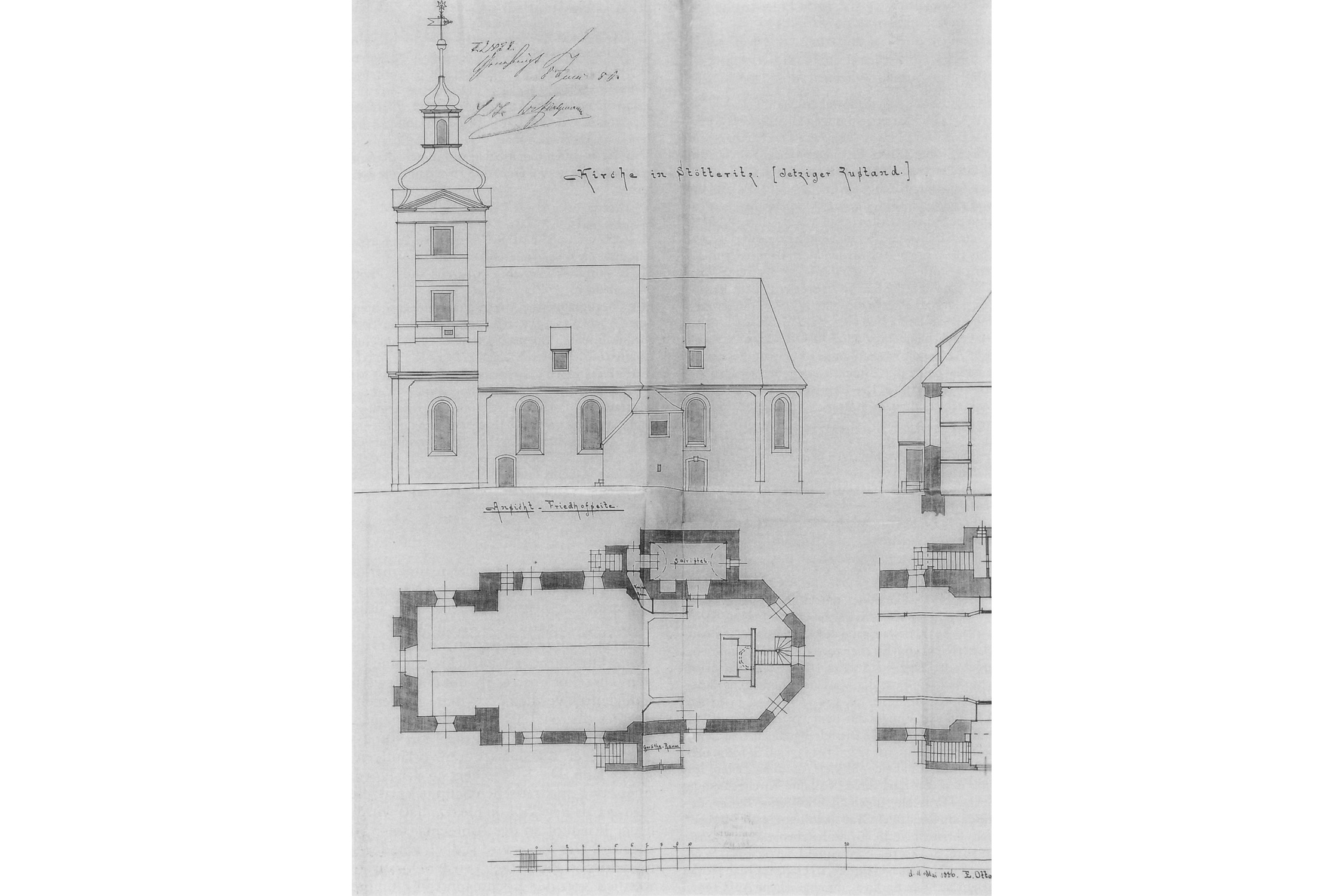
Architectural drawing prior to the 1886 redesign. The Architectural and Artistic Monuments of Saxony. City of Leipzig. Sacred Buildings. Munich 1995. ISBN 3-422-00568-4, public domain, https://commons.wikimedia.org/w/index.php?curid=4003837
In view of the tight budget, the new church building was initially constructed as a nave only, without a tower. The name of the master builder responsible for this phase of construction is not recorded. Following completion of the building, the consecration took place on the third Sunday of Advent 1703 in the presence of the Leipzig superintendent Thomas Ittig (1643–1710).
A few years later, the new church too proved to be too small. Consequently, in 1712, the landowner Engelbert von der Burg (d. 1712) submitted a request for financial support for the construction of a church tower to King Augustus the Strong of Saxony, who subsequently authorised the felling of timber in the royal forests.
The stone required for the construction of the church tower was quarried in the fields to the south of the church. Furthermore, the building work was made possible by funds drawn from the church’s assets, donations from the local landowners and voluntary labour provided by the farmers of Stötteritz.
In 1713, the tower, built to the west of the nave, was completed. From then on, it housed the bells that had previously stood in the open air and increased the number of available seats by 100.
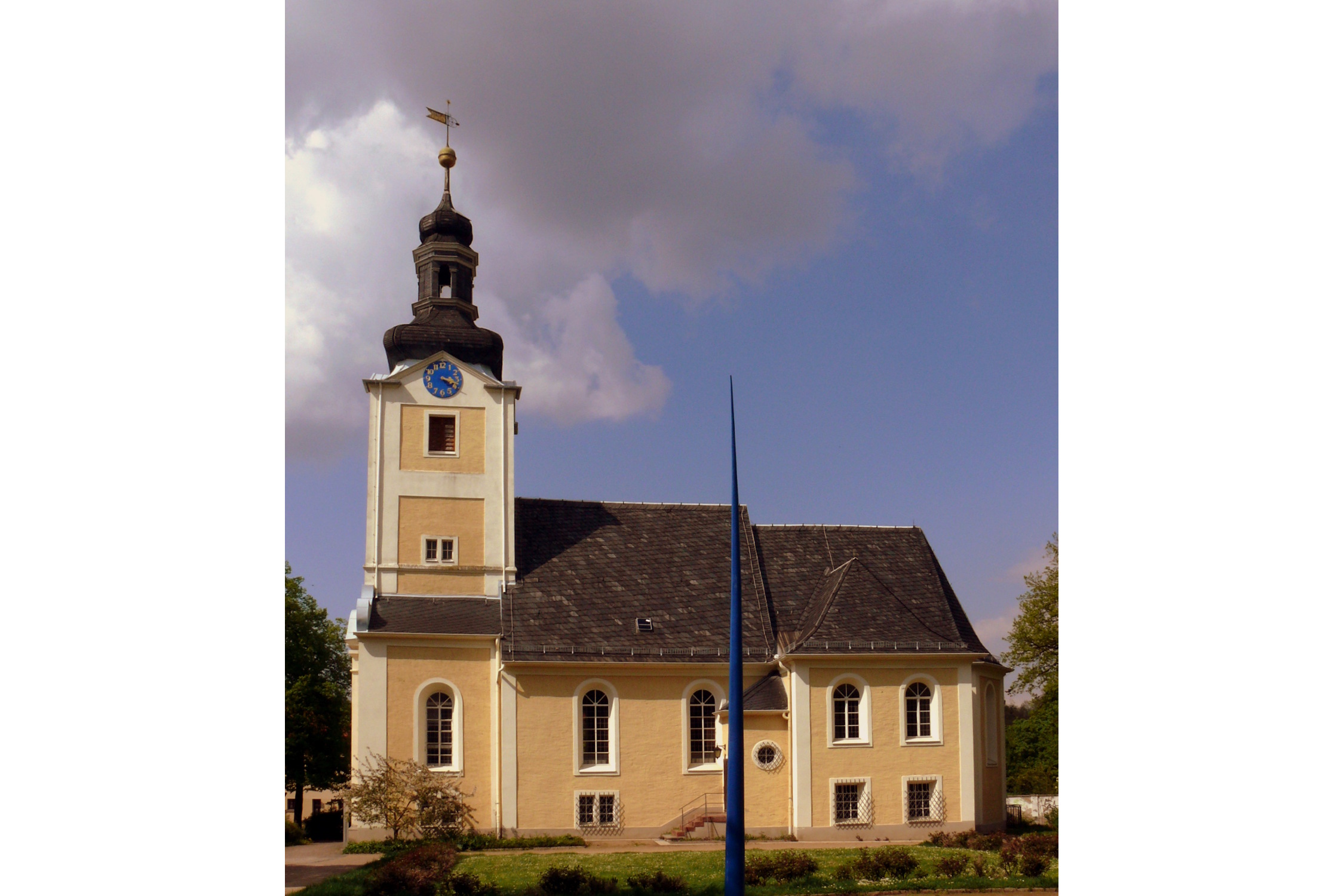
South view of Stötteritz St Mary’s Church. Modmate, CC BY-SA 4.0, https://commons.wikimedia.org/w/index.php?curid=4008843
During the 18th and 19th centuries, restoration work was carried out on St Mary’s Church.
In 1906, the church council of the Stötteritz parish – which had been independent since 1887 – resolved to name the church St Mary’s Church. In 1908, the church’s interior was repainted. In 1910, the year Stötteritz was incorporated into Leipzig, the area surrounding the church was transformed into a public square by the City of Leipzig.
In 1922, electric lighting was installed, replacing the gas lamps that had been in use until then. Two years later, the tower was repaired. In the course of 1928, the interior and exterior of the church were completely renovated and partially altered. Once this work was complete, the side galleries had been extended into the area of the former chapels.
St Mary’s Church did not emerge from the Second World War unscathed, but unlike many other church buildings in Leipzig’s districts further from the city centre, the damage was limited. On 20 October 1943, St Mary’s Church was the first church building in Saxony to be damaged during an air raid on Leipzig. The church sustained further damage during an air raid at the end of February 1945 and during the capture of Leipzig by the US Army in April 1945.
From August 1945, the church council endeavoured to repair the war damage. However, both raising the necessary funds and obtaining building materials proved to be extremely difficult. By 1946, services were once again being held in the church.
Following repairs to the tower in 1953 and minor external refurbishment in 1961, major alterations were carried out in 1963 for the first time since the end of the war. Overall, however, these maintenance measures – some of which involved substandard or unsuitable materials – were unable to prevent the structural condition of St Mary’s Church from deteriorating further. By the mid-1960s, the church roof was leaking, the spire was dilapidated and the external plaster was patchy and grey. The war damage, which had only been provisionally repaired, was also becoming increasingly apparent once more.
It was not until the major repair works carried out in 1967–1968 that this creeping decay was halted. In addition to safeguarding the building’s structural integrity, the focus was on the consistent application of heritage conservation standards. Once again, there were difficulties in sourcing building materials. It also proved difficult to engage specialist building contractors, with the result that the restoration work – with the exception of the work on the church roof and the painting – was carried out by parishioners on a voluntary basis.
The colour scheme of the pulpit altar was restored to its original state. After the reinstallation of the spire had been celebrated with a festive service on 24 August 1967, the church was reconsecrated on 29 September 1968 following the completion of the restoration work.
The most recent alterations to date were carried out during the 1990s. In 1991, sandstone slabs were laid in the aisle of the central nave and on the altar area, which raised the floor level. In 1995, the church was given a new coat of external plaster. In addition, the group of statues above the tower portal was restored.
Building
St Mary’s Church is a single-nave hall church in the Baroque style. Its eastern section, which is enclosed on three sides, is slightly recessed and set apart from the nave by its own roof with a lower ridge. To the west, in front of the nave, stands the tower, which houses the main entrance, the vestibule, the gallery staircase and the organ chamber at gallery level. This part of the church is connected to the parish hall by a sweeping arched opening.
The architecturally imposing tower façade forms the artistic focal point of the exterior. The main entrance is flanked by two colossal pilasters supporting a concave, sweeping round gable. The edges of the tower are adorned with broad pilaster strips. From the side extensions, volute-shaped gable curves lead up to the centrally rising tower.
The impact of the entrance area is enhanced by a group of figures situated in a niche above the entrance door. The tower has an onion dome, which is considerably flatter than the dome shape typically found in Saxon Baroque churches. It is topped by a lantern and an onion-shaped finial with a gilded spire, weather vane and star. The total height of the tower is given as 30 metres.
In the eastern part of the church, to the north and south of the altar area, there are two-storey extensions which house the sacristies on the ground floor and the galleries on the upper floor. Natural light enters the church interior through 15 round-arched windows of varying heights, some of which are flanked by rectangular windows.
A simple commemorative plaque honouring the soldiers from the rural parish of Stötteritz who fell in the Franco-Prussian War of 1870–71 has been affixed to the eastern external wall of the church since 1872.
Group of figures above the tower portal
Above the main entrance to the church by the tower stands a group of figures carved from yellow Silesian sandstone. It depicts Jesus Christ standing in a gesture of blessing, with an elderly man kneeling on the ground. It is situated in a niche that was created during the exterior renovation in 1890, following the closure of a tower window that had originally been located at this point.
Pulpit altar
At the eastern end of the nave stands a stately wooden pulpit altar, which was erected during the construction of the church in 1702–1703. The altar has a two-storey façade that extends from the church floor almost to the ceiling.
The colour scheme of the richly decorated altar has been altered several times over the centuries. During the church’s restoration between 1967 and 1969, it was restored to its original state, featuring red, grey and black marbling, gilded ornaments and capitals, and white, polished figures.
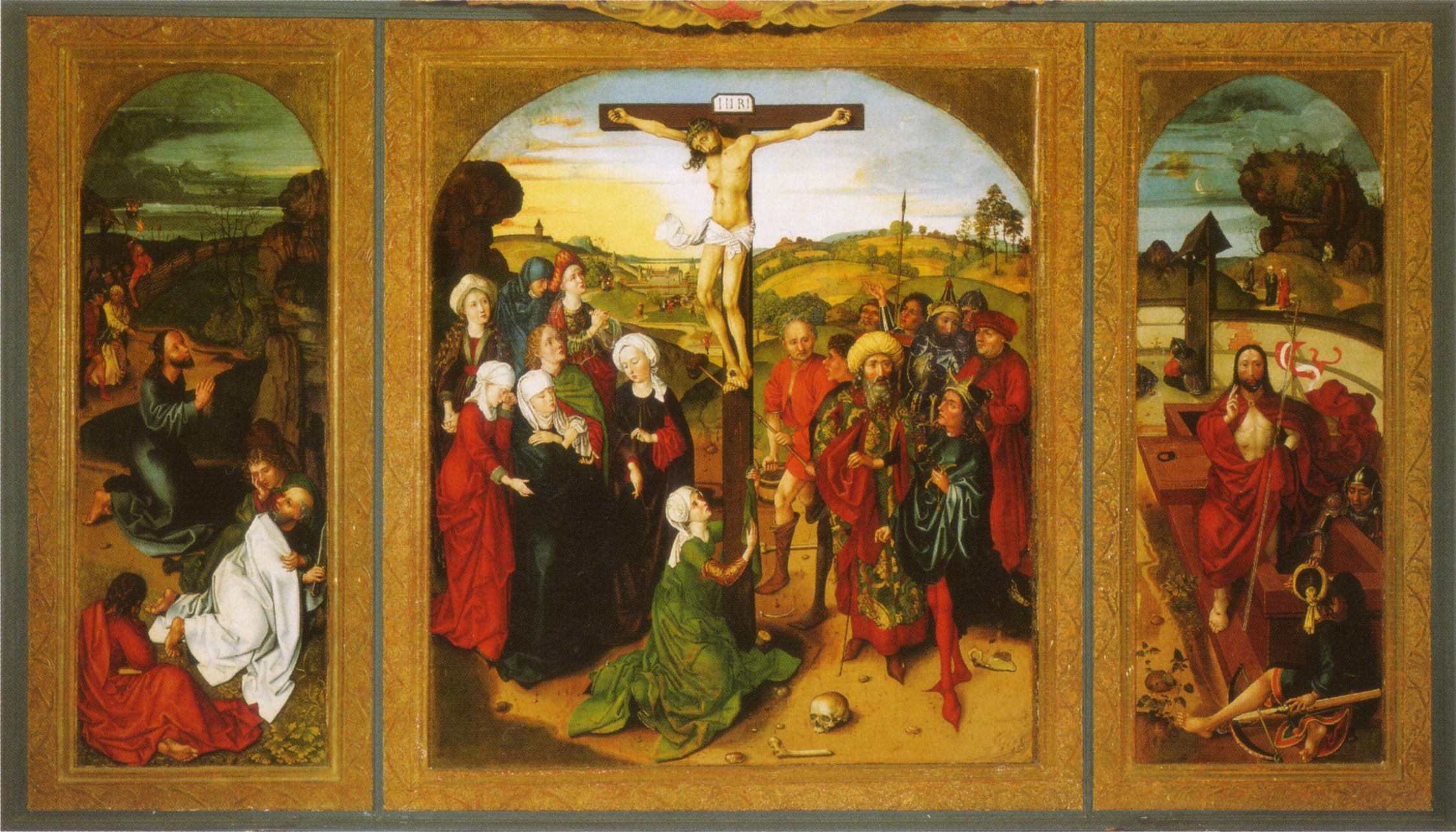
Late Gothic altarpiece. St. Mary’s Church, Stötteritz. Edition Akanthus, Delitzsch 2003. ISBN 3-00-011972-8, Public domain, https://commons.wikimedia.org/w/index.php?curid=3998621
Altarpiece
The altarpiece, set into the lower section of the pulpit altar, is the church’s most important piece of furnishings from an art-historical perspective. It is described as being of very high quality and is regarded as the most significant work of late-Gothic panel painting in Leipzig. The central panel of the triptych depicts the Crucifixion of Jesus, the left wing panel his Arrest, and the right wing panel the Resurrection.
The backgrounds of the three paintings depict a unified landscape, albeit one characterised by varying lighting conditions. The resulting impression of unity between the paintings is reinforced by a path running through the background, which, as it were, guides the viewer from one painting to the next.
The present-day organ
Just over a decade after the Stötteritz parish became independent, the decision to build a new organ was taken in 1899. On 21 July 1899, a contract was signed with the organ builder Georg Emil Müller (1857–1928) from Werdau for the construction and installation of the new organ. The instrument was completed as early as December 1899. It featured pneumatically-operated cone chests, two manuals and a pedalboard with 16 stops.
During the First World War, the parish was forced to hand over the tin pipes. These could not be replaced until 1927, when they were substituted with lower-quality ones. In 1920, an electric blower was installed.
The organ built in 1899 was thoroughly rebuilt in 1930 by the Crimmitschau-based master organ builder Hans Michel. He had the windchests replaced and two stops added.
The organ was also damaged during the air raid on the night of 20–21 October 1943. The war damage was repaired in 1947 by the Dresden-based organ-building firm Jehmlich.
In 1953, the organ builders at Jehmlich carried out a further general overhaul of the organ and made changes to its sound. In accordance with the wishes of the church council, the organ’s previous soft, Romantic sound was to give way to brighter and sharper timbres. This is how the organ at St Mary’s Church still sounds today. The most recent restoration work was carried out in 1980 by master organ builder Arwed Rietzsch from Rödlitz and in 2005 by master organ builder Gerd Bochmann from Kohren-Sahlis.
Baptismal font
To the left of the altar stands the 142 cm high movable baptismal font, the basin of which, according to current research, was crafted at the time the church was built in 1702/1703. The basin, which is clad in wood, has a diameter of 72 cm. It widens towards the top and has eight side panels, each featuring a panel framed with gold ornamentation. Every second panel depicts a seated figure of one of the four Evangelists, together with their symbol and a corresponding inscription.
The white, wood-carved lid of the baptismal font, decorated with gold, was acquired after 1813. It depicts a wreath of palm leaves curving downwards, at the top of which stands an urn. The stone octagonal base and the shaft of the baptismal font probably date from 1899.
Bell Ringing
St Mary’s Church has had a set of bells since the year of its consecration. As the church had no tower during the first ten years of its existence, the bells were initially housed in the open air. It was only after the completion of the church tower in 1713 that the bells were installed inside it.
It is not known whether the bells were taken over from the first church in Stötteritz, but this seems likely. This is because as early as 1734, a large and a medium-sized bell were cast in Leipzig to replace two of the older bells. In 1745, a small bell was added.
This set of three bronze bells was replaced in 1908 by a new set, also consisting of three bronze bells. During the official registration and categorisation of all bronze bells in the German Empire, the bells of St Mary’s Church were assigned to Group A (cast after 1860), which resulted in the immediate confiscation of the large and medium-sized bells for armaments purposes.
As a replacement, three steel bells cast in Bochum were acquired in 1922; these still form the peal of St Mary’s Church today. The small bell from 1908 was sold to Geyersdorf in 1923. The current set of bells bears inscriptions from St Paul’s Epistle to the Romans (Romans 12:12). The largest bell weighs 1,000 kg and bears the inscription ‘Rejoice in hope’. The middle bell weighs 550 kg and bears the inscription ‘Be patient in affliction’. The smallest bell weighs 250 kg and bears the inscription ‘Persevere in prayer’.
New: Blessings with the ritual agency ‘rita’ and ‘einfach heiraten’
Reverend Friederike Kaltofen and Reverend Paul Glüer are members of the St Mary’s parish in Stötteritz. Recently, both have also become actively involved with the ritual agency “rita”, established by the Evangelical Lutheran Church District of Leipzig.
The website rita-leipzig.de states: “Whenever something in life comes to an end, begins anew or becomes uncertain, a ritual can help us find stability and gain a sense of direction. At rita, we set out on this journey together with you and work together to create rituals for a wide variety of life situations. These can be traditional celebrations such as baptisms, weddings or blessings, farewells and bereavements. But they can just as easily be personalised rituals, for example to mark a birth, a special birthday, a move, a new beginning, or even a separation, a fresh start or other occasions.”
Behind rita are trained pastoral carers and ritual designers: “Drawing on our experience, we’d like to help you shape life’s transitions – in whatever way you need right now, given your current circumstances. We work in an open and accessible way; church membership is not a prerequisite. What matters far more is the desire for a blessing.”
A highlight was the nationwide #einfachheiraten campaign on 26 June 2026, under the motto ‘Your love. God’s blessing.’ The venue in Leipzig was Stötteritz’s Marienkirche and the adjacent copse. Friederike Kaltofen and Paul Glüer blessed numerous couples in various life situations: newly in love, engaged, in long-term relationships, or already married in a civil ceremony. No further requirements are necessary for a couple to receive such a blessing.
Coordinates:
51° 19′ 16.6″ N, 12° 25′ 26.9″ E
Stötteritz St Mary’s Church on Wikipedia:
https://de.wikipedia.org/wiki/Marienkirch (Leipzig)
rita Leipzig:
https://www.rita-leipzig.de
Empfohlen auf LZ


So können Sie die Berichterstattung der Leipziger Zeitung unterstützen:




There is one comment