Dieser Artikel ist auch in deutscher Sprache verfügbar: Zum deutschen Artikel.
“At the end of 2023, there were around 1.8 million people living with dementia in Germany. The most common cause of dementia is Alzheimer’s disease. In 2023, around 400,000 people aged 65 and over were newly diagnosed with dementia. Around two-thirds of them are looked after and cared for at home by relatives. As a result of demographic change, the number of people affected continues to rise. Unless there is a breakthrough in prevention or treatment, current estimates suggest that by 2050 up to 2.7 million people aged 65 and over in Germany could be living with the condition.”
This is what can be read on the website of the German Alzheimer’s Society (DAlzG). These are alarming figures, particularly when one considers the ageing of our society. The DAlzG talks about prevention and treatment, but there is also the important aspect of diagnosis. Roboscreen GmbH, a company based in Leipzig, has been conducting research in this field for some time.
Back in April 2024, we spoke to the managing director, Dr Ingolf Lachmann, about the company, its history, Alzheimer’s disease and ELISA (enzyme-linked immunosorbent assay) as an approach to early detection. After more than two years, it was time to follow up. Mr Lachmann was happy to agree to an interview, and we met on 10 July.
The interview
Mr Lachmann, over two years have passed since our last conversation – what developments have there been in the field of Alzheimer’s treatment and diagnosis?
A great deal has happened internationally; two years ago, we discussed how the first drug was on the horizon. There are now two approved therapies – these are antibodies designed to reduce plaque build-up. Naturally, these drugs have accelerated the search for diagnostic options. All the major industrial companies working in the life sciences and diagnostics sectors have now moved in this direction. A hugely competitive market has emerged.
As a small company, we’ve joined in and managed to establish three test systems. We cannot compete on our own because we lack the necessary equipment. We develop the chemistry ourselves, working with Tecan
and IBL at their Hamburg site. IBL is a diagnostics company that has been in existence for 50 years and with which we have been collaborating for some time.
As I said, the market has become enormous and the number of players involved can no longer be counted on the fingers of one hand, as was the case back then. Now, even the really big names, such as Roche, Fujirebio and also new US companies, are involved. This has greatly accelerated pharmaceutical development. There have been some very interesting developments, to the extent that work is now beginning on vaccines with which patients could be immunised in advance. These are intended to prevent the formation of these deposits.
We discussed at the time that these deposits form long before any symptoms become apparent. To date, they can only be detected using imaging techniques or cerebrospinal fluid analysis, but logically speaking, these cannot be applied on a widespread basis. They want to detect this using a blood test. When do these deposits start to form – is it even possible to specify an age?
If you look at the population as a whole, then over 50 is certainly the right age range. It could be 45 or thereabouts, but we don’t know exactly yet. Since we last spoke, research has progressed to the point where changes in the blood can now be detected at least ten years before a patient seeks medical attention due to symptoms. However, it is not yet clear whether this indicates the onset of Alzheimer’s. What can be measured in the blood, though, is that a change has occurred.
The community of researchers, doctors and so on has now developed programmes for establishing a testing system. This involves various stages, such as blood-based analysis, confirmatory testing and follow-up. We talk about ‘at-risk groups’ – people who are more likely to develop Alzheimer’s dementia, for example because there is a family history of the condition. If such markers can be detected in these individuals, a decision can then be made regarding treatment.
The drugs have now also been authorised in the EU, but they have side effects, so there are clear restrictions in place. The existing diagnostic methods – namely imaging and cerebrospinal fluid analysis – are used in this context. These are very safe and are employed to confirm the results of the blood analysis.
Is it likely that one day it will be possible to test for this marker in the blood as part of a routine health check-up with a GP?
That would be the aim, although at the moment GPs are not yet involved. These are still specialist examinations, and patients are referred to specialists. But we are working to ensure that this early diagnosis really does provide a high degree of certainty. There are various approaches to this. At the moment, the focus is essentially on two markers. If only one marker is measured, the diagnosis is subject to a high degree of uncertainty. That’s why a great deal of work is still being done on this, but the overall picture is accurate.
Before a diagnosis of Alzheimer’s is made, there is the mild cognitive impairment phase, which involves the onset of cognitive disturbances. This phase can be very long, and prior to it there is what is known as a ‘subjective cognitive impairment’, where the patient feels that something is wrong, but a doctor – who assesses the situation using questionnaires and imaging techniques, amongst other things – is not yet able to make a diagnosis.
Do you mean that I myself notice: I’m having trouble finding the right words and I’m forgetting things?
That’s the aim – to be able to detect changes at an early stage using markers. Ultimately, the whole process is intended to lead to a treatment that can then be started as early as possible, so that the pathological changes can be prevented before they spread.
So it’s similar to cancer screening, as I understand it. You said earlier that you only handle the chemistry; everything else is done with partners. That means, to put it simply, you develop the formulas, whilst the partners take care of the rest – from the carrier films right through to the machine that analyses the samples.
We’ve been developing monoclonal antibodies against biomarkers in the neurological field for a very long time, specifically for Alzheimer’s. We’re a small company, and a small company naturally always has limited visibility, but over time we’ve made a name for ourselves. And we’re no longer just a test developer; we’ve now also become a supplier to large companies. They’ve recognised that we develop high-quality antibodies which they can incorporate into their test systems.
Ultimately, it’s always about money. Could one put it this way: is diagnosis and, potentially, early treatment probably cheaper than care homes full of Alzheimer’s patients in need of care?
In Europe, it’s already a fact that five years ago, care costs per patient per year were between 50,000 and 70,000 euros. With treatment, we can reduce these costs to well under half that figure. As I said, these are the annual care costs. With treatment, I can of course save that amount over the long term.
What is the current situation regarding the treatment of Alzheimer’s?
At the moment, it is difficult to assess how successful the treatment will be in the long term. Most treatment trials are still ongoing. This is due to the requirements set by the regulatory authorities, including the FDA. Further studies still need to be submitted, and the effectiveness of the treatments in real-world settings must be demonstrated. These are studies that were launched when the treatment came onto the market and are still ongoing. Hospitals are handling this very cautiously. So, patient selection is important, as are the counselling process, informed consent and everything else involved. There are certainly differences between countries; in the US, there was a great deal of activity right from the start. They also have a completely different healthcare system, which is much more privately oriented. Above all, the private market there has developed very strongly. Let me put it this way: you can get tested there and pay for the treatment, and then you’ll actually receive it.
When I think about it, that means: I’m spending a lot of money every month on a medicine and am effectively taking part in a clinical trial. But back to Roboscreen – is your test for diagnosing Alzheimer’s already on the market?
We don’t yet have a diagnostic test on the market, as there are still other hurdles to overcome. Two major companies, Roche and Fujirebio, were the first to obtain certification and are now marketing their products. We haven’t achieved this yet because the process is very labour-intensive and extremely expensive. We need to organise that for ourselves first. The European Regulation on in vitro diagnostic medical devices was introduced in 2022, and we’ve been certified as a company under this regulation since 2026. That was a real milestone for us. We have also received authorisation this year for our first high-risk product for viral diagnostics – a Class D product – under the new regulation (IVDR). We’re very pleased about that, but it’s been a very gruelling and also very costly process.
The bureaucratic burden – that is, regulations and so on – and the costs involved have multiplied. This affects larger companies too, and some firms have decided to abandon certain projects for this very reason. Even large companies, because the effort involved is out of proportion to the expected return. For a small company like ours, this is naturally an issue that needs to be assessed very carefully. Can we afford it right now? Can we go ahead with it now? For early-stage Alzheimer’s diagnosis, we still have a great deal to prepare and organise before the clinical trials can begin.
So we’ll have to wait a while longer for this test – will it take several more years?
You could say: several years. I think it will definitely be another three years.
Mr Lachmann, thank you for the interview, and I wish you and your team every success.
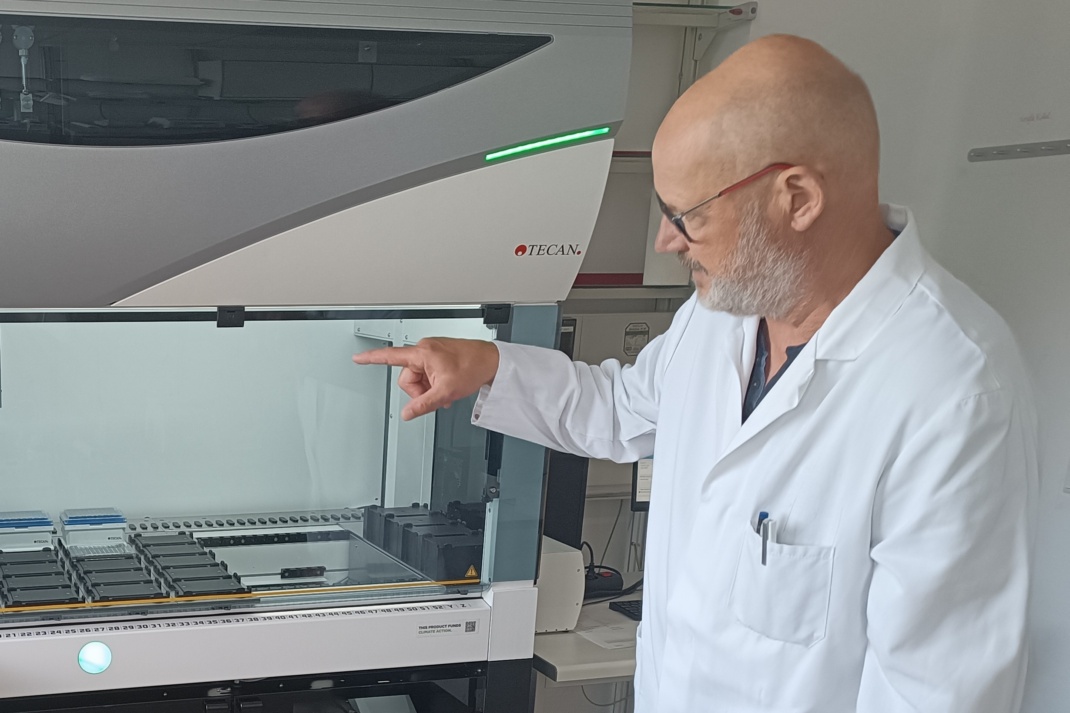
Mr Lachmann then showed us the Tecan fully automated analyser, which handles the entire workflow – from the blood plasma or serum sample right through to the result indicating whether the Alzheimer’s biomarker is elevated. This can be seen in the cover image.
Empfohlen auf LZ


So können Sie die Berichterstattung der Leipziger Zeitung unterstützen:




There is one comment