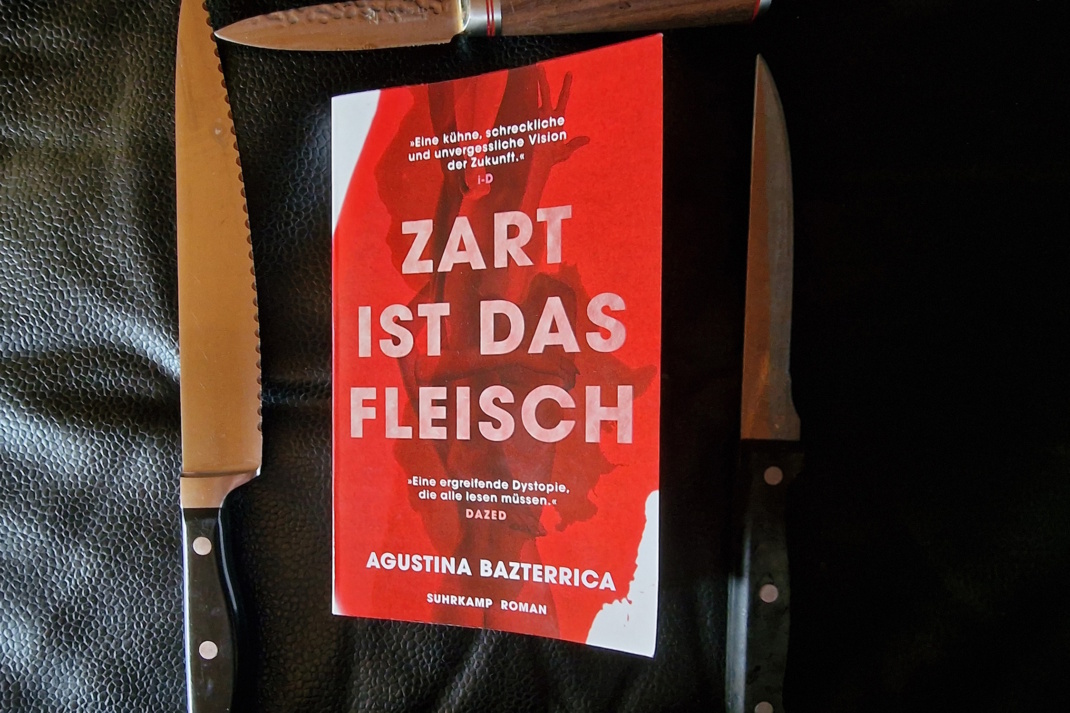
“Men are pigs,” Die Ärzte once sang. In the case of this novel, touted as a TikTok phenomenon, everyone gets a good roasting, regardless of gender. It’s a rancid roast, mind you, albeit rather prettily packaged in a cover with an elaborately designed texture.
Let’s take it in order: a South American country, sometime in the near future. An unspecified pandemic has led to the extinction of almost all animals; there are still a few left, but they are so rare that encountering one is considered a sensation, and none of them make it onto the menu anymore.
Because, at least in the author’s world, humans are greedy carnivores and overpopulation is a looming threat anyway, after a few teething problems, people have come to treat humans in exactly the same way as livestock.
In other words: they are fattened up, slaughtered and eaten. There are therefore farms, livestock transport, hunting grounds, abattoirs and tanneries where humans are reared, transported, killed, hunted, butchered and prepared for consumption. It is not clear from the text who separates the ‘humane’ livestock from those permitted to eat them, or where, how and when this takes place. And that is just one of the difficulties with the text.
A hero without qualities
The novel’s protagonist is a middle-management slaughterhouse worker, whose daily life the book recounts. He lost his child some time ago, is temporarily separated from his wife, and loves his father—who has since slipped into dementia—whose care in a care home he pays for.
This Marcos is a man with almost no distinguishing characteristics. For apart from the fact that he occasionally has sex with a freelance butcher amidst bloody limbs, still loves his wife in some way, and feels responsible for his father, we learn almost nothing about his inner life.
Ah yes, he despises his sister and her idyllic family life with a breadwinner and twin teenagers in the suburbs. Because a supplier of super-delicatessen meat tries to bribe him, one day a young woman ends up in his courtyard, whom he can slaughter, sell or fatten up further, just as he pleases. Merely sleeping with her or treating her as a human being would result in punishment and social ostracism.
New title for the paperback
Originally published in 2020 as a hardback by Suhrkamp under the title ‘Wie die Schweine’, the publisher has reissued the book following what appears to have been significant international attention on social media.
However, not under the original German title, but as “Zart ist das Fleisch” (“Tender is the Flesh”), a new translation of the title given to the book in its English translation. The fact that there is no mention of this whatsoever in the book can be shrugged off as either an oversight or a marketing ploy. One might, however, simply find it rather insincere.
The author, born in Buenos Aires in 1974, comes from a culture that is downright obsessed with meat consumption. It stands to reason that she would address the themes of livestock rearing and slaughter in a novel in order to poke fun at certain cultural phenomena typical of her country or the macho culture that still prevails in her homeland. To criticise her for that alone would be petty.
What one can certainly criticise her for, however, is that she has created characters without any rough edges, whose actions – and scant reflections – are driven solely by the desire to maximise the shock factor. This is reflected in the fact that the main and supporting characters are characterised as simply as possible: either merely as beautiful, old, slim, fat, or according to their ethnic background.
Literarily and psychologically, the characters in this book are about as exciting as watching wall paint gradually dry. There is, admittedly, a certain plot thread. Yet it is so transparent that, in a twisted sort of way, it is almost exciting to discover that the very plot twist you expected does indeed occur, just as expected.
As for the ‘shock factor’ that has been highlighted with such wide-eyed naivety in various reviews of the novel, one can certainly understand it for people who wanted to believe that steaks grow on supermarket chiller shelves. Everyone else – whom the reviewer assumes constitute the majority – will undoubtedly grow bored of it very quickly.
Especially as technologies and equipment from mass animal slaughter have apparently been adopted one-to-one for use on humans, which doesn’t seem plausible.
A satire that doesn’t work
‘The Meat Is Tender’ has been interpreted by readers and some critics as a satire on capitalism. After all, satire thrives on breaking taboos. And there are plenty of those in the text. But even the crudest social satire only works dramaturgically as long as readers can form some sort of emotional connection with the characters described in the text. The characters in this novel, however, are clichéd caricatures whose decisions and fates leave one cold.
Even Edward Lee, the American grandmaster of deliberately unsubtle horror bloodbaths, manages to give his characters more depth than the author has managed to do with her characters.
This reviewer advises readers: if you’re in the mood for a horror spectacle, reach for the literary original: Read Margaret Atwood’s *The Handmaid’s Tale*, read Angela Carter’s *The Dollmaker’s House* or *Bluebeard’s Room*, read Pavel Kohout’s magnificent satire on totalitarianism, *The Executioner*.
Those who prefer something more visceral and blood-soaked should take a look at the catalogue from Leipzig-based Festa-Verlag, the German-language go-to for horror in all its dark, red or colourfully iridescent variations.
Agustina Bazterrica, *Tender is the Flesh* , Suhrkamp, Berlin 2026, 12 euros.
Empfohlen auf LZ


So können Sie die Berichterstattung der Leipziger Zeitung unterstützen:





There is one comment