Dieser Artikel ist auch in deutscher Sprache verfügbar: Zum deutschen Artikel.
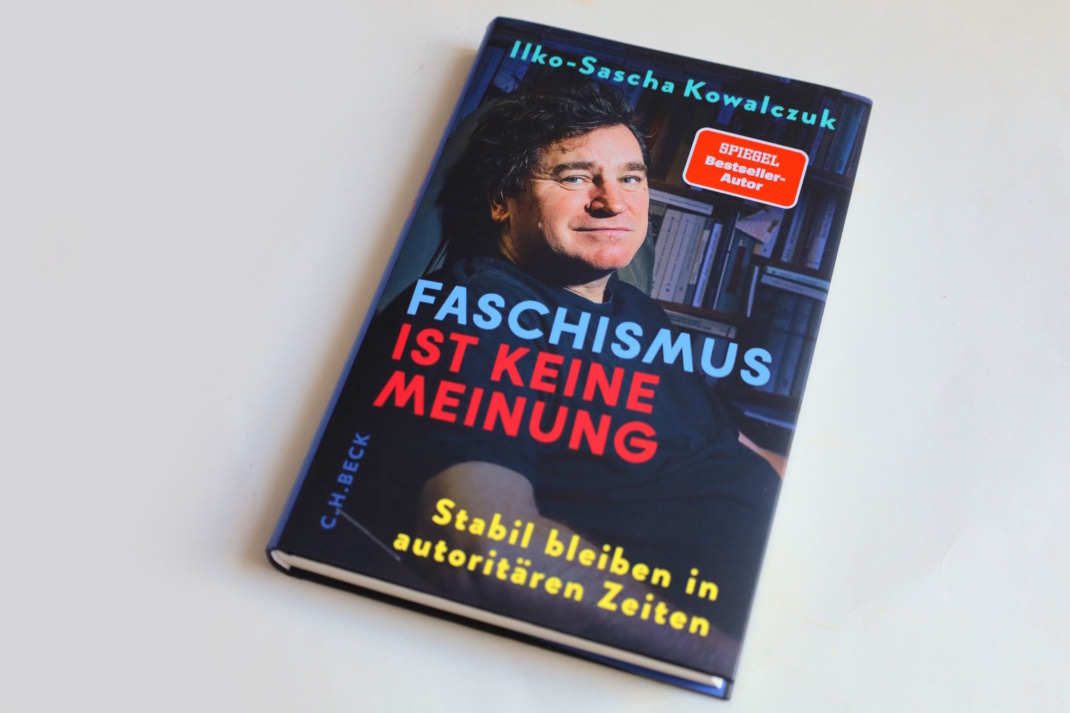
The present is always shaped by the past. All the more so when the past is romanticised as a paradise and a sense takes hold that our world is currently going down the drain. A sense of doom dominates social media. And many kitchen-table conversations. This also influences elections. For it is the far-right parties that stand to gain from this sense of doom. Not just in Germany or eastern Germany. There are reasons for this, which Ilko-Sascha Kowalczuk explores in his new book.
He knows that the past does not simply disappear when you vote out a government or an entire country. “The past is always a battlefield too,” he observes. And: “The longing for security leads many people to romanticise their own space, the only experience considered safe: the past.”
This applies not only to many East Germans. Or rather: “East Germans”, for there is no such thing as a homogeneous group of East Germans – only in the minds of West German commentators too lazy to analyse the situation, and in the slogans of a far-right party which, with its simplistic (and false) solutions, is currently threatening to win three East German elections.
A looming success fuelled by images of decline. And this is nothing new. This is how fascists have always stirred up support for themselves. The best-known example is Oswald Spengler’s book *The Decline of the West*. A book much discussed in the 1920s, published in two volumes in 1918 and 1922 – and which is practically unreadable today.
An ‘idealised past’?
But the underlying idea has long since found its way into the repertoire of modern fascists. Not just in Germany. They seem to be on the rise throughout the West. But Ilko-Sascha Kowalczuk is particularly concerned about people in the East, where the AfD’s election results were already high when people in the West still believed that such a thing wouldn’t happen there. But that is exactly what happened there in the last elections. Because, of course, there are people there too who are susceptible to the fear-mongering of the far right. After all, crises naturally cause fear. It doesn’t matter where you live.
And there are plenty of crises. The fact that they have been sat out and ignored for decades doesn’t make things any better. Not even when – as Kowalczuk points out – East Germans, too, belong to that 5 per cent of privileged people who, by global standards, live in prosperity. The figures bear this out.
But that’s simply not how political decisions work. Because, naturally, crises create a sense of helplessness. Just as – incidentally – does freedom. Which is why Kowalczuk wrote about the ‘shock of freedom’ in his latest book. This, too, is backed up by figures that he repeatedly puts on the table. For revolutions – including the Peaceful Revolution – are made by minorities. They set things in motion, shake up the status quo. But what about all those people who just stand by and watch? Who stand behind their curtains and wait to see what happens?
Who really only want one thing: to live their everyday lives undisturbed and unmolested? Often even glad when they don’t have to make any decisions, because others do that for them?
The Challenge of Freedom
Kowalczuk knows that these mindsets did not disappear with the GDR. On the contrary. They were even catered for further after 1990 – by ‘statesmen’ such as Kurt Biedenkopf, Bernhard Vogel and Manfred Stolpe, who convinced their voters that they needn’t worry about a thing, as their government would take care of everything. This worked a treat in the first ten years after the ‘Wende’ and led to massive electoral successes. It appealed to many people precisely at the point where freedom is actually demanding and challenging.
For that was what they had learnt and internalised: that one can live quite well in an authoritarian state where one simply hands over one’s responsibility. Others make the decisions. Others are – if things go wrong – to blame for everything.
And Kowalczuk notes, almost in astonishment: “Nobody noticed that, after 1990, the majority of East Germans continued to cultivate precisely this paternalistic understanding of the state.”
It quickly becomes apparent that his book is, in fact, a polemic with which he dismantles the fundamental self-perceptions of many East Germans and large sections of the political establishment. But it also exposes the vast blind spots in historical scholarship, which effectively refuses to engage more deeply with the GDR, SED rule and its psychological consequences. You won’t get anywhere with that, nor will you secure one of the coveted professorships in history. Not even at East German universities, as Kowalczuk points out.
He also criticises the latest books by Dirk Oschmann and Jana Hensel, because in many respects they re-emphasise the ‘East Germans’ role as victims and duplicate the conventional victim narratives. As if nothing had changed in the last 30 years. In fact, says Kowalczuk, everything has already been discussed to death. He also points out that a consensus on East German history has long since been reached.
Overwhelmed by the present
“The force with which Oschmann’s book sparked a political debate that irritated almost everyone was linked to the fact that most people had believed the debate had long since moved on.” A debate, says Kowalczuk, that had been conducted primarily by East Germans with other East Germans. That is true. And yet it is not quite true. For the reaction itself showed that this debate had by no means achieved the necessary broad impact.
And Kowalczuk points this out himself when he discusses the lack of research into GDR history in history departments. Research that should long since have examined the experiences of upheaval from 1990 onwards. For that, too, influences our view of the present day. The past does not disappear. It merely becomes a different place, one that people romanticise when they feel insecure in the present.
“Much has changed; some things too quickly, others far too slowly,” writes Kowalczuk. “People can only endure and cope with a certain amount of change within a given period of time. Being overwhelmed leads to discouragement, despair, anger and fear of loss. In the East, many have been overwhelmed since 1990. It was the non-material things that overwhelmed so many.”
And so many residents of the East began to romanticise their own past and their lives in the GDR. Incidentally, this is a process that is not unique to East Germany. The same can be seen in the American MAGA movement, in the Brexit campaigns and in all other right-wing populist movements in the West. Everywhere, populists paint pictures of a past that never actually existed.
And they find receptive minds that are only too willing to believe the fairy tales of decline in the present and to seek salvation in the past. In a fabricated past, it must be added.
A romanticised past
But this appeals to emotions. Very strong emotions. The past becomes an imagined place of security, tranquillity and peace. Unlike the present, with all its undeniable crises. And it is precisely this reservoir that populists can tap into with their slogans.
‘It was only when anger, frustration, disappointments not only failed to subside but were also passed on to the next generation, and anti-democratic political attitudes advanced into the heart of East German society, did it become clear to me, too, that the past we thought we had overcome had not gone away at all, but was still very much alive, wafting through all the subtexts of public discourse”, says Kowalczuk.
Well, the question remains: what can be done? What can be done to counter this obvious longing for an authoritarian state? Because the fact is: we don’t have to put up with this. What we fought for in 1989 is far too precious for that. Kowalczuk therefore prefaces his book with ‘Ten Principles’, which above all set the record straight regarding the mendacious narratives of right-wing populists.
For, contrary to what the grand orators in blue claim, we do not live “in a society of consensus, but in a society of compromise”. We do not all have to agree. Dissent is part of democracy. And conflicts and problems are resolved through compromise.
But that does, of course, require a willingness to compromise. And with it, a somewhat stronger sense of self-confidence. For one must wrestle with others to find solutions. This is – though Kowalczuk need not emphasise it at all – the not entirely straightforward realm of freedom. And freedom is what it’s all about.
It was the same in 1989. Kowalczuk recalls this in the appendix, where he describes his own journey to becoming one of the best-known and most critical historians from the East. He also discusses his time before 1989 and how he learnt to question the view of history that prevailed in the GDR at the time, to read the ‘classics’ – such as Marx himself – and to realise in the process that Karl Marx would probably have felt as though he were in the wrong film in the GDR.
False narratives
But it is also true that many of the false narratives taught to citizens of the GDR as early as school still resonate today and also distort the view of history held by many East Germans.
How does one actually put this right, when the GDR is now only dealt with in passing, even in school lessons? And when historians prefer to avoid the field of research because it brings no glory?
Good question. One that has become even more pressing since the Russian President ordered the invasion of Ukraine in 2022 and his German parrots are now spreading Russian narratives that are falling on particularly fertile ground in the East. Underpinned by a rather all-encompassing ignorance of Ukrainian history. Many East Germans still believe the Kremlin’s imperialist claims and confuse today’s Russia with the Soviet Union.
It stands to reason that Kowalczuk addresses precisely this in a separate chapter entitled ‘Decision in Ukraine’. In it, he also, of course, addresses the ignorance of Western politicians, who often negotiated with the potentate in the Kremlin in an even more naive manner.
Democracy under attack
This is actually a recurring theme throughout Kowalczuk’s book: that the East is by no means the sole ‘black sheep’ that everyone can now point the finger at, along the lines of: ‘You haven’t understood democracy.’ Which, in turn, fits into the old patterns of ‘othering’, but completely ignores the fact that the entire West now has the same problem. Fuelled by filthy-rich oligarchs for whom the democratic state, with all its rules of balance, has always been a thorn in the side.
Try keeping your head above water in that situation. And the courage to challenge false claims. Because, as Kowalczuk observes, we are neither defenceless nor helpless. Freedom, too, needs a strong backbone. ‘Freedom means getting involved in one’s own affairs, engaging in socio-political issues, and taking on social responsibility,’ is one of Kowalczuk’s guiding principles.
Nor is democracy the rule of the majority, which now dictates to minorities, even if that is what the authoritarian parties would have us believe. It also incorporates the “interests of the vulnerable, the marginalised and the minorities”. Not always in a good or reliable way. But fascism thrives precisely on trampling the interests of all these minorities underfoot. And the temptation to adopt this merciless way of thinking is always there, Kowalczuk observes at the end, where he also gives space to Wolfgang Mattheuer’s sculpture *Der Jahrhundertschritt* (*The Step of the Century*).
The sculpture stands in Leipzig directly in front of the Forum of Contemporary History, a reminder of how easily a society succumbs to the temptations of fists and boots and state irresponsibility if we do not resist the militant self-righteousness of the authoritarians.
Ilko-Sascha Kowalczuk, *Fascism Is Not an Opinion*, C. H. Beck, Munich 2026, 23 euros.
Empfohlen auf LZ


So können Sie die Berichterstattung der Leipziger Zeitung unterstützen:




There is one comment