Dieser Artikel ist auch in deutscher Sprache verfügbar: Zum deutschen Artikel.
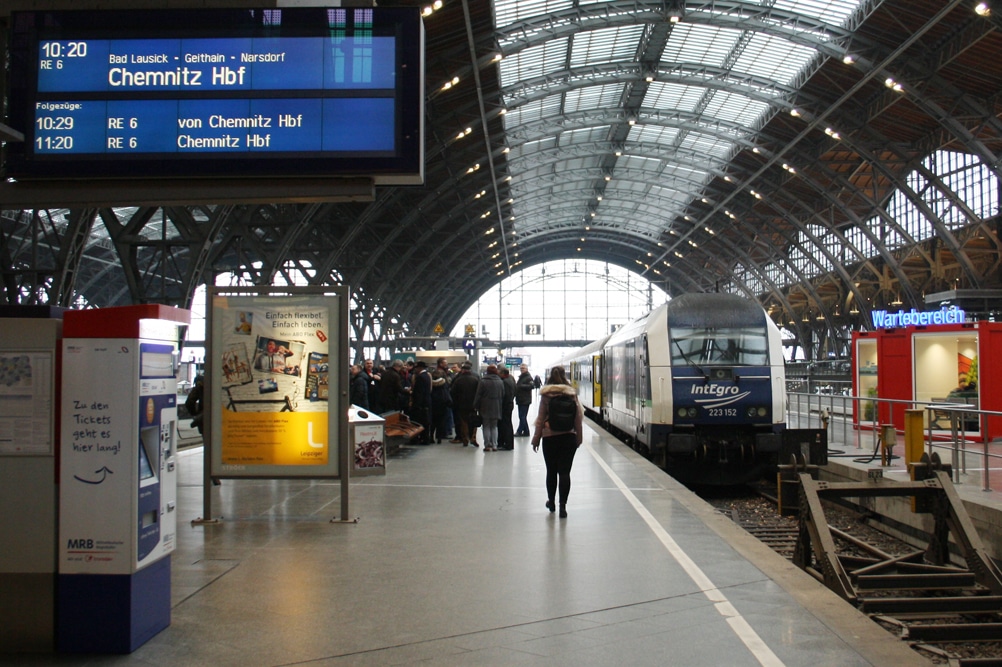
The situation regarding the expansion and electrification of the direct rail link between Leipzig and Chemnitz is a tragedy: for years, Deutsche Bahn, the federal government and the Free State of Saxony have dragged their feet on the project. Now the project has found itself in the midst of a period of radical cutbacks. And so the Saxon State Ministry for Infrastructure and Regional Development (SMIL) announced on Wednesday, 17 June: “The expansion of the northern section of the Chemnitz–Leipzig railway line is feasible within the existing budgetary framework. This is the key finding of the feasibility study initiated by the Free State of Saxony and commissioned by DB InfraGO AG.”
This feasibility study identifies a solution that is both effective and financially viable – with targeted double-track sections where they are required for service frequency, capacity and operational reliability.
The study had become necessary after a cost estimate from DB InfraGO AG in February 2026 for a fully double-track expansion, at 1.32 billion euros, was significantly above the allocated funding framework. Against this background, the parties involved had agreed to carry out a thorough assessment to identify an efficient and financially viable solution.
20 kilometres to remain single-track after all
Specifically, the study proposes upgrading around 24 of the total 44 kilometres of the northern section to double track. The study estimates the cost of this at around 531 million euros. According to the SMIL, this amount includes not only construction and planning costs but also indexation over the construction period, as well as a risk buffer of 30 per cent for unforeseen costs. The existing funding mechanism under the Investment Act for Coal-Mining Regions (InvKG) is to be used for the double-track upgrade.
The study estimates the cost of electrifying the line at around 149 million euros. This figure also includes, in addition to construction and planning costs, an adjustment for inflation over the construction period and a risk buffer of 30 per cent. This brings the total cost of the high-capacity upgrade, including electrification, to around 680 million euros. Funding for the electrification is to be secured through a grant under the Local Transport Financing Act (GVFG).
To secure full funding for the overall solution, the Free State is currently engaged in intensive consultations with the federal government, whose involvement is required for this purpose.
Hourly services to Chemnitz?
“We now have a solid basis in place for an operational concept that has gained the approval of both transport operators, ZVMS and ZVNL, and for the at least necessary double-track upgrade between Leipzig and Geithain,” explained Minister of State Regina Kraushaar on Wednesday. “We also have a plan for electrification: here, we will specifically seek funding via the GVFG.”
To ensure the line’s expansion remains within the existing budget, the second track is to be built specifically on those sections where trains need to pass each other and where additional infrastructure is required for a more frequent, stable service. According to the study, a second track is not strictly necessary on the remaining sections for the operational programme on which the study is based. Even with the adjusted scope of the upgrade, the half-hourly service for the RE 6 during peak hours between 6 am and 8 am and between 3 pm and 6 pm – as set out in the study – will be achieved. Outside these times, an hourly service is planned.
According to the SMIL, the results of the feasibility study are now to be incorporated into the next stages of planning. The Free State of Saxony is overseeing the project via a dedicated technical project support unit at departmental management level, which reports regularly to the State Secretary. At the same time, planning for the southern section is continuing. However, it will only be possible to make reliable statements regarding a timetable once the preliminary planning has been completed.
The Greens: The cost-cutting option is an admission of failure in transport policy
Criticism of the cost-cutting option presented came immediately from the Alliance 90/The Greens parliamentary group in the Saxon State Parliament.
“The results of the feasibility study that have been presented fall well short of what the Chemnitz–Leipzig railway line needs. 24 kilometres of double track instead of 44 will cement the bottleneck,” explained Katja Meier, transport policy spokesperson for the Greens parliamentary group in the Saxon State Parliament, on Wednesday.
“This is not a forward-looking expansion, but an admission of failure in transport policy. This vital rail link needs more capacity, greater reliability and a genuine prospect for growth. Instead, the double-track expansion is being scaled back and planned as a bare-bones programme: half-hourly services on regional routes only during peak hours, with hourly services at other times. Capacity utilisation is already at 140 per cent. Building now without a buffer will perpetuate today’s shortages for decades to come.”
The misrepresentation regarding long-distance services is particularly bitter, according to Meier. “Instead of a reliable two-hourly service, Chemnitz now faces the prospect of a sham long-distance service with just three trains a day. This is not a proper connection for a major city and a region with over a million inhabitants, but a token service that completely undermines the region’s legitimate expectations.”
The Greens are therefore calling on Saxony’s Minister-President to make the expansion a top priority and not to accept the option now presented as a final solution. The federal government must contribute to the increased costs. Furthermore, there needs to be scope for extending the project beyond 2038 so that important rail projects supporting structural change do not fail due to time constraints.
“Chemnitz doesn’t need empty promises, but an efficient, electrified and reliable rail link to Leipzig,” emphasises Katja Meier. “If the federal government is serious about structural change, it must not leave Saxony to cope with the increased costs on its own. And the state government must not be content merely to manage the shortfall as cheaply as possible. The aim must be an expansion that reliably supports the 30-minute interval service, creates capacity for additional services and finally opens up genuine long-distance transport prospects for Chemnitz.”
Empfohlen auf LZ


So können Sie die Berichterstattung der Leipziger Zeitung unterstützen:



There is one comment