Dieser Artikel ist auch in deutscher Sprache verfügbar: Zum deutschen Artikel.
If a federal state has a relatively well-developed, efficient public transport system, many of its residents generally do not need a private car. If, on top of that, one in three residents also lives in one of the major cities with efficient public transport, the demand falls further. It is therefore hardly surprising that Saxony, with 544 cars per 1,000 inhabitants as at 1 January 2026, was, as in the previous year, was around 8 per cent below the German national average of 593 cars per 1,000 inhabitants.
As reported by the State Statistical Office of the Free State of Saxony on the occasion of the update to the Regional Atlas of Germany, car density in Saxony rose slightly by 0.3 per cent compared with the previous year (542 cars per 1,000 inhabitants). However, this means that Saxony remains the largest federal state in terms of area with the lowest car density.
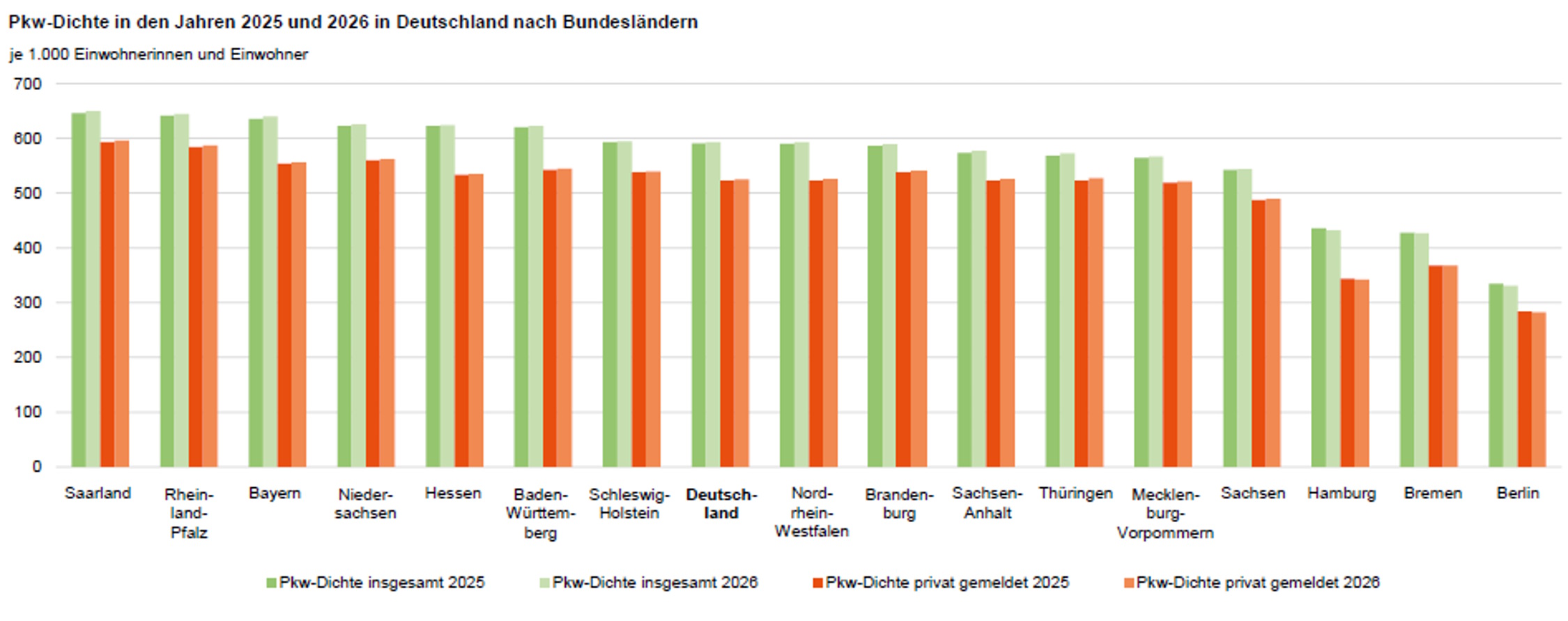
Car density by federal state. Graphic: Free State of Saxony, State Statistical Office
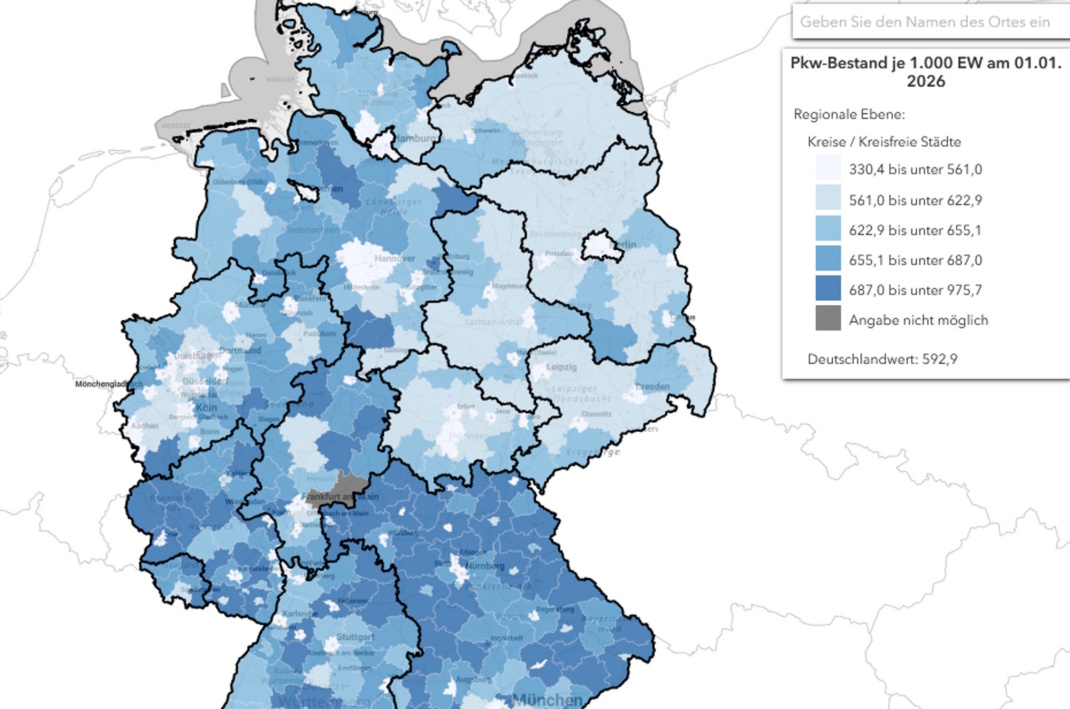
And Germans continue to buy cars. Districts in federal states such as Bavaria and Rhineland-Palatinate in particular stand out with a car density of over 700 vehicles per 1,000 inhabitants.
In a comparison of federal states, an increase in car density was recorded for all land-based federal states, according to Saxony’s statisticians, whilst the city-states of Berlin, Bremen and Hamburg recorded a decline. The highest car density in Germany was once again recorded in Saarland, at 649 cars per 1,000 inhabitants (2025: 646 cars per 1,000 inhabitants), and the lowest in Berlin, at 330 cars per 1,000 inhabitants (2025: 334 cars per 1,000 inhabitants).
A question of infrastructure
Which means that in large cities, significantly more people can manage without their own car. Not only because the public transport network is more extensive, but also because all essential amenities are usually to be found in the immediate neighbourhood – from doctors’ surgeries to supermarkets, nurseries and schools, right through to leisure facilities.
This means that car density also reveals a great deal about the presence or absence of infrastructure.
This also applies to Saxony.
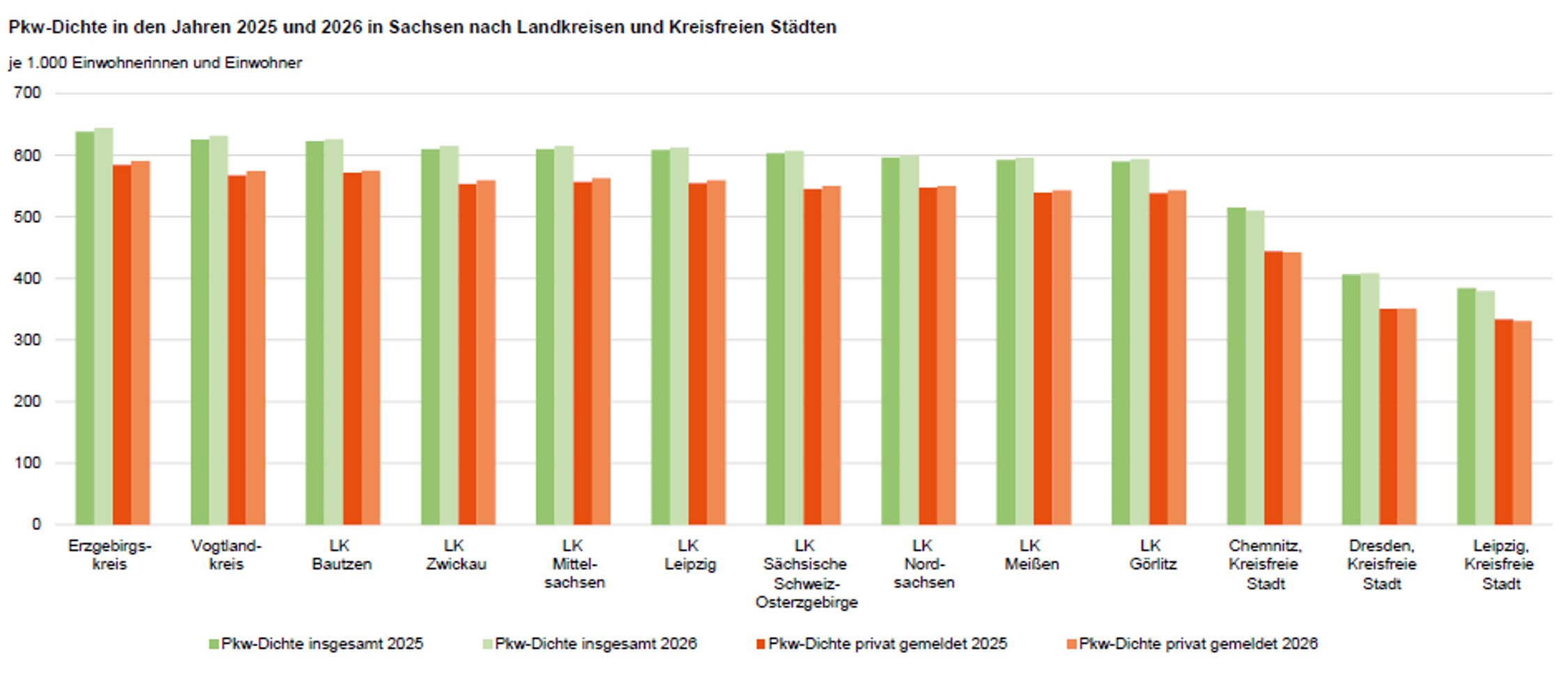
Car density by districts and independent towns in Saxony. Chart: Free State of Saxony, State Statistical Office
The picture for Saxony’s districts and independent towns was similar to that of the previous year. Once again, the Erzgebirgskreis had the highest car density on the reference date (644 cars per 1,000 inhabitants), followed by the Vogtlandkreis and the Bautzen district.
In the independent cities of Chemnitz and Dresden, however, the car density was significantly lower. The independent city of Leipzig recorded the lowest car density in Saxony – at 380 cars per 1,000 inhabitants – and the second-lowest among major cities in Germany after Berlin. Munich, for example, has 525 cars per 1,000 inhabitants, Frankfurt 457 and Cologne 489.
Compared with 2025, car density in the independent cities of Chemnitz and Leipzig has actually fallen slightly – by around 1 per cent in each case, according to the State Statistical Office.
For the first time, the number of privately registered cars was also compared as of the reference date. In this analysis too, the Erzgebirgskreis district had the highest car density in Saxony, at 590 cars per 1,000 inhabitants. The independent city of Leipzig also recorded the lowest car density in Saxony, with 331 privately registered cars per 1,000 inhabitants.
Further facts on car density can be found in map form in the Regional Atlas of Germany.
Empfohlen auf LZ


So können Sie die Berichterstattung der Leipziger Zeitung unterstützen:





There is one comment