Dieser Artikel ist auch in deutscher Sprache verfügbar: Zum deutschen Artikel.
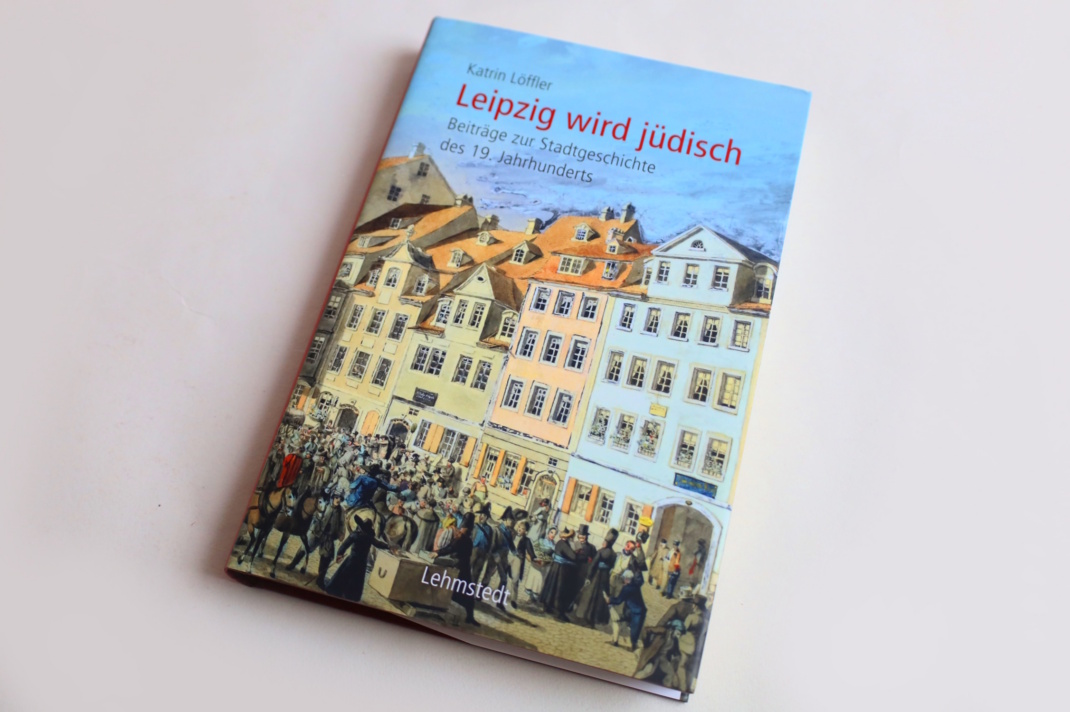
The book’s title is reminiscent of two other books published by Lehmstedt Verlag – *Leipzig wird braun* (Leipzig Turns Brown) from 2008 and *Leipzig wird rot* (Leipzig Turns Red) from 2011. But that is not quite the intention. Katrin Löffler’s book does not tell the story of a turning point in history. In her book, Leipzig does not change colour. But it is changing in a quiet way. For the 19th century was, after all, also a century of emancipation. And for Jews in particular, this meant that they were finally treated as equal citizens in many areas. This is a story that has not yet been told in this way for Leipzig.
The literary scholar and historian Katrin Löffler is currently the most prolific researcher in this field. In 2022, she published – also with Lehmstedt Verlag – her book on the oldest Jewish cemetery in Leipzig, in Johannistal, of which only a few traces remain today. But the history of this cemetery alone tells of the emancipation of the city’s Jewish inhabitants, the growth of the Jewish population and the emergence of a Jewish community of its own.
No such community existed before the 19th century – perhaps in the Middle Ages, although there is hardly any evidence of this early Jewish community and it disappeared again with the mass expulsions of that period. From the 18th century onwards, Jews were once again part of Leipzig’s cityscape – but primarily as ‘fair Jews’, who travelled to the major Leipzig fairs, mainly from Eastern Europe.
The Saxon settlement laws were strict. It was not until 1710 that Gerd Levi received permission from the Saxon Elector to settle in Leipzig. This was an exception, as the Elector needed people like Levi to raise funds.
The emergence of a Jewish community
Genuine civil rights for Jews only became a reality with the changes in the early 19th century. And Katrin Löffler uses the available archival records to describe how this then became evident in the life of the city, how the Leipzig community gradually grew and established its first burial ground at the cemetery in Johannistal.
At the same time, the number of fair-trading Jews increased significantly; without them, the influence of the Leipzig fairs, which extended as far as what is now Ukraine, would have been inconceivable. Not only did they ensure a substantial trade in goods – which certainly impressed Leipzig’s city fathers, leading them to take the wishes and petitions of the fair Jews very, very seriously—they also established the first synagogues – at that time still in private premises, before the large Central Synagogue on Centralstraße was built in 1855.
But Katrin Löffler, of course, explicitly poses one question: How did the Jewish citizens actually live in Leipzig at that time? What did they live on, and what professions did they pursue? This is a vast field and one that remains largely unexplored to this day. Löffler devotes an entire chapter, for example, to Jewish students, and another to private scholars. Jewish food stalls come into the picture, insofar as their existence is recorded in municipal records.
But even these records show how the Jewish minority became increasingly visible in Leipzig’s city life. One can only imagine the extent of research that will still be required here to capture the full picture, for the chapter on private scholars already shows that Jewish students, for good reasons, studied primarily law and medicine, as a career directly at the university was effectively barred to them until the end of the 19th century. These barriers and prejudices still existed. And from the 1880s onwards, they really ran riot in the form of ‘modern anti-Semitism’, to which Katrin Löffler naturally also devotes a chapter.
The reaction of the staunchly conservative middle classes
This was simply part and parcel of the fierce reaction of a staunchly conservative middle class, which not only perceived the increasing emancipation of the Jews as competition, but went so far as to construct conspiracy narratives whose pernicious effects are still felt today. One of the worst agitators when it came to anti-Semitism was active in Leipzig of all places: Theodor Fritsch (1852–1933), who from 1881 onwards systematically published anti-Semitic pamphlets.
The student body, too, became increasingly anti-Semitic. In the background, of course, were the economic crises in the wake of the Franco-Prussian War of 1870–1871, for which the incorrigible middle classes naturally sought someone to blame and found a scapegoat in the Jews.
Yet Jews formed a minority even within the economic middle classes – except in one sector: banking. As is well known, this has historical reasons, which are also linked to centuries of marginalization. This is a chapter still missing from Löffler’s book and one that probably requires a great deal of further research. For Leipzig, too, was increasingly shaped by Jewish entrepreneurs from the mid-19th century onwards – one need only think of Martin Samuel Koch, who founded the Kroch jr. banking house in 1877, commemorated to this day by the Kroch Hochhaus on Augustusplatz – as well as the Kroch housing estate in Gohlis.
Similarly, the world of Jewish artists remains to be explored. A number of authors, journalists and publishers are featured in Löffler’s book. They are representative examples, for naturally the full diversity of Jewish life is not reflected in the city’s records. As Löffler shows, some details can be found in Jewish periodicals of the time and widely read magazines such as the *Gartenlaube* and the *Illustrierte Zeitung* – including images of Jewish life in Leipzig.
A very special place: the Brühl
And Löffler ultimately brings this into sharp focus in a separate chapter devoted to the Brühl. For even before the 19th century, it was a key meeting place for Leipzig’s fair-going Jews, but in the 19th century it finally developed into the centre of the tobacco trade, with hundreds of businesses, most of which were Jewish-run.
There are numerous accounts of this very special part of Leipzig’s economy in travel guides, newspapers and even novels. Even Egon Erwin Kisch, who visited the Brühl in 1930, was still able to give a vivid account of this bustling marketplace right on the street. This was a scene that could be witnessed right up until the early 1930s, before the Nazis set about not only eradicating Jewish life in Leipzig, but also putting an end to the tobacco trade on the Brühl.
And that had consequences, as we all know, for after the war it was not only the Jewish community that was marginalised – the memory of the flourishing Jewish life in Leipzig up until the Nazis came to power was also almost wiped out. Whoever set about exploring the subject – one need only think of Bernd-Lutz Lange’s ambitious search for traces – had to start practically from scratch and could not draw on any relevant research at the university, as such research was virtually non-existent.
During the GDR era, the study of Jewish history was simply not part of the official canon of remembrance. And so the rich Jewish life of the 19th century has almost completely faded from view, often visible only in old archive records, or occasionally in journal articles.
A vast field of research
Katrin Löffler’s book gives a glimpse of what else might yet be unearthed with diligence, provided that relevant research projects are funded and that printing subsidies are available for the publication of the findings.
And the 19th century in particular would be an important field of research, precisely because Jewish emancipation coincided directly with the development of German national consciousness and the establishment of the German Empire, with the onset of capitalism in Saxony and the economic boom immediately following the founding of the Empire, in which the conflicts of the 20th and 21st centuries are already becoming visible – along with the destructive backlashes such as the emerging anti-Semitism that still smoulders in the background of conspiracy theories of all kinds to this day.
In her book, Katrin Löffler sketches a picture of a Leipzig that no longer exists in this form. It is a book that gives a sense of what has been lost. And of how, in particular, Jewish fellow citizens, who seized the emerging opportunities for emancipation, increasingly became part of official life in Leipzig. At times, this seems almost alien – as in the case of business ventures set up right in the fur traders’ quarter on the Brühl. For the most part, however, they had long since assimilated and were so integrated into city life that one must meticulously comb through files and periodicals to bring these figures of Jewish background to light.
In any case, the book serves as an introduction to a thoroughly formative chapter in Leipzig’s history, one that is only gradually coming to light (once more) through a steady stream of new pieces of the jigsaw.
Katrin Löffler, *Leipzig wird jüdisch* (Leipzig Becomes Jewish), Lehmstedt Verlag, Leipzig 2026, 25 euros.
Empfohlen auf LZ


So können Sie die Berichterstattung der Leipziger Zeitung unterstützen:




There is one comment