Dieser Artikel ist auch in deutscher Sprache verfügbar: Zum deutschen Artikel.
1918: Munich is in a state of emergency. The city is in turmoil. Violence is breaking out. Soldiers are shooting at one another. Kurt Eisner declares Bavaria a republic. The First World War has come to an end. It is revolution. History is being made. A note appears on the door of the poet Rainer Maria Rilke’s flat in Munich: ‘The poet Rilke’s home must not be looted – The Revolution’
It is unclear who, in the name of the revolution, forbade the looting of the poet’s modest household. We know only that the note was there thanks to Oskar Maria Graf, the man who later, from exile, urged the Nazis to go ahead and throw his books onto the pyres as well. No spoiler: the Nazis did him the favour.
Rilke did not live to see the rise of the German fascists. He died in Switzerland in 1926.
It is not easy to escape the usual biographers’ penchant for dramatic narrative, which portrays a life as a sequence of birth, childhood, education, early successes, relationships, gradual decline or new and even greater successes. Alois Prinz has succeeded in doing so.
Silenced by the war
He begins with Rilke’s years in Munich, when, as Prinz puts it, he ‘fell silent’ during the First World War. That is to say, apart from odd jobs, he wrote no major works, because the course of world events had thrown him so far off his poetic track. Taking this period as his starting point, Prinz explores Rilke’s youth and his relationships with publishers, the upper middle class, patrons and his marriage to the artist Clara Westhoff. Their marriage failed, just as (almost) every attempt by Rilke to settle down for any length of time had failed.
Alois Prinz, who achieved great success many years ago with a biography of Hannah Arendt, is one of the great biographers writing in the German language, who consistently succeeds in striking the right balance in his writing between anecdote, psychological insight and the spirit of the times. Stylistically, he is a cut above most of his rivals, who in this country tend either to adopt a professorial tone or to delve too deeply into speculative family history, thereby undermining their own credibility.
When the war finally caught up with the poet Rilke – who had originally been classified as unfit for service – his extensive network of influential friends saved him from the front line. Nevertheless, the poor man had to undergo basic military training. To which, however, he is driven in his recruit’s uniform in the Countess of Thurn and Taxis’s car. Although Prinz alludes to this only very subtly in his text, it is obvious how this was received by Rilke, with his simple, homespun cap.
An added irony: Rilke’s popular early work *The Ballad of Love and Death of Cornet Christoph Rilke* is harnessed to the propaganda machine of the Wilhelmine High Command and achieves unprecedented print runs. This delights the Leipzig publisher Kippenberger, but unsettles and annoys Rilke.
Driven by the desire to create one last great work, Rilke ploughed through the war years, convinced that the war, which lay like a shadow over the world, constituted a crime against culture and humanity. After a period during which he was apparently surprisingly content to fill blank pages with grid lines in a military administrative office, Rilke is discharged and finds himself caught up in the turmoil of the revolution.
For him, these go hand in hand with the turmoil of love. He is used to that. The revolution, however, demands even greater tolerance and strength of will from him, although he is increasingly open-minded towards it. Fortunately, Alois Prinz is honest enough to mention, in his assessment of Rilke, even his very early, rather dreadful poems. After all, even great poets don’t just fall from the sky.
Strong women
Almost as an afterthought, he manages, in his text of just under 300 pages, to paint sensitive portraits of the series of impressive women who shaped Rilke’s life. Among them, Lou Andreas-Salomé – with whom he remained connected, at times ‘above ground’ and at times ‘below ground’, for almost his entire life – and his wife Clara Westhoff are the most outstanding.
Before Rilke found himself in Switzerland following the bloody end of the Munich Soviet Republic, he bid farewell to Lou Andreas-Salomé: ‘But I am leaving, just as animals leave when the closed season is over.’
This book is a treasure trove of anecdotes and insights. Reading it is a great pleasure. The only criticism I can level at the book is that, in such a short and concise work, Alois Prinz goes into Rilke’s attitude towards religion in somewhat too much detail. But that is a complaint on a high level.
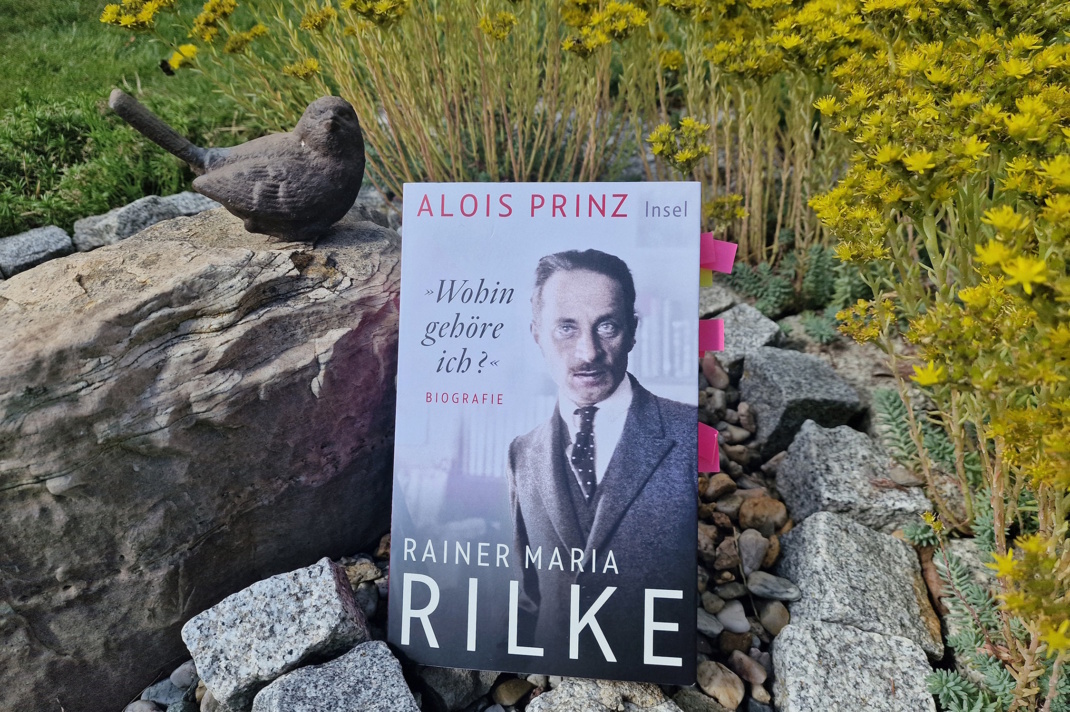
Alois Prinz, *Where Do I Belong?*, Insel Verlag, Berlin 2026, 20 euros.
Empfohlen auf LZ


So können Sie die Berichterstattung der Leipziger Zeitung unterstützen:





There is one comment