Dieser Artikel ist auch in deutscher Sprache verfügbar: Zum deutschen Artikel.
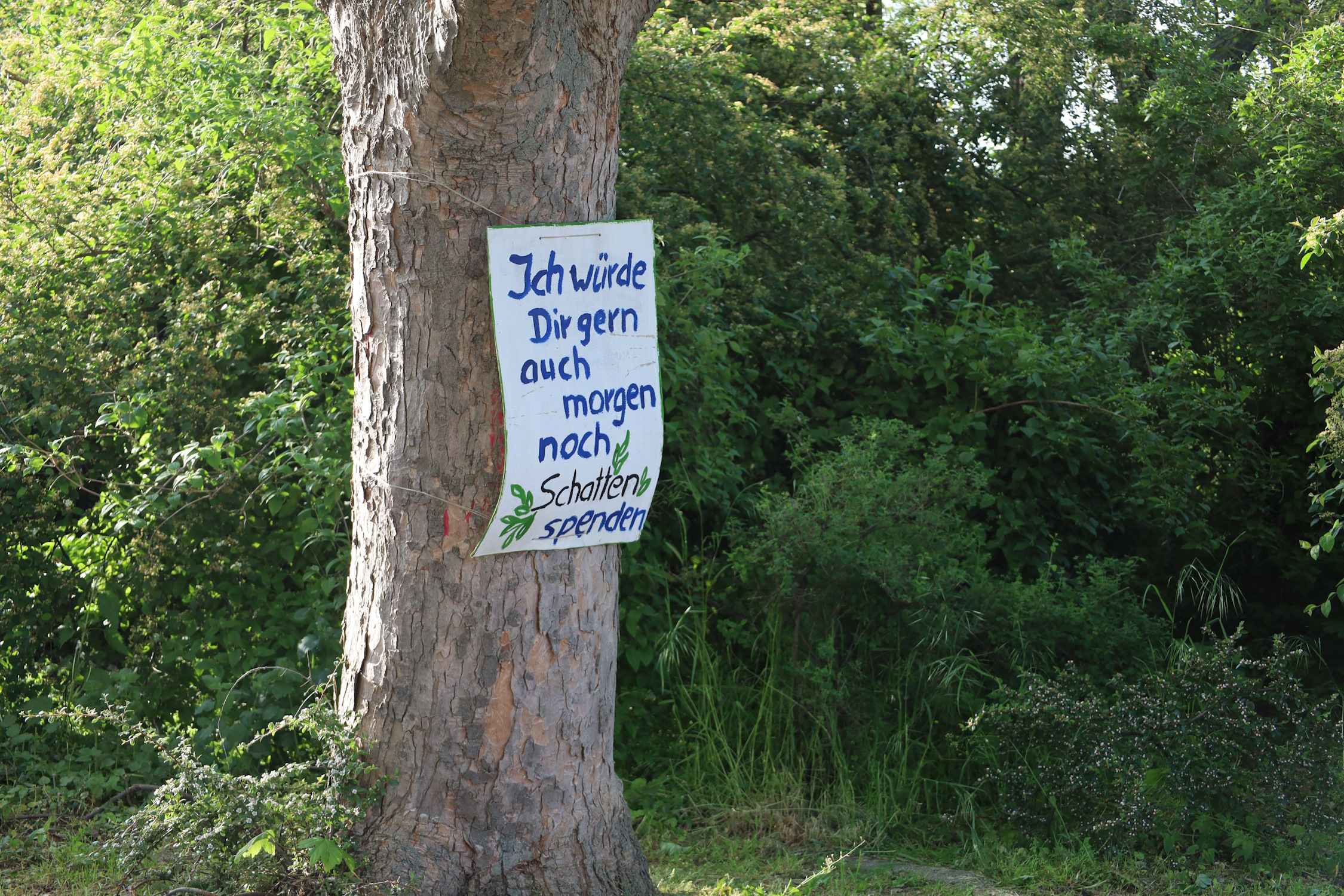
Fighting for two trees – is it worth it? Two 80-year-old maple trees on Wilhelm-Leuschner-Platz, right next to the Bowlingtreff, in front of the future Natural History Museum. All Leipzig residents experienced just how valuable the city’s natural green spaces are during the heatwave in June and July. The city needs green spaces. Far more green spaces than it has now. NABU Leipzig and the Stadtnatur initiative, in particular, campaigned for this at Wilhelm-Leuschner-Platz. And the Green Party parliamentary group took up an idea developed there: at the very least, the two old maple trees should be saved.
This is because the Forum Recht and the new Faculty of Law, which the Free State of Bavaria intends to build there, are set to be significantly smaller in future. The Free State is also running out of money, because German tax policy has been virtually clouded for three decades by a focus on cutting taxes for the rich, the wealthy and top earners. Money that is sorely lacking, above all, in the federal states and local authorities. So cuts and cancellations are being made.
The Greens felt that this could well be an opportunity for the trees on Leuschnerplatz, which the City of Leipzig had already unlawfully interfered with back in 2020.
“In its administrative response, the administration justified its rejection of the motion on the grounds that deviating from the building line would make it impossible to realise the planned layout for the Forum Recht and the Faculty of Law,” wrote the Greens in their revised motion, after the administration had rejected the proposal to save the trees with rather stubborn arguments.
The parliamentary group leader, Dr Tobias Peter, picked apart the arguments in his speech on 2 September at the council meeting. “In light of the tight budgetary situation at both federal and state level, it is becoming apparent that the space allocation plan for the Forum Recht will be significantly reduced, from 6,700 to 4,300 square metres.
It also remains unclear whether the Free State will be able to realise the law faculty to the extent originally planned. This could result in considerable scope overall to deviate from the building line whilst maintaining a high standard of architectural and urban planning quality. In any case, it must be ensured that the trees are not felled until construction work is imminent, so as not to create a fait accompli prematurely.”
The urban development strategy has been in place for 15 years
Yet he had not even mentioned the administration’s key argument. “Any adjustment to the building envelopes would interfere with the urban development strategy of the City of Leipzig, which has been in place for around 15 years and is enshrined in planning law. The plans for implementing the relevant spatial programmes in the northern development area, drawn up by the Forum Recht Foundation and the University of Leipzig, are based on the building envelopes defined in the legally binding local development plan; these have already been agreed upon in intensive and time-consuming processes with the Federal Government and the Free State of Saxony.
“The plots have already been sold as part of this process,” stated the Department of Building in its response. This essentially summed up just how resistant to advice the city’s senior administration had been from the very beginning. It has stubbornly pushed through its visions for the site – which was once the Markthallenviertel – as set out in its plans.
Not to mention any willingness to accommodate the nature conservation organisations, which – at the very least since the heatwaves of 2018 – have had sound arguments in favour of preserving the green space at Wilhelm-Leuschner-Platz.
The city’s position became even clearer in the following passage: “In future, the northern development site is to be used by two public institutions at federal and state level and for the creation of what is expected to be municipal housing. The residential component, with a floor area of approximately 8,000 m² (including a proportion of social housing eligible for subsidy of at least 30 per cent), has been restricted to the MK 1 development site in accordance with the council resolution.
The Federal Foundation Forum Recht wishes to construct a contemporary museum, education and performance centre on Wilhelm-Leuschner-Platz, whilst the Faculty of Law at the University of Leipzig plans to bring together all its faculty facilities – which have hitherto been scattered across various locations – at this central site. A jointly agreed space allocation plan has been drawn up for this purpose, with a requirement for approximately 31,000 m² of floor area.
This space allocation plan (see the SIB’s feasibility study of April 2022) could only be brought into line with the plot size specified in the development plan through the mutual exploitation of synergies and a number of compromise solutions agreed upon by both institutions. The decision to house the Forum Recht at the Wilhelm-Leuschner-Platz site in Leipzig is based on a resolution of the Bundestag (Parliamentary Paper 19/8263, resolution of 22 March 2019). In its resolution (VII-DS-01980) of June 2022, the Leipzig City Council endorsed the above-mentioned uses in agreement with the Free State of Saxony.
A reduction in the developable areas would mean that these public uses, which are of immense importance to both the City of Leipzig and the Free State of Saxony, could not be realised jointly at this site.”
Ökotopia
At least within the City Hall, there is a conviction that the loss of trees to the east of Wilhelm-Leuschner-Platz could be adequately compensated for on its western side: “As part of the impact and compensation assessment, the development plan provides for the planting of at least 38 new trees in the area of the future open spaces. With the implementation of the ‘Ökotopia’ green square design, the number of trees planted will increase significantly. A transformation of the vegetation will take place.
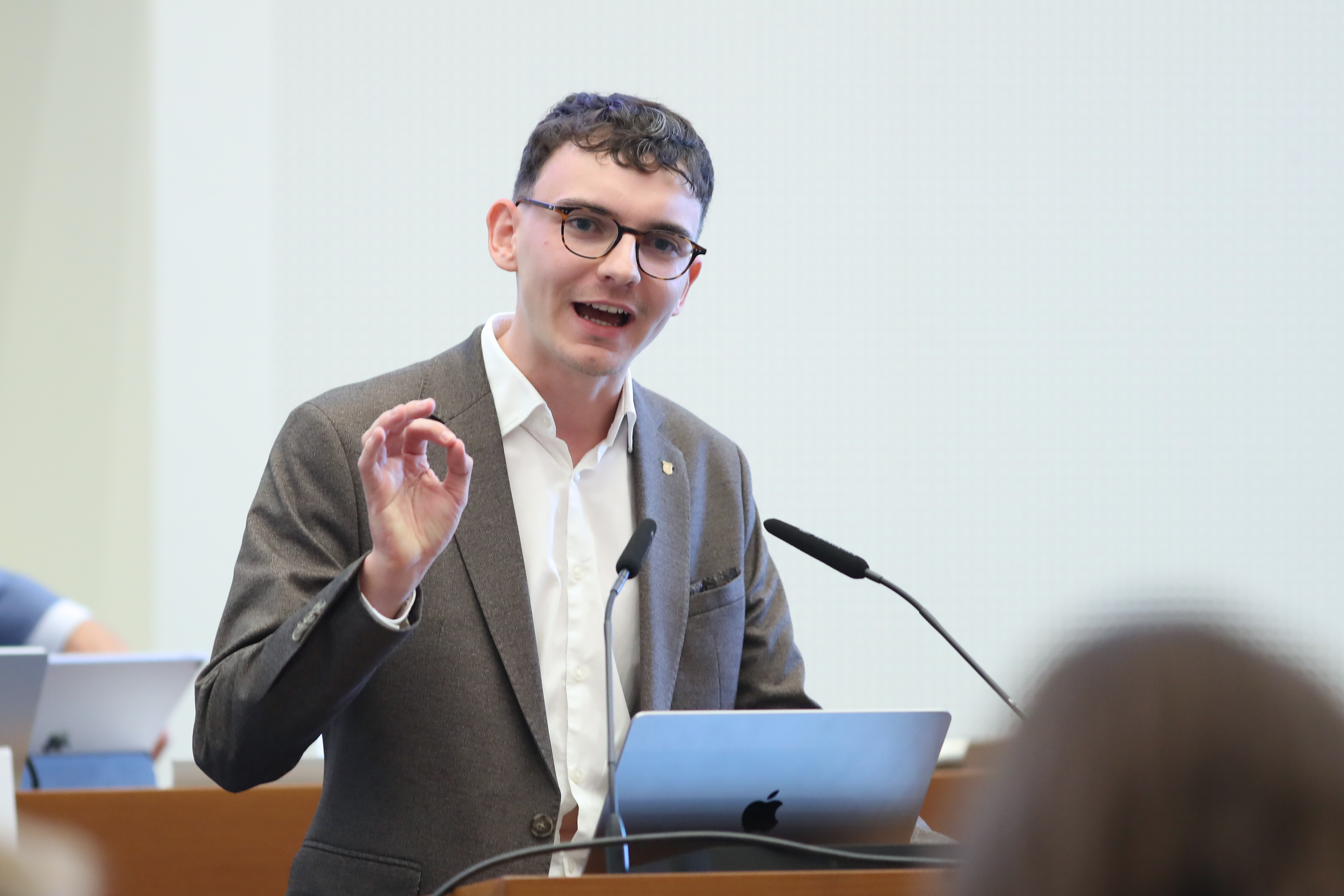
Marius Wittwer (SPD) in the Leipzig City Council on 2 September 2026. Photo: Jan Kaefer
Any restriction on the developability of the land resulting from the preservation of the trees would cause significant damage to trust on the part of stakeholders in the Free State and at federal level, as they, like the representatives of the City of Leipzig, assume that the land can be developed in accordance with the consultations held in recent years and in line with the statutory resolution on Development Plan No. 392 ‘Wilhelm-Leuschner-Platz’.
The Greens received support from the SPD parliamentary group. The latter proposed – should the trees indeed have to be removed – that consideration be given to a replacement at an early stage: “The Lord Mayor is instructed to examine whether, in the immediate vicinity of the current location, two trees suitable for the site can be planted as replacements, which do not require any adjustment to the building lines in the northern construction zone of Wilhelm-Leuschner-Platz.
When selecting these trees, consideration must also be given to whether, where possible, potted solitary trees can be used to quickly establish greenery and enhance the aesthetic and ecological quality of the square.”
The term ‘nursery-grown solitary trees’ in the speech by SPD city councillor Marius Wittwer caused a certain amount of amusement. But it was to no avail. Nor was the remark by city councillor Stefan Rieger that the idea of saving the maple trees had actually come from him.
On 2 September, the council majority voted 28 to 34 against the Greens’ motion. And in doing so, they also rejected the chance to actually preserve the trees directly in front of the new Natural History Museum for as long as their natural lifespan would allow.
Empfohlen auf LZ


So können Sie die Berichterstattung der Leipziger Zeitung unterstützen:





There is one comment