Dieser Artikel ist auch in deutscher Sprache verfügbar: Zum deutschen Artikel.
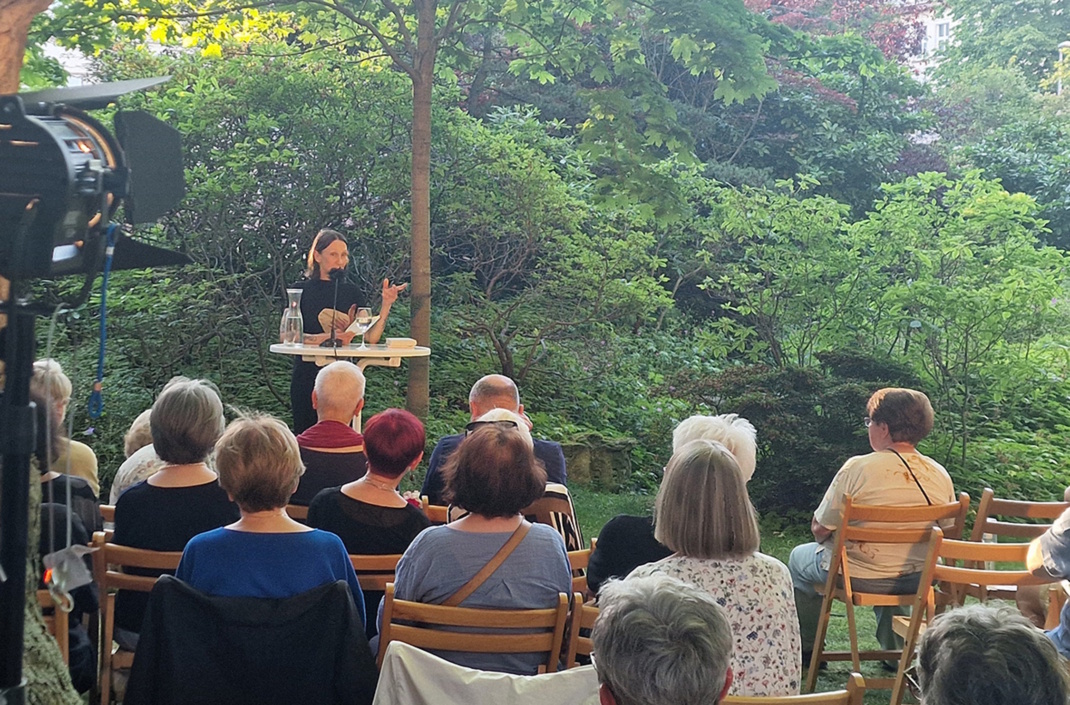
Last Friday, 19 June, insects were blown off the pages of books several times over in the garden of the Literaturhaus at the Haus des Buches. The air smelled of summer in the city, of sweat, perfume and the bratwurst stall. Every now and then, a tram rattled past in the distance or children bellowed. Outside, the city went about its usual evening routine, the beer gardens were filling up, and on the other side of the world, the Football World Cup was also taking place.
Here, however, a hundred or so people had gathered to listen to literature and celebrate an astonishing success – one that, whilst not exactly quiet, had not been blared from the headlines either, precisely because it was dedicated to art and artists.
Leipzig will retain its Literaturhaus, at least in the medium term. For after 30 years of successful work, its funding had been teetering dangerously since last year. Thanks to a skilful campaign by authors, supporters and the Kuratorium des Haus des Buches e.V. association, closure was averted. There was no shortage of prominent advocates. Motivating them to draw the public’s attention to the impending loss felt like a home game.
Nevertheless, it was by no means a foregone conclusion that artists and arts managers across the country would campaign to preserve a place where the quiet word and the edgy thought count for more than clamour or conformity. ‘Books are letters to unknown friends,’ the essayist, poet and great letter-writer Jean Paul once claimed. The man was a Romantic and may have exaggerated somewhat.
Nevertheless, on that hot Friday evening in Leipzig, one was inclined to believe that the word, freedom and the spirit still carry weight in an era of rapid and frightening change.
The deserted altars …
That evening, Giorgio Ferretti read about resilience on dreary Sunday afternoons, Martina Hefter evoked the (probably, at least in a poetic sense) healing sap of trees and stood in for her husband, the poet Jan Kuhlbrodt, who was unfortunately unwell; Linn Penelope Rieger weighed up the apocalyptic power of volcanoes against that of pandemics; Anja Kampmann reflected on the looming seas of blood of the Second World War, and Clemens Meyer read about a man who, in his cheap camouflage jacket, probably didn’t belong in the lobby of a luxury hotel in Karlsbad.
The band played cover versions of songs by Leonard Cohen and Rio Reiser. It was a cosy gathering. There was even the odd person dancing on the lawn.
‘The abandoned altars are inhabited by demons,’ commented the controversial anarchist and belated humanist Ernst Jünger, once describing his 20th century of wars and crumbling ideologies. Demons, as Jünger meant them, do not debate or ponder; they are self-sufficient in their dazzling horror. A small act of exorcism against such terrible blue or brown demonic powers was performed last Friday in the garden of the Literaturhaus Leipzig.
May those beautiful losers of the arts be able to continue keeping watch for a long time to come against the dreadful spirits that are currently charging from both the past and the future against the palaces of words and the walls of metaphors.
Empfohlen auf LZ


So können Sie die Berichterstattung der Leipziger Zeitung unterstützen:





There is one comment