Dieser Artikel ist auch in deutscher Sprache verfügbar: Zum deutschen Artikel.
Church buildings are a feature of many villages. They are known as landmarks, the centre of the village or points of reference. These places of worship hold great significance in terms of architecture, art history and regional history. This time, we are focusing on a church that narrowly escaped destruction due to the opencast lignite mining near Leipzig – the Kreuzkirche in Störmthal.
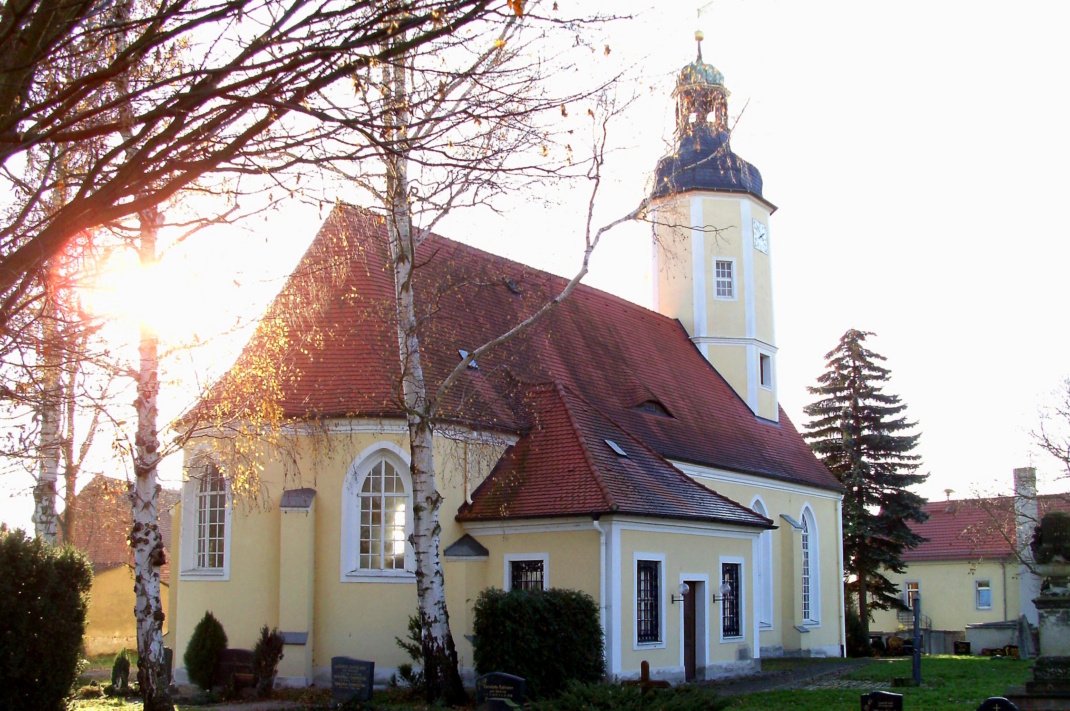
The Kreuzkirche in Störmthal is the Evangelical Lutheran church in Störmthal, a district of the municipality of Großpösna in the Leipzig district, south-east of Leipzig in Saxony. It is a listed building.
History
The originally Gothic hall church was probably built in the 15th century. It was rebuilt between 1667 and 1668. From 1690, the parish became independent: in that year, Statz Friedrich von Fullen (1638–1703), the owner of the Störmthal manor, succeeded in separating Störmthal from the parish of Magdeborn and establishing its own. This required the approval of the Electoral Court in Dresden as the highest authority. With the branch churches of Dreiskau and Kleinpötzschau, Störmthal became the mother church.
Statz Friedrich von Fullen’s son, Statz Hilmar von Fullen (1691–1751), had the church rebuilt and enlarged in 1722, whilst the south side of the nave was largely preserved; the following year, the organ by Zacharias Hildebrandt (1688–1757) was installed the following year. After 1990, the church underwent extensive renovation.
Architecture
The church is approximately 26.5 metres long and 9.5 metres wide. The building is rendered, with pointed-arch windows and stepped buttresses. The east end has a floor plan in the shape of an open trefoil arch.
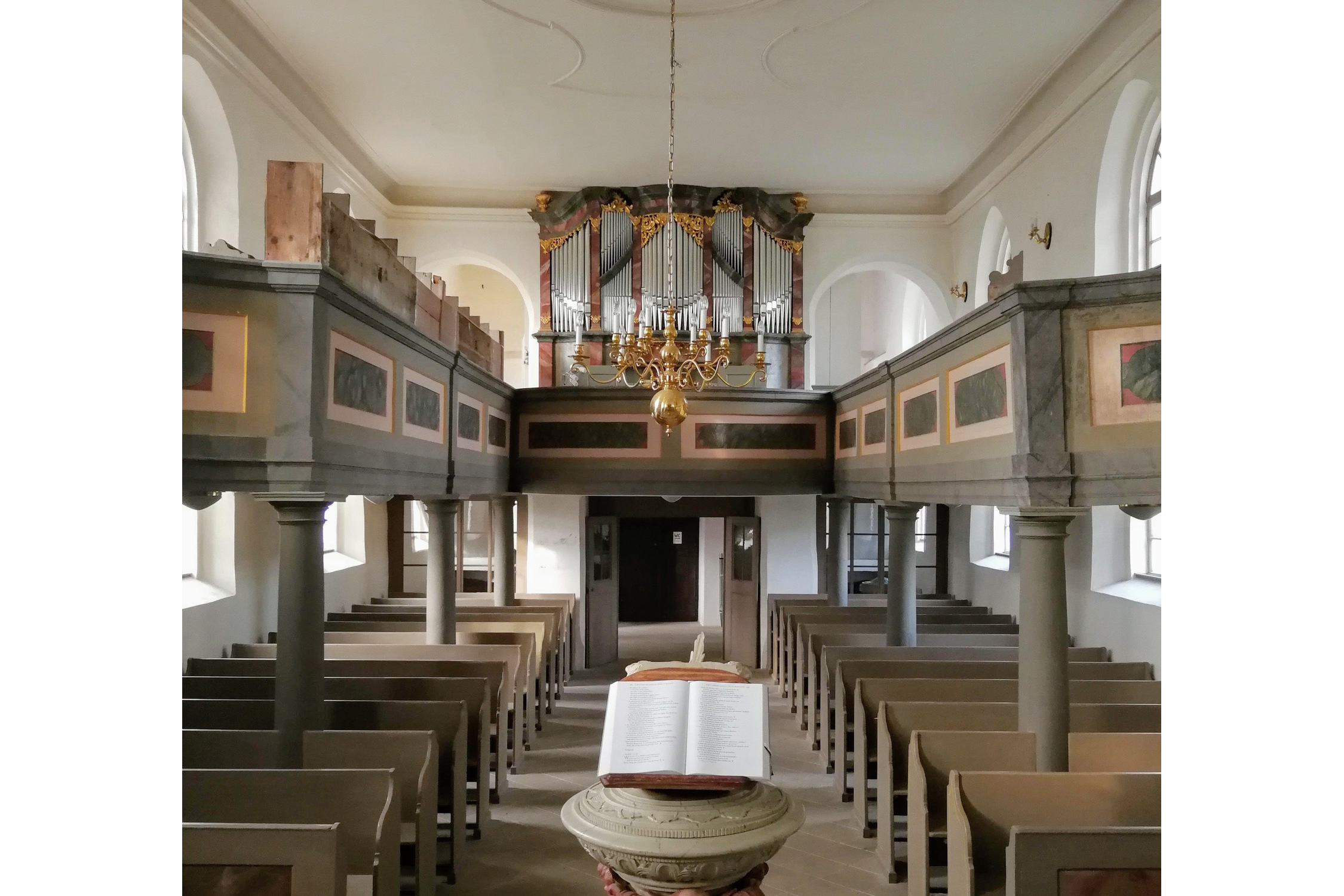
In contrast to the Gothic features of the nave, the octagonal tower, which is integrated into the building, is topped by a Baroque dome with a lantern. Adjoining the north side is a rectangular structure housing the sacristy and the patron’s box. The interior has a flat ceiling and the gallery runs around three sides.
Interior
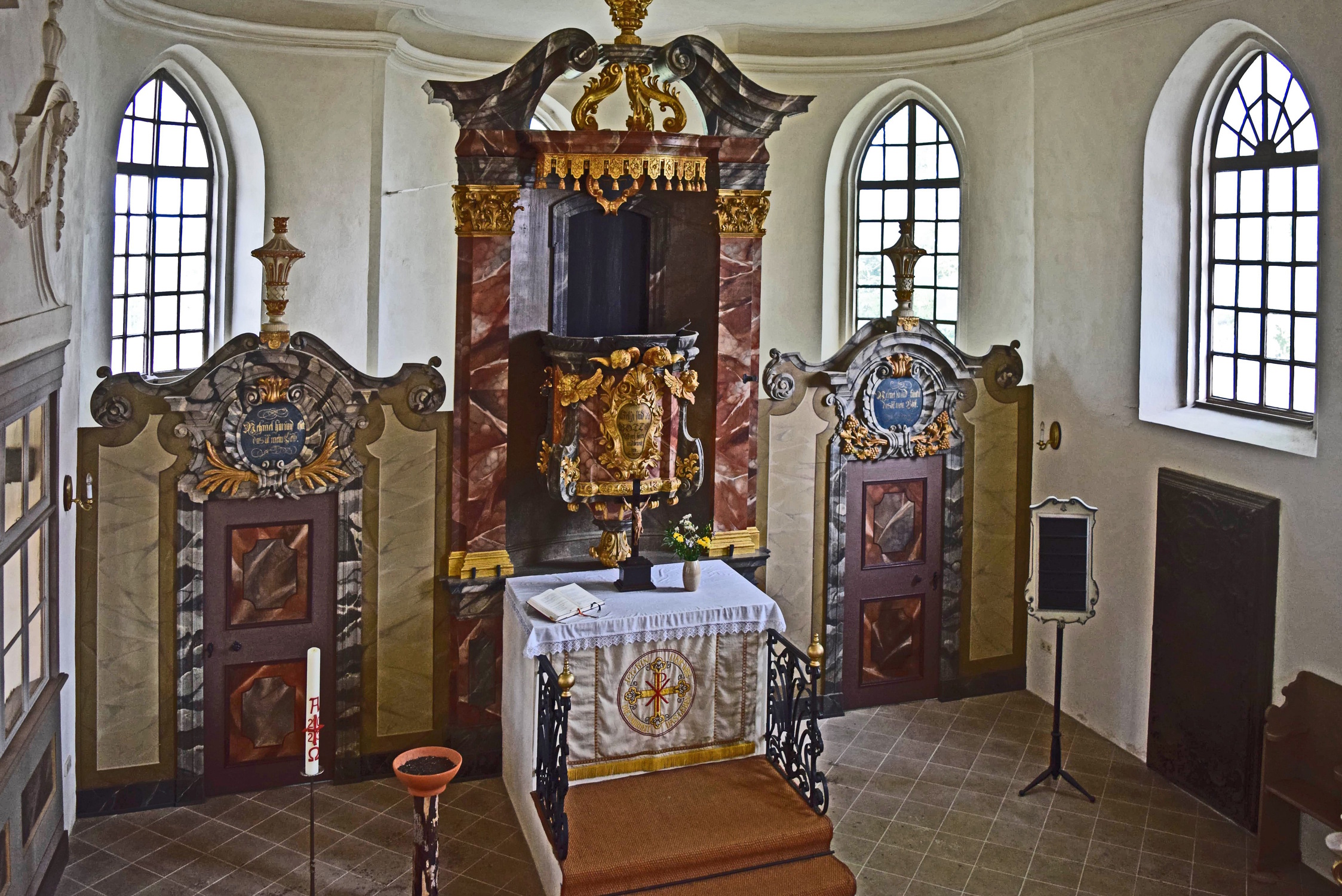
Störmthal was a prosperous village, as evidenced, for example, by the Baroque furnishings of the church dating from 1722. The pulpit-altar, partly finished in imitation marble, is richly decorated with carvings and cherubs. A golden cartouche on the pulpit bears the inscription: ‘Blessed are those who hear the word of God and keep it. Luke 14:28.’
The altar is flanked by two elaborately decorated doors, which formerly served the altar gallery associated with the reception of Holy Communion. The baptismal font, adorned with angel heads and fitted with a cover, can be used as a lectern.
The ground-level patron’s box displays the coats of arms of the former owners of the knightly estate: the von Fullen, von Kötteritz, von Watzdorf and von Schulenburg families. The galleries and pews are coordinated in colour and style.
The oldest feature is the crucifix with a life-size corpus carved from lime wood, which probably dates from the early 16th century and originates from the previous church in Störmthal, which was also known as the Kreuzkirche. Restoration was planned for 2014.
An epitaph from 1703 for Statz Friedrich von Fullen depicts him as an oil painting in a trophy frame, showing his dates of birth and death, titles and roles.
Organ
The church’s most notable feature, recognised far beyond the local area, is the Hildebrandt organ from 1723, commissioned by Hilmar Statz von Fullen. He initially asked Gottfried Silbermann (1683–1753) to build the organ. However, the church’s patron then turned to Silbermann’s master pupil, Zacharias Hildebrandt – presumably because Silbermann’s asking price was too high for him.
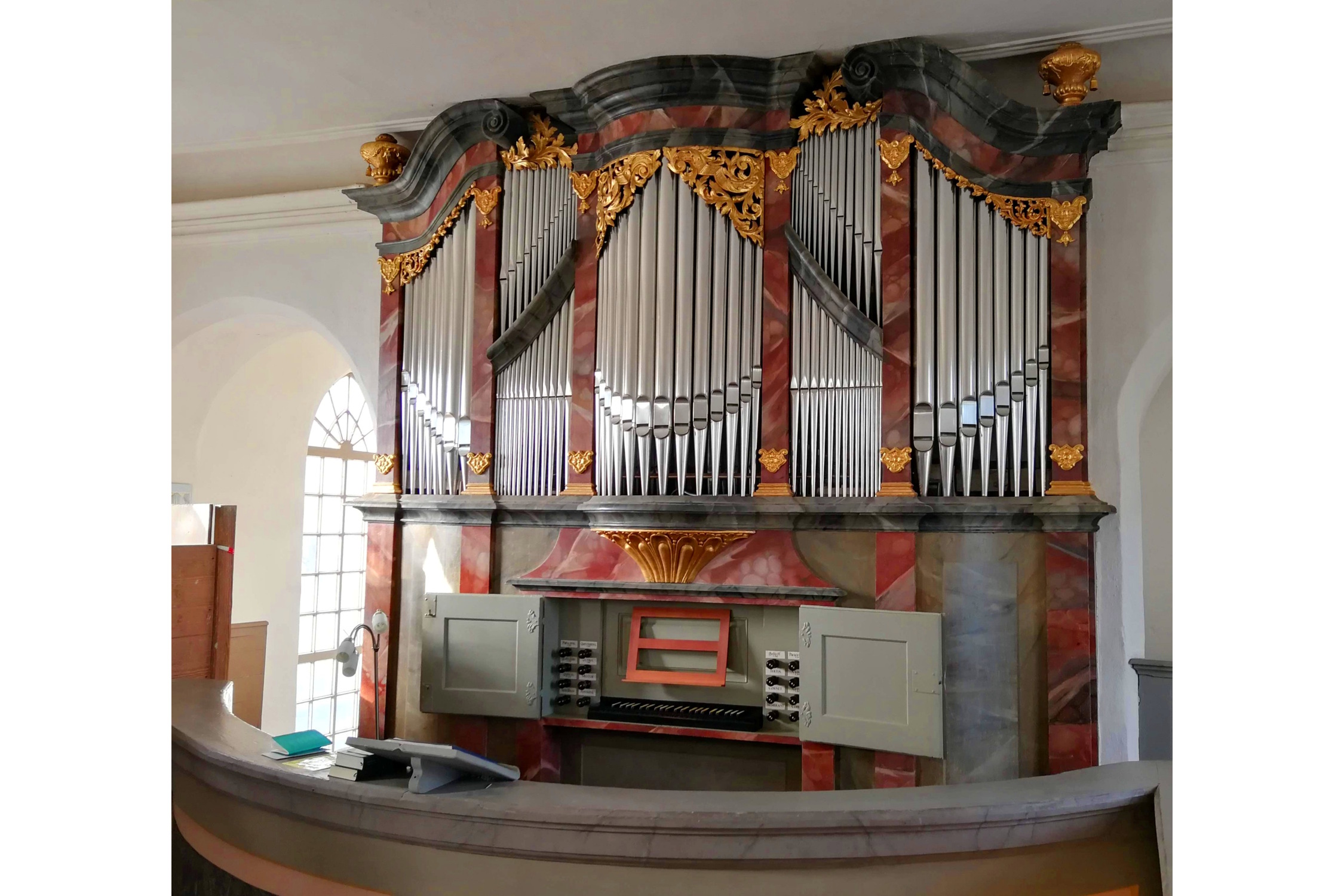
Organ. Subbass1, CC BY-SA 4.0, https://commons.wikimedia.org/w/index.php?curid=112423772
Hildebrandt made an offer of 400 talers, and the two reached an agreement. However, this subsequently led to a falling-out between Silbermann and Hildebrandt: both had agreed that Hildebrandt would require Silbermann’s consent for any organ-building project he intended to undertake in the Saxon region.
The instrument, with 14 stops on one manual and pedal, is one of the few organs played by Johann Sebastian Bach (1685–1750) that has been largely preserved in its original condition or restored to its original state. At its inauguration ‘on 2 November 1723’, Bach performed his cantata ‘Höchsterwünschtes Freudenfest’ (BWV 194), which he had composed especially for the occasion.
The single-manual instrument with pedal was restored in 2008 and has been returned to its 1723 stop configuration.
Parish
The church building, together with the churches in Probstheida, Güldengossa and Wachau, belongs to the Evangelical Lutheran parish in the south-east of Leipzig.
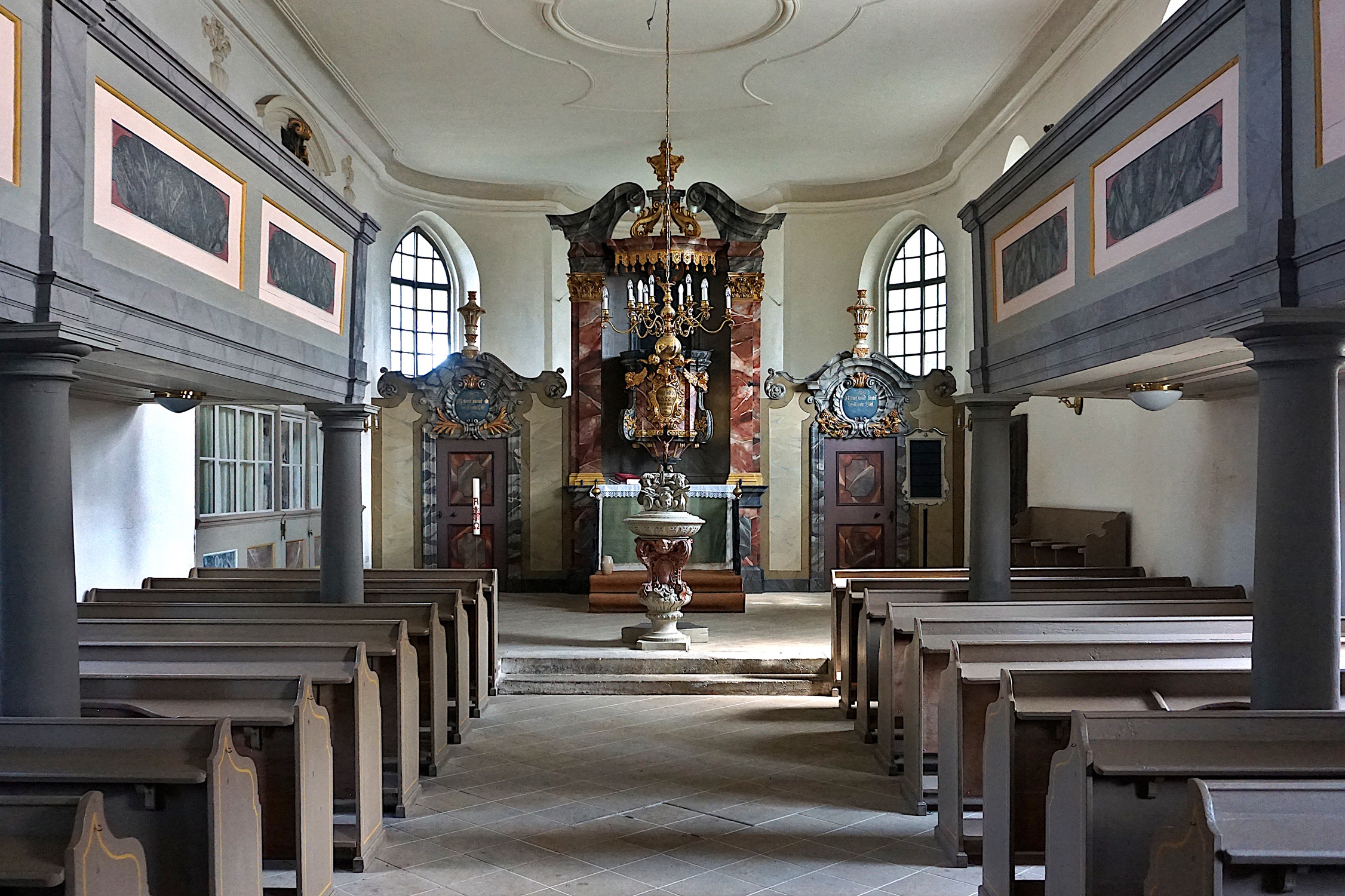
View into the nave. Gliwi, CC BY-SA 4.0, https://commons.wikimedia.org/w/index.php?curid=174005279
Miscellaneous
– Friedrich Naumann (1860–1919), after whom the Friedrich Naumann Foundation for Freedom is named, was born on 25 March 1860 in the Störmthal vicarage as the eldest son of the local vicar and was baptised in the church on 11 April 1860. He spent his early childhood there. A small exhibition in the annexe to the vicarage offers an insight into the life’s work of this vicar, theologian, liberal politician and member of parliament.
– To mark the Leipzig Bach Festival in 2026, MDR Kultur and Deutschlandfunk broadcast the Protestant service from the Kreuzkirche in Störmthal on 21 June 2026, thereby drawing national attention to this place of worship.
– In the early 1980s, plans were made to close the village – and with it, the church: the GDR Ministry of Energy had decided to level Störmthal and other villages to make way for the expansion of the Espenhain opencast lignite mine. A building ban was imposed, and the village fell into disrepair before our very eyes. The Peaceful Revolution in the GDR brought an end to these plans, and Störmthal escaped devastation. The village came back to life, and many farms and the church have since been restored. The open-cast mining pit near Störmthal was flooded and is now known as Lake Störmthal.
Coordinates: 51° 14′ 51″ N, 12° 28′ 17.9″ E
The Störmthal Cross Church on Wikipedia: https://de.wikipedia.org/wiki/Kreuzkirche_(Störmthal)
The Evangelical Lutheran Parish of Probstheida-Störmthal-Wacha: https://www.kirchenquartett.de
Empfohlen auf LZ


So können Sie die Berichterstattung der Leipziger Zeitung unterstützen:



There is one comment