Dieser Artikel ist auch in deutscher Sprache verfügbar: Zum deutschen Artikel.
Church buildings are a feature of many villages. They are recognised as landmarks, the centre of the village or points of reference. These places of worship are of great significance in terms of architecture, art history and regional history. Some churches are now used for other purposes. This is also the case with a Catholic church in Großkayna, a district of Braunsbedra, in the Saale district of Saxony-Anhalt.
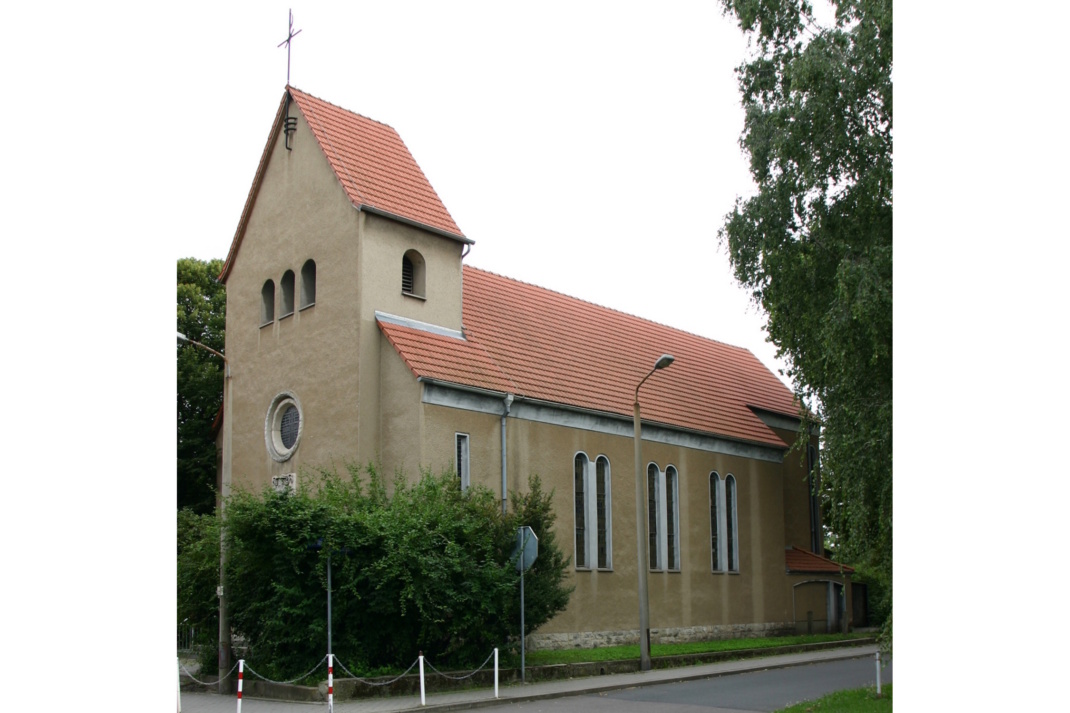
The Church of the Three Kings in Großkayna, built in 1935, was the Catholic church in Großkayna, a district of Braunsbedra, in the Saale district of Saxony-Anhalt. The church, named after the Three Kings, most recently belonged to the parish of St Norbert, based in Merseburg in the Merseburg deanery of the Diocese of Magdeburg. The church is listed as a historic monument in the Saxony-Anhalt Register of Monuments under registration number 094 20746.
History
In the 1920s, Großkayna grew considerably as a result of the construction of housing estates by the mining and energy companies. In 1920, Elektrizitätswerk Sachsen-Anhalt AG had built a power station in Großkayna, and lignite had been mined in an opencast mine near Großkayna since as early as 1906. At the end of 1910, Großkayna still had 857 inhabitants; by 1933, the population had risen to 3,572.
The Catholics in Großkayna initially belonged to the parish of Weißenfels. Catholic services were held in a Protestant church until Christmas 1924. After that, the venues for services changed several times: first from the Ohm inn in April 1925 to a room provided by Elektrizitätswerk Sachsen-Anhalt AG.
On 6 April 1930, a makeshift chapel set up in a solid barrack belonging to Elektrizitätswerk Sachsen-Anhalt AG came into use. When a glassworks became the new owner of the land on which the chapel stood, the chapel had to be abandoned again in mid-October 1931.
From 20 November 1931, a new chapel, which had been set up in the canteen of the Michel-Vesta trade union, became the new home for the local Catholics. In mid-1935, a branch (parish) vicariate belonging to Weißenfels was established in Großkayna. Vicar Franz Külpmann became its first chaplain; he remained in Großkayna until 1939.
In 1931, the local trade union had donated a building plot on Teichstraße to the Catholics of Großkayna for the construction of a church. However, when it transpired that this site lay above a coal-bearing layer of earth, the current church site was made available on 8 June 1934.
Plans by the architect Wilhelm Ulrich from Halle (Saale) were not implemented; instead, construction of the church began on 4 June 1935 according to plans by Johannes Reuter from Bitterfeld.
The foundation stone was laid on 23 June 1935, and on 22 September 1935 the church was consecrated by Caspar Klein, Archbishop of the Archdiocese of Paderborn, to which Großkayna belonged at the time. In 1939, around 650 of Großkayna’s 3,620 inhabitants were Catholic.
During the Second World War, on 30 November 1944, the church was severely damaged by bombs and the vicarage was completely destroyed; Josef Immekus, curate of Großkayna from 1939 to 1949, was forced to move into a flat in the village. Reconstruction began in October 1945.
Owing to the flight and expulsion of Germans from Central and Eastern Europe between 1945 and 1950, the number of Catholics in Großkayna continued to rise. By 1948, almost 3,000 Catholics belonged to the Großkayna vicariate.
On 1 October 1950, the branch parish of Großkayna was elevated to an independent parish, with Johannes Bindig becoming its first parish priest.
As parts of Großkayna had to make way for lignite mining in the 1960s, the population of Großkayna fell considerably. In 1972, the Großkayna and Kayna-Süd opencast mines, as well as the Großkayna power station, were decommissioned.
Architecture and interior
The church building and the vicarage, attached at right angles to it, stand on the plot at Grüne Straße 1, on the corner with Nordstraße. The church building was constructed to designs by the architect Johannes Reuter from Bitterfeld.
The church is a simple hall church with a recessed tower. Above the entrance portal is a so-called ‘ox’s eye’ – a small, oval window – and beneath it the coat of arms of Archbishop Caspar Klein, who consecrated the church. On the occasion of his 70th birthday in 1935, he organised a collection for the church; the church’s patronage is named after his first name.
The mural on the rear wall of the chancel depicts Jesus Christ in the arms of Mary, with the adoring Three Kings in the foreground.
In addition to the high altar, on which the tabernacle stood, a people’s altar was installed in the chancel following the liturgical reform of the Second Vatican Council.
Recent history and the present day
On 8 July 1994, the Diocese of Magdeburg was established, to which Großkayna has belonged ever since. From 1996, the Geiseltal parishes of Großkayna, Mücheln and Braunsbedra/Neumark formed a pastoral unit, with their parish priest based in Braunsbedra.
On 1 September 2007, the parish association comprising Merseburg – Bad Dürrenberg – Leuna – Großkayna – Schkopau – Braunsbedra/Neumark – Bad Lauchstädt – Langeneichstädt – Mücheln was established. At that time, the parish of Großkayna still had around 110 Catholic parishioners. On 20 August 2009, the last service was held in the church, followed by its deconsecration.
The church building was auctioned off in 2013; and has since been used by the Centre for Circus and Active Learning e.V. from Halle (Saale), under the name ‘Geiseltal Sports and Circus Church’, as a group, training and event venue for school trips, seminars, rehearsals and cultural events. The former vicarage has a large self-catering kitchen and also offers 34 beds across six rooms for overnight stays. The former church building can be hired for private events.
Coordinates:
51° 17′ 32.4″ N, 11° 55′ 53.6″ E
The Großkayna Church on Wikipedia:
https://de.wikipedia.org/wiki/Hl._Drei_Könige_(Großkayna)
Zirkus Klatschmohn:
zirkusklatschmohn.de
Großkayna Circus Church:
www.zirkuskirche.de
Empfohlen auf LZ


So können Sie die Berichterstattung der Leipziger Zeitung unterstützen:




There is one comment