Dieser Artikel ist auch in deutscher Sprache verfügbar: Zum deutschen Artikel.
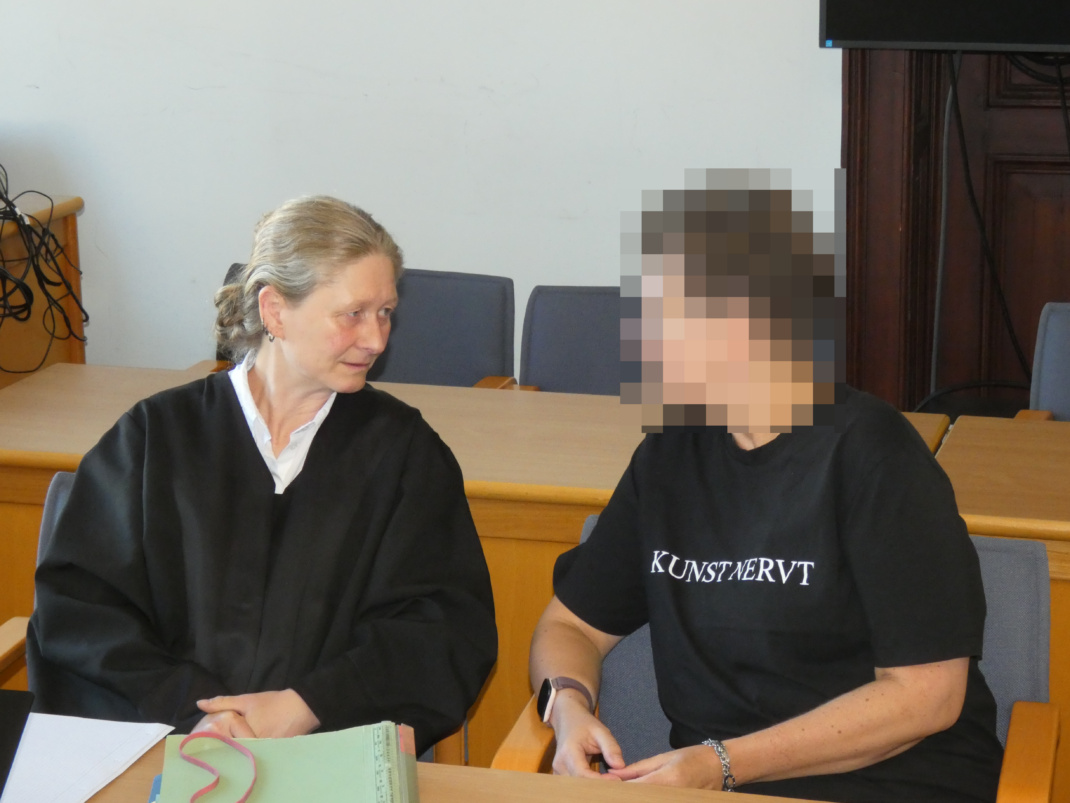
As the reasons for the judgement were read out, Ines F. struggled to contain her emotions: almost seven years after the last of two brutal attacks attributed to the far-left extremist scene, the Regional Court acquitted the accountant, thereby overturning a first-instance ruling. The court found that there was no conclusive evidence that the defendant had disclosed sensitive personal data, thereby facilitating the violent offences.
Shortly after 1.00 pm on Tuesday, the presiding judge, Johann Jagenlauf, announced the verdict: Ines F. is acquitted of the charge of aiding and abetting grievous bodily harm in two cases, one of which was in conjunction with trespass. The 18-month suspended prison sentence that the Magistrates’ Court had imposed on the 56-year-old in February is therefore null and void.
 Brutal attacks and suspicions surrounding the ‘Hammer Gang’
The mother of two had been back in court since 8 September because she and the public prosecutor’s office had lodged an appeal against the verdict of the Leipzig Magistrates’ Court. The court had found Ines F. guilty of using her access to the register of residents – whilst working in the debt collection department at Magdeburg University Hospital – to pass on address details to left-wing extremists.
On 30 October 2018, the neo-Nazi Cedric S. (aged 20 at the time) was beaten up and seriously injured by a group of people whilst on his way to a sports session near his home in Wurzner. A year later, on 3 November 2019, a property agent in north-west Leipzig fell victim to attackers to whom she unsuspectingly opened her flat door; they then punched the then 34-year-old repeatedly. In both cases, the identity of the attackers remains unknown to this day, although investigators identified grounds for suspicion regarding the ‘Hammerbande’ gang led by Lina E.
Prosecution upheld the initial verdict
The prosecution alleged that Ines F., who was entrusted with tracing debtors’ addresses for debt collection proceedings on behalf of Magdeburg University Hospital, abused her exclusive access to databases to obtain and pass on the addresses of both victims.
At the conclusion of the appeal hearing on Tuesday, prosecutor Sandra Daute argued that the defendant could and should have anticipated that violent attacks might occur. She stated that case law does not require her to have been directly involved in the offences for a conviction: it is sufficient that she accepted the possibility of violence. Ines F.’s involvement in the left-wing scene, the database enquiries and data collections she was found to have made that were unrelated to her work, and the attacks: the overall picture emerging from the evidence presented suggests this was no coincidence.
The defence saw no evidence
Defence lawyer Rita Belter took a different view: she agreed with the prosecution only that Cedric S. and the authorised signatory had indeed been victims of brutal attacks. Nevertheless, she argued that the neo-Nazi Cedric S., who was also involved in the large-scale attack on Connewitz in 2016, had already been exposed at vocational college in spring 2018, which subsequently led to him being expelled from his training programme in March. Consequently, his details had long been known anyway, according to the lawyer.
There were also too many doubts and ambiguities surrounding the authorised signatory. For example, a police officer is said to have taken an interest in the woman and carried out an enquiry, without this being followed up, said the defence lawyer, who saw a one-sided zeal to prosecute the defendant. There was no apparent link between her client and the second target of the attack, the authorised signatory: “There is absolutely no indication that Ms F. had any interest in this person.”
Despite acquittal: court sees moral complicity
In her closing statement, the defendant had once again taken the floor to express her fear of a shift to the right. The picture painted of her – that she advocated violence and had set others up to be targeted – was false. As a mother and grandmother, she was also aware of her responsibilities. “I am being criminalised for my research in a way that has deeply shaken me.”
The presiding judge addressed this statement in his reasoning for the judgement: Judge Jagenlauf emphasised that, in certain circles, the data of political opponents was certainly not being spied on for the purpose of sending holiday greetings. “You will not be able to evade a certain degree of moral responsibility for this,” he told the defendant. There was no doubt that she had researched personal data even without an official justification.
The fact that Ines F. was nevertheless acquitted was solely due to the lack of conclusive evidence as to whom the data was passed on to, what data was involved, and when this took place. The judge admitted that this gap could not be filled with evidence.
When asked, the Public Prosecutor’s Office stated that it was considering lodging an appeal against the judgement.
Empfohlen auf LZ


So können Sie die Berichterstattung der Leipziger Zeitung unterstützen:




There is one comment