The energy transition is working. And sensible governments would simply promote it wherever possible. Even in Saxony, where for years the mantra of the all-important ‘domestic lignite’ prevailed, the transformation of the energy landscape is having a positive impact. After all, the less lignite that is burnt to generate energy, the lower energy consumption will ultimately be. Logically, this means that less energy is ‘blasted up the chimney’.
But that’s actually a physics issue. And that’s highly unpopular with most politicians. Far too much effort.
The issue of efficiency
Keyword: efficiency. The efficiency of coal-fired power stations is usually between 30 and 40 per cent. This means that over 60 per cent of the energy contained in the coal burned is not utilised; most of it is released into the environment as waste heat. With wind turbines, efficiency is merely a technical measure, as it primarily describes the energy that cannot be extracted from the available wind. So it is not lost, nor does it mar the landscape. It is simply not ‘harvested’.
But this has consequences when the expansion of wind power and photovoltaics is being driven forward and both forms of energy generation account for an increasingly large share of the electricity mix.
This is because significantly less coal will then need to be burnt. And this demonstrably reduces actual energy consumption.
On Thursday 23 July, the Saxon State Office for Statistics published the figures for energy consumption in the Free State of Saxony in 2024.
Declining primary energy consumption
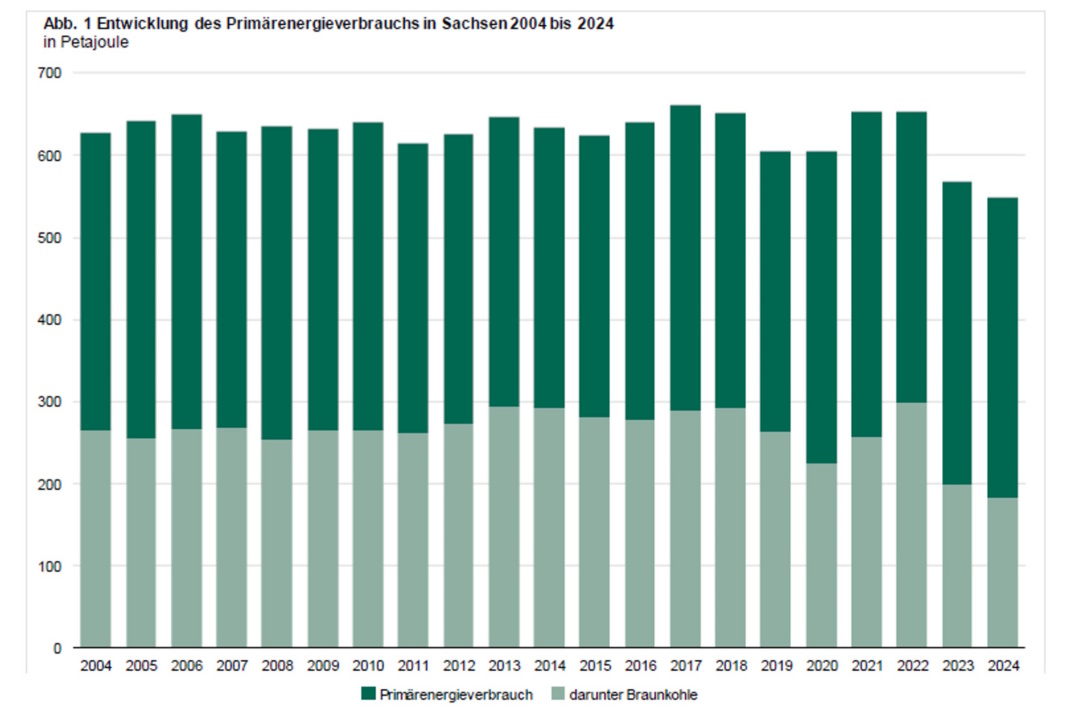
And the figures are clear: “According to the provisional Saxon energy balance, total primary energy consumption in 2024 amounted to 548 petajoules. This represented a 3 per cent decrease compared with the previous year. As the State Statistical Office further reports, primary energy consumption had already fallen by more than one-eighth (13 per cent) in 2023 (567 petajoules) compared with 2022. The reason for this was a further reduction in lignite consumption.
In 2024, it stood at around 187 petajoules, a good 8 per cent less than in the previous year. Compared with 2004, it had even fallen by just under a third (-31 per cent). In the case of renewable energy sources, however, primary energy consumption rose by 2 per cent to 62 petajoules in the reporting year 2024, and by 13 per cent over the last 10 years.”
This is precisely where it becomes clear just how inefficient the combustion of lignite is. And it is not the only fossil fuel with a dismal energy balance. The same effect is evident in road transport, where diesel and petrol vehicles, with their poor efficiency, continue to dominate. The efficiency of a petrol engine stands at 20 per cent, whilst that of a diesel engine is roughly double that. However, the same applies to both: the majority of the energy contained in the fuel is simply released into the air as waste heat.
However, as the people of Saxony increasingly switch to electric vehicles, this immediately leads to a reduction in energy consumption here too. Admittedly, this was somewhat obscured in the 2024 statistics because the decline in air travel resulted in an even more significant drop in demand for kerosene.
The State Statistical Office commented: “With regard to final energy consumption, too, 2024 – just like 2023 – saw a decline across all consumption sectors. Compared with the previous year, total final energy consumption fell by 2 per cent to 347 petajoules. Among the consumption sectors, transport recorded the largest decline, falling by almost 3 per cent to 103 petajoules. This can be attributed almost exclusively to the fall of just under 11 per cent in energy consumption by the aviation sector (23 petajoules). In the sector comprising households, commerce, trade, services and other consumers, final energy consumption amounted to 158 petajoules (-2 per cent). In industry, it totalled 86 petajoules (-1 per cent).“
Less coal needs to be burnt to generate Saxony’s electricity
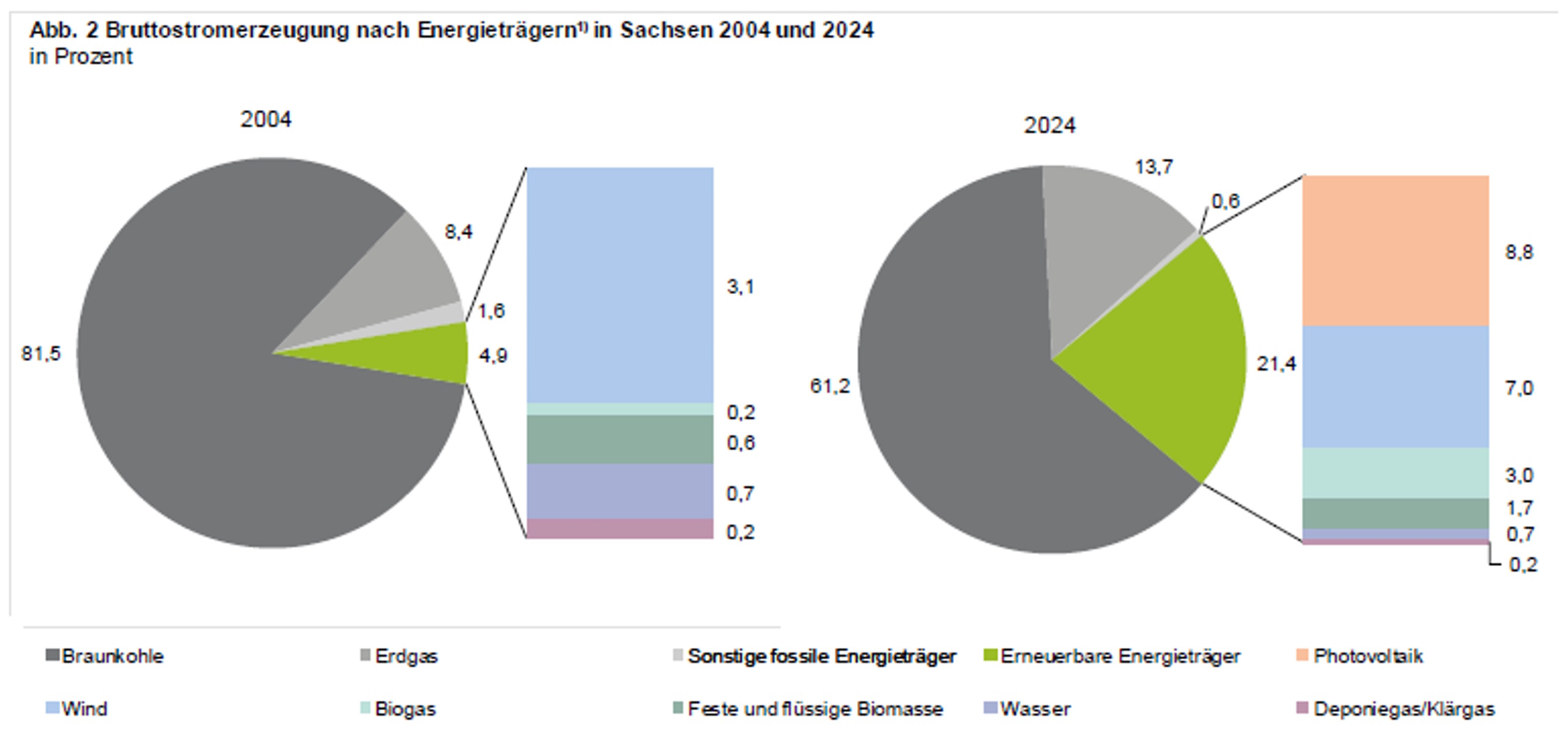
And when more electricity comes from wind power and photovoltaics, the proportion of electricity required from coal-fired power stations falls significantly. Very significantly, as the state statisticians note: “Gross electricity generation in Saxony fell by just over 1 per cent in 2024 compared with the previous year, to 33 terawatt-hours. This was largely driven by electricity generation from lignite, which accounted for 61 per cent (20 terawatt-hours).
Renewable energy sources collectively accounted for the second-largest share, at 21 per cent (7 terawatt-hours). Compared with 2023, the volume of electricity generated from renewable energy sources increased by just over 8 per cent; compared with 2004, it almost quadrupled. Within this, photovoltaics dominated with a gross electricity generation of almost 3 terawatt-hours (accounting for nearly 9 per cent of the total), ahead of wind power with more than 2 terawatt-hours (accounting for 7 per cent of the total).’
The conclusion is clear: the more electricity generated from wind power and photovoltaics, the more energy consumption in Saxony falls, because less energy is released into the air as waste heat. Not to mention the climate-damaging emissions.
Empfohlen auf LZ


So können Sie die Berichterstattung der Leipziger Zeitung unterstützen:





There is one comment