Dieser Artikel ist auch in deutscher Sprache verfügbar: Zum deutschen Artikel.
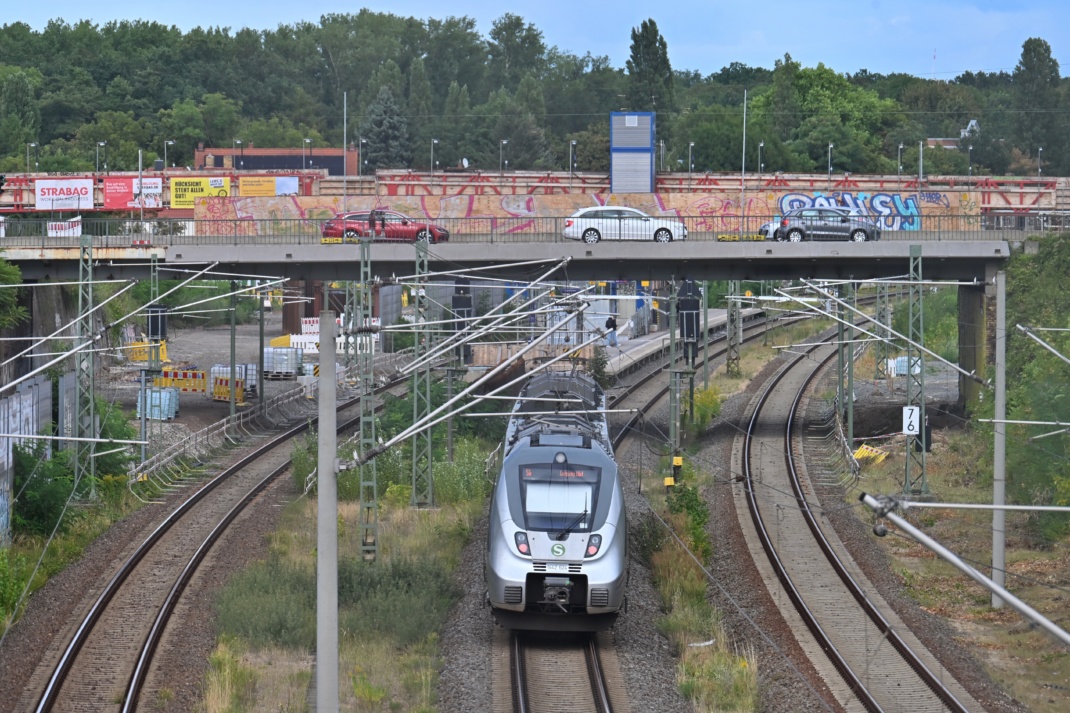
There’s really no point in arguing about it now: once a construction project like the massive Georg-Schwarz bridges between Leutzsch and Böhlitz-Ehrenberg has got underway, you can’t simply stop it if costs rise along the way. Not everything can be calculated down to the last Heller and Pfennig from the outset. This mega-project, which will keep the west of Leipzig on tenterhooks until 2031, began in 2025 with a cost target of just under 99 million euros.
However, in 2026, the first cost overrun occurred, which the City Council had to decide on on 2 September. This overrun is primarily due to higher initial costs reported by STRABAG, the contractor. Construction was due to begin on 29 September 2025. And contrary to expectations, the costs for 2026 are rising significantly – by 22 million euros. In return, the annual instalment for 2027 is now estimated to be 13 million euros lower. And the projections date back to 2023 anyway.
In the words of the Building Department in the proposal to the City Council: “The original cost forecast was drawn up by the MTA three years before construction began. For the purposes of budget planning, the total costs were, for the sake of simplicity, divided into six equal annual instalments at that time, as no reliable construction schedule was available at that stage. However, this linear distribution does not realistically reflect the actual, dynamic course of construction. A major construction project can certainly incur disproportionately high costs in the initial phase.”
High initial costs
This is now also the case with the Georg-Schwarz Bridges: “The BMH project i-5 Georg-Schwarz Bridges/Am Ritterschlößchen has been under construction since 29 September 2025 and is proceeding largely according to plan in line with the construction schedule. On 12 March 2026, the contractor Bau submitted a payment schedule which, given the available annual budget allocations in accordance with the existing construction and financing resolution VII-DS-09251, does not correspond with the budget – particularly for the year 2026.
In addition, audited supplementary claims totalling 1,214,391.35 euros (gross) are currently on file. Furthermore, the necessary funds for land acquisition for the years 2027/2028 have been allocated in the budget of the Mobility and Civil Engineering Office to the sum of 1,233,350.19 euros. In 2026, there is an estimated additional requirement of approximately 22,437,571.45 euros.”
And a potential cost risk still lies within this project, as the Planning Department explains: “Due to a suspected presence of unexploded ordnance in the area where the bored piles for the foundations of Bridge Structure II/R11 are to be constructed – which was identified during an ordnance survey and could not be ruled out by a follow-up survey – delays in the construction schedule are possible.
A plan is currently being drawn up to enable the removal of the object in question – short-term closure periods will need to be coordinated for this purpose. Depending on the outcome of further investigations, delays in construction are to be expected. This may result in corresponding reductions to the previously forecast cash outflow in 2026.”
Significantly more funding
You wouldn’t necessarily want to be in the site manager’s shoes right now.
This massive project began with an estimated construction cost of 98.7 million euros, of which 20.9 million euros was in the form of funding. From the city’s perspective, the funding situation has improved significantly – partly due to substantially increased funding from the Free State.
Although the planning department now estimates total costs at 101.2 million euros, 48.3 million euros of this will be covered by funding, meaning the city will only have to raise 52.9 million euros instead of 77.9 million. This will be done through borrowing, incidentally, as the city’s precarious budgetary situation is, as is well known, forcing it to finance major infrastructure investments – such as the construction of the new Georg-Schwarz bridges – entirely through loans.
The City Council approved the proposal to increase the budget on 2 September by a clear majority, with just one vote against.
Empfohlen auf LZ


So können Sie die Berichterstattung der Leipziger Zeitung unterstützen:





There is one comment