Dieser Artikel ist auch in deutscher Sprache verfügbar: Zum deutschen Artikel.
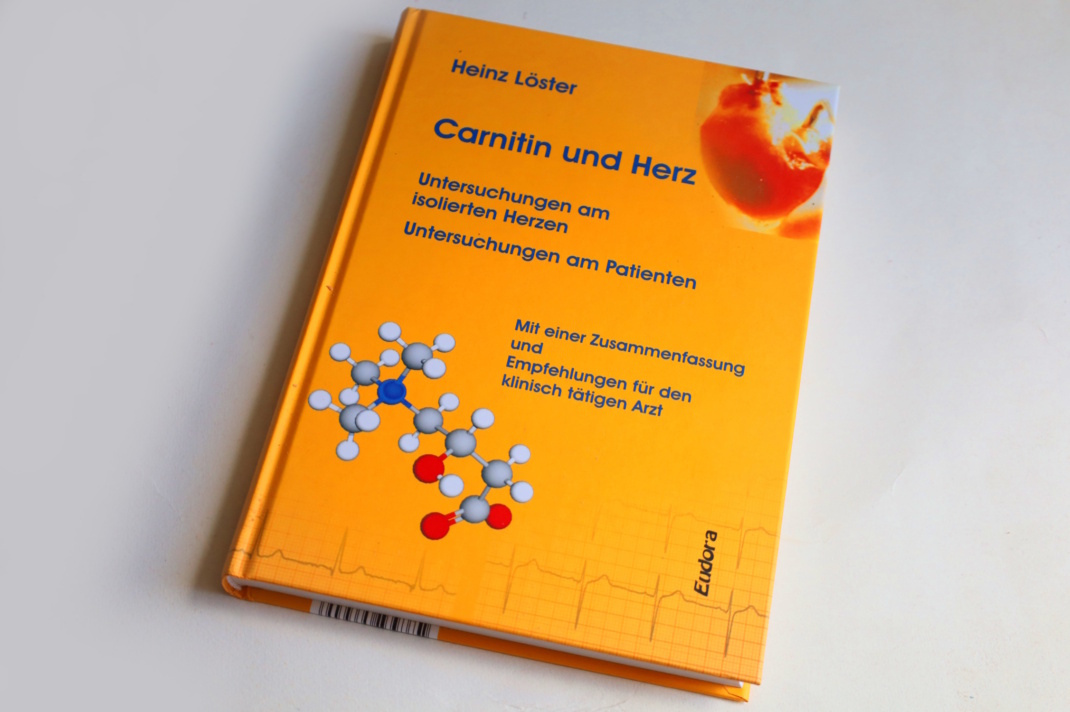
Books of this sort are usually published by university presses; they’re genuinely specialised material for specialists. But why not, thought publisher Ralf C. Müller, and so he decided to include this rather unusual title in his catalogue. A book for specialists. And perhaps also for all those who, as patients, have come across the term before. After all, carnitine supplements are sometimes part of a treatment regimen. And this is despite the fact that we actually consume carnitine through our normal diet. Without carnitine, however, the situation becomes extremely dangerous.
Or, to quote Dr Heinz Löster, who, at the Institute of Pathological Biochemistry and Clinical Chemistry at the University of Leipzig (later the Institute for Laboratory Medicine, Clinical Medicine and Molecular Diagnostics), has spent decades studying the effects of carnitine in the human body, particularly its effect on the heart’s metabolism. The heart, too, has a metabolism and requires a constant supply of energy. But how does this energy reach the mitochondria?
This is where it gets scientific – and really exciting for biochemistry enthusiasts. Because without carnitine, nothing works there. Without carnitine, the fatty acids that the mitochondria need to produce energy cannot pass through the cell membrane.
It goes something like this: ‘As the acyl-CoA esters of long-chain fatty acids cannot cross the inner mitochondrial membrane, they are transesterified on the inner side of the outer mitochondrial membrane with carnitine, catalysed by carnitine palmitoyltransferase I (CPT I), on the inner surface of the outer mitochondrial membrane. In this form, they can cross the inner mitochondrial membrane, catalysed by carnitine-acylcarnitine translocase.”
It quickly becomes apparent that Löster has studied this subject extensively since completing his PhD in 1975. At one point, he even uses the apt term ‘carrier’: carnitine is the transporter that carries the fatty acids across the mitochondrial membrane. Without it, nothing works there.
When there is a lack of carnitine in the body
And this plays a role throughout the entire body, even though Löster focuses on the heart in this book. For the fact that many people’s hearts fail is often enough down to the energy supply no longer functioning properly because carnitine levels are too low.
For this volume, Löster has summarised the findings of decades of research, going back as far as 1905, when carnitine was discovered, although research continued to grope in the dark for decades as to what this substance’s actual function in the human body is. The breakthrough came in 1952 thanks to the zoologist Gottfried Fränkel, who was forced to flee Germany during the Nazi era and subsequently continued his scientific career in the USA. Since then, it has been known that carnitine plays an irreplaceable role in the fat metabolism of the mitochondria.
And in this book, Löster summarises no fewer than 14 doctoral theses dealing with the specific effects of carnitine. Or rather, its lack of effects. For as is often the case with newly discovered chemical substances in the human body, certain optimists attribute all manner of superpowers to the newly discovered substance and try to sell it to the world as a miracle cure.
Essential for many organ functions
Many of the hypotheses put forward in this way simply vanished into thin air when tested. But that, too, is science. It must also correct false expectations – and do so rigorously, through well-documented experiments and test series.
So, with Löster’s help in this book, we gradually work our way towards the current state of knowledge regarding carnitine and its role in our bodies. And also towards various clinical conditions linked to a carnitine deficiency. A minor surprise: we consume most of our carnitine through meat. Vegetarian products contain significantly less carnitine. This is a topic that has not yet been fully debated. After all, our bodies are also capable of producing carnitine themselves.
But research has now shown at least one thing, according to Löster: “A carnitine deficiency therefore has a serious impact on many organ functions.”
The important role it plays for our heart
Here he mentions an issue that has only gradually become clear to researchers: that a carnitine deficiency could possibly be a cause of sudden infant death syndrome. This is because some infants are born with a carnitine deficiency. However, as this is a rare occurrence, it is also rarely reported in the literature. However, if the carnitine deficiency is diagnosed early, it can be treated.
In that sense, it is not a miracle cure, but one of the basic chemical compounds without which our metabolism cannot function. And not just the human metabolism. Nevertheless, this does not make carnitine a performance enhancer or – as was still believed in the early 1990s – a ‘fat burner’ that can then be marketed to people as a performance-boosting substance.
In medicine, synthetic carnitine is primarily administered in cases where a primary carnitine deficiency has been diagnosed. This is often found in connection with dialysis treatments (where carnitine is effectively flushed out of the body) and in the advanced stages of diabetes mellitus. However, strenuous, long-term sports can also trigger a carnitine deficiency in the body.
But at the heart of Löster’s book lies the heart and its reduced performance when the condition leads to a loss of carnitine. Here, treatment with synthetic carnitine clearly helps to restore the heart’s performance. Treatment with carnitine is therefore recommended here, notes Löster, who, through this book, has taken his readers on a journey through several decades of carnitine research. And for those who have not studied the subject, it provides an introduction to a substance that is otherwise rarely discussed, yet is fundamental to our metabolism. This extends to the performance of our heart, which, after all, must work continuously and therefore requires a constant supply of energy.
Heinz Löster, *Carnitine and the Heart*, Eudora Verlag, Leipzig 2025, 69 euros.
Empfohlen auf LZ


So können Sie die Berichterstattung der Leipziger Zeitung unterstützen:





There is one comment