Dieser Artikel ist auch in deutscher Sprache verfügbar: Zum deutschen Artikel.
Historians are delighted by such finds: eyewitness accounts from a time when newspapers were still a rarity and did not really report in great detail on what was happening in the city. Take the Book Fair, for example, which twice a year turned Leipzig into a meeting place for booksellers and publishers. Everyone of any standing travelled to Leipzig for the event. This was also the case for the Easter Fair of 1780, when the publisher Nathanael Siegmund Frommann from Züllichau (now Sulechów) came to the fair in Leipzig with his 14-year-old son, Carl Friedrich Ernst Frommann.
And what makes this journey special is that the son kept a diary. Perhaps at his father’s request. Perhaps also for those back home, for this journey to Leipzig also marked the boy’s first steps towards independence from his parents’ home. And it was also intended, to some extent, as a learning experience and an opportunity to get to know people. For the boy was destined to take over his father’s publishing business one day. That had already been decided.
So he came along too, to meet as many of his father’s colleagues in Leipzig as possible – people with whom his father had business dealings. Their names virtually fill his diary, which Dr Claudia Taszus, a German studies scholar from Jena, discovered in the Goethe and Schiller Archive in Weimar, where it is catalogued in the as yet unexplored collection of the Frommann family’s estate.
And this young Carl Friedrich Ernst is also fascinating because he moved the publishing house from Züllichau to Jena in 1798, thus placing it in the immediate vicinity of the Classicists active in Weimar and Jena.
Easter Fair in the Rain
But how does a 14-year-old write a diary? What is important? Or does one simply jot down all the people one’s father met in Leipzig? That in itself is fascinating for literary historians. After all: how did publishing contacts work back then? Who knew whom? And whom did a publisher meet beyond the scope of business? Was the son – in order to learn – clinging to his father’s coattails the whole time? After all, it was the boy’s first time in Leipzig – and, naturally, he struggled to describe the city, which was a completely different kettle of fish from the rather provincial Züllichau. How does one find the right words?
Not at all, really, unless you’re already talented and have a flair for literary writing. And so, naturally, one misses out on quite a few things that, as a later reader of the diary (which wasn’t actually intended for publication), one might wish for. As you picture this Leipzig during the Easter Fair, whilst it’s practically raining non-stop. Where, then, did the booksellers meet? The boy was probably so impressed by the well-known names of the time that he completely forgot to describe the offices and inns, the food, the accommodation, the topics of conversation …
He only really becomes more specific when he visits, with his father, the monument to the poet Christian Fürchtegott Gellert – who died in 1769 – in the garden of the Wendler House. This gives one the slight feeling that he might, after all, be able to describe the city in 1780 in a somewhat more vivid way.
Fascinated by the theatre
But sometimes the experiences really blow you away. Like the theatre, which the young man experiences on several evenings. There was nothing like that in Züllichau. He sees four comedies and two dramas and puts his enthusiasm for the performances into words for those back home, describing practically the entire plays. Just as he later describes the performance of a troupe of acrobats (the ‘Luftspringer’ from the title), which were, of course, a natural part of the Leipzig Fair at that time.
The trip to the fair was also a cultural excursion. His father, too, will have made an effort to take in as much as possible of what was on offer in Leipzig. Such as Carl Leopold Röllig’s harmonica concert on 24 April. An occasion on which he not only got to see the Dukes of Weimar and Gotha, but also a certain Mr Göthe, who was quite obviously accompanying the Duke of Weimar to the Easter Fair in Leipzig. One at least takes note of such things, even if the 14-year-old has no inkling at this stage that he would later become even more closely acquainted with Goethe.
Claudia Taszus has supplemented the young diarist’s account with a set of notes, covering what he does not mention because everything is still new to him and he is, it seems, unable to shake off his sense of wonder so easily. She also does so in a detailed foreword, in which she explores the close relationship between father and son. For it is quite evident that Nathanael Sigismund took great pains to ensure his son’s moral upbringing, taking him by the hand with genuine trust – something that was by no means a matter of course, even in the world of Pietism, where the Frommann publishing house was based.
A rare testimony
What’s more, the father had already begun to restructure the publishing programme, increasingly incorporating Enlightenment literature into the catalogue. This included a thoroughly controversial, combative and much-discussed theologian named Karl Friedrich Bahrdt, whom the young traveller also met on 14 April.
He was, after all, something of a best-selling author for Frommann’s publishing house. If one can place the names mentioned by the diarist in context, a picture of this stay in Leipzig gradually emerges, featuring encounters that extend far beyond his father’s 24 fellow booksellers.
And even if one sometimes wishes the boy had written down even more, the diary is a rare account of the world of the Leipzig book fairs of that time – the sort one hardly ever comes across. The publishers were, after all, more preoccupied with business, accounts and deals. You don’t really look around much in such situations.
Even when you meet people like Johann Gottlob Immanuel Breitkopf or Johann Adam Hiller. You can at least surmise that the boy was utterly impressed and didn’t dare to ask any questions himself. After all, they were celebrities in their day – and here came this lad from the sleepy village of Züllichau … What could he have said, what could he have asked?
But the journey seems to have been worthwhile, and doors appear to have opened for the young man’s future career as his father’s successor. After all, he met the Berlin publisher August Mylius, with whom he would complete his apprenticeship as a bookseller. Little did he know that, just six years later, he would have to take over the publishing house of his father, who had died prematurely. But the foundations had been laid. And the encounters at the Leipzig Easter Fair in 1780 are likely to have played a significant part in this.
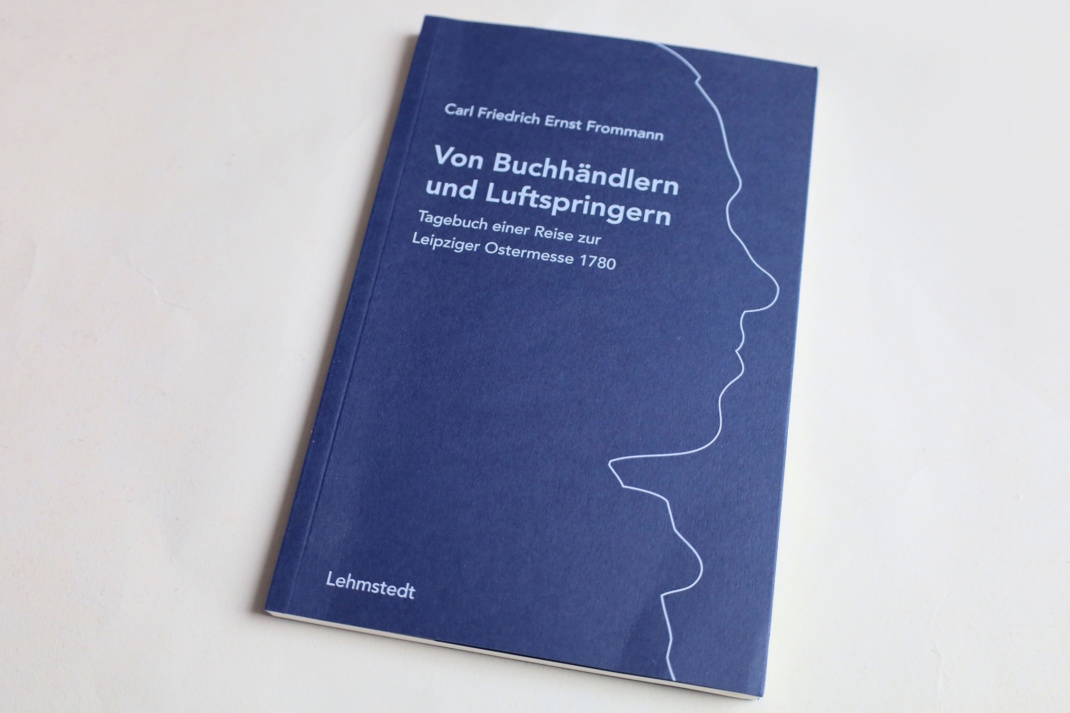
Friedrich Ernst Frommann, *Von Buchhändlern und Luftspringern* (On Booksellers and Acrobats), Lehmstedt Verlag, Leipzig 2026, 25 euros.
Empfohlen auf LZ


So können Sie die Berichterstattung der Leipziger Zeitung unterstützen:




There is one comment