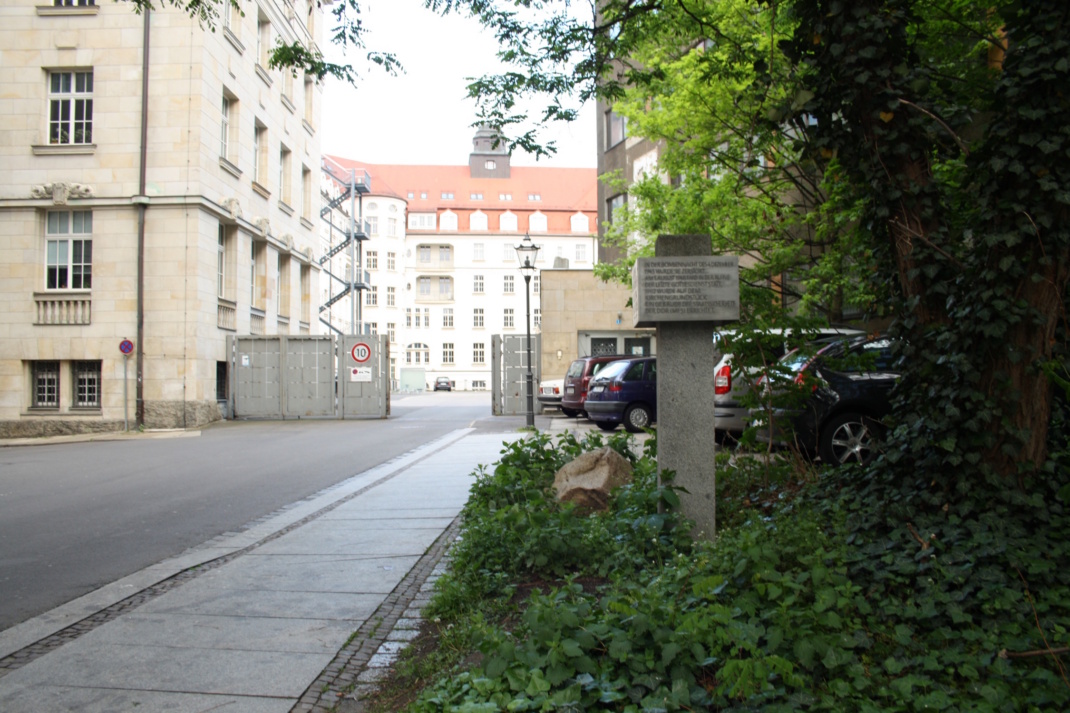
It will probably be years before anything happens at Matthäikirchhof. And a number of mistakes will still need to be rectified. Here, the city wanted to develop a vision for a new urban quarter through public participation – but with a whole host of preconditions that forced it into half-hearted compromises from the outset. However, as no investment is expected for years to come, Matthäikirchhof should really have been opened as a place people can experience even before then. Yet even that does not seem to be working out.
The Matthäikirchhof is intended to develop into a ‘place of living democracy’ – with the future Stasi Records Archive for Saxony (Federal Archives) as its central component. A mixed-use, urban neighbourhood is to be created around this centre, which will be open to the public and offer spaces for housing, education, culture and community engagement. But to date, it is not possible to experience the site; the gates are locked. Nor are there any activities on offer at the former Stasi site. Apart from shivering in the lifeless grey of the concrete.
“The site’s accessibility is essential for interim use!” explains City Councillor Katharina Krefft, who represented the Greens parliamentary group in the public consultation process.
Following the broad public consultation process and a motion by the Bündnis 90/Die Grünen parliamentary group for the interim use of the Matthäikirchhof, the Urbact local group was founded, which supported the development of a concept for interim use over a period of three years. As a result, the group outlined a plan for a cultural and educational centre (KuBZ). The KuBZ is intended to ‘crack the Matthäikirchhof code’ – creating a space of possibilities that is accessible to all, cross-cultural and rooted in everyday life, bringing socio-political themes such as democracy, freedom and participation to the fore.
And this is also the wording of the City Council’s resolution, ‘Conceptual Process (Sale) of the Stand-alone Plot at Matthäikirchhof and “Development Concept for the Implementation of the Urban Planning Competition Result”’, as adopted at the turn of the year.
“Contrary to the recommendation of those involved, the building was not put to immediate use following the departure of the administrative units,” says Katharina Krefft, recalling the group’s forward-thinking work. The vacant building was subjected to vandalism and set on fire on several occasions. Consequently, the site was cordoned off for safety reasons: in addition to the necessary CCTV surveillance, the area was surrounded by hoardings and the gates were locked.
On the occasion of the ‘Lange Tafel der Baukultur’ (Long Table of Building Culture) on 19 June 2026, at the invitation of the Association of German Architects, ideas were developed and feasibility discussed, focusing on openness, opportunity and experimentation. In Leipzig, there are examples ranging from gatehouses to delicatessens and the Tapetenwerk that demonstrate how to put empty buildings to use and preserve them.
“We are now asking the council what might ultimately come of this thought-provoking initiative,” says Katharina Krefft, referring to the question tabled by the Green Party parliamentary group, which is now due to be answered after the summer recess.
Empfohlen auf LZ


So können Sie die Berichterstattung der Leipziger Zeitung unterstützen:





There is one comment