Dieser Artikel ist auch in deutscher Sprache verfügbar: Zum deutschen Artikel.
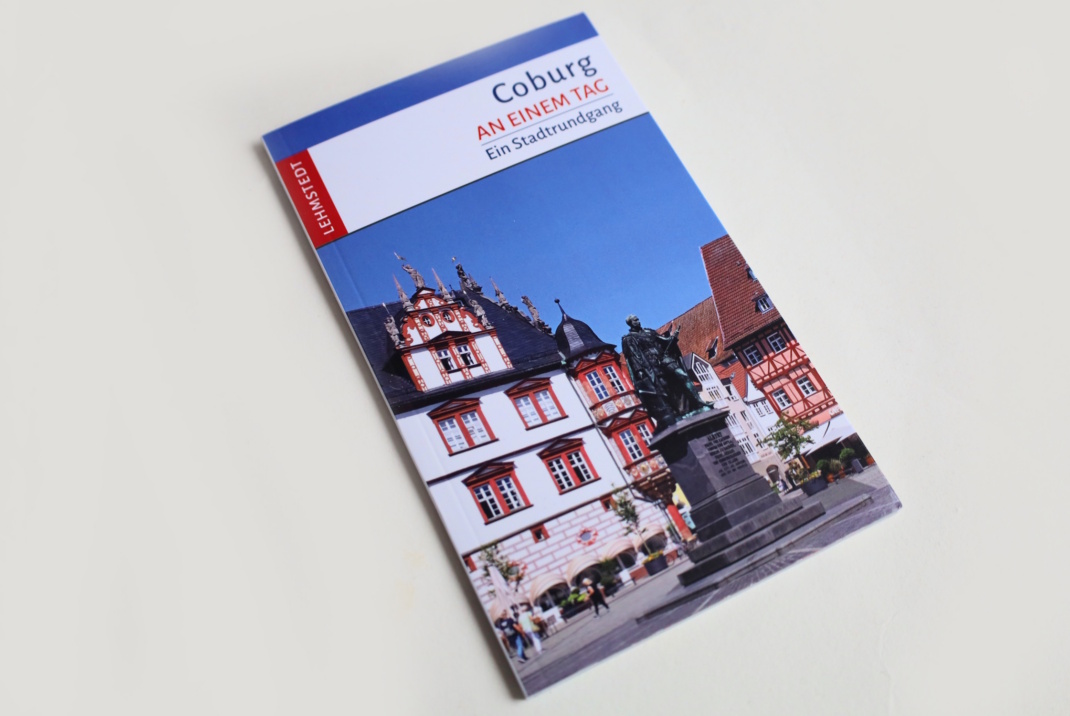
Perhaps this is just the right little town to spend a few days relaxing away from the stresses of the big city: Coburg. Famous for the ducal family of Saxe-Coburg and Gotha who once ruled here, whose offspring were once highly sought-after by European royal houses. Just think of the British royal family. For such a small princely house on the southern edge of Thuringia always had one immense advantage: whoever married the daughters or sons of the house ran no risk of conflict with other great powers.
At first glance, therefore, it appears small and tranquil. Even though such small princely houses as that of Saxe-Coburg and Gotha had another advantage: they wanted to shine just as brightly as the great kingdoms and therefore invested a great deal of money in their magnificent castle. In this case, Ehrenburg Castle, situated practically on the edge of the old town, complete with its stables, former riding hall and castle gardens. And everywhere you look, there are stately monuments to various princes. Some of them were keen spenders, yet they were still loved by the people of Coburg.
The locals are certainly keen to tell visitors that their little Coburg was once an independent Free State for three years – from the abdication of Duke Carl Eduard until the 1921 referendum, when the people of Coburg voted to become part of the Free State of Bavaria.
A decision that was, in fact, ahistorical. For the small duchy actually belonged to the Wettin mini-principalities that had emerged in Thuringia after the Ernestine principality had become increasingly fragmented.
The Veste above the town
This is what strikes the walker as they climb up to the Veste Coburg, which towers defiantly above the town. A fortress that became famous not so much for military conflicts as for its most famous visitor: Martin Luther. He set off for Coburg in April 1530 to follow the proceedings at the Imperial Diet in Augsburg from there. And fans of Luther will also be able to marvel at a Luther Room here – just as they can at Wartburg Castle.
And Martin Luther felt just the same here as he did at Wartburg Castle: he felt lonely and abandoned.
Not everyone is cut out to live in a castle. In this case, it was also far off the beaten track. For in Augsburg, traditionalists (who still formed the majority at the time) and Protestants were negotiating how they might coexist peacefully in future. And, of all people, the leader of the Protestants was not allowed to be there, because Luther was under a ban.
All that remained for him was the role of a distant observer. And one can well imagine how upset this must have made him. For there was no peace in Augsburg. The Emperor and the traditionalists put massive pressure on the Protestant princes, who were still in the minority. Consequently, they left early and did not recognise a single one of the Augsburg Decrees.
Instead, they founded an alliance – the Schmalkaldic League – with which they armed themselves against the overwhelming Catholic League. But that is another city and another story.
St. Moritz on the coat of arms
In any case, you shouldn’t miss the Veste Coburg if you treat yourself to a day or two in Coburg, a little town that’s perfect for a leisurely stroll – with some truly lovely highlights such as the preserved city gates, the rose garden and St. Moritz Church. This immediately brings to mind the town’s unique coat of arms, which depicts one of the Three Wise Men, Saint Maurice, who was traditionally portrayed in the Middle Ages as a dark-skinned king.
The Middle Ages had no problem with this, but the Nazis did. Yet the people of Coburg stand by their coat of arms and quickly reinstated it after the Nazis, fortunately, called off the Battle of Coburg. This prevented greater destruction of the town.
So today one can still stroll through ancient alleyways in the ‘Crown of Franconia’, as Coburg is often marketed. But the marketing experts were probably actually thinking of the magnificent Veste fortress overlooking the town, one of the best-preserved in the German-speaking world. And anyone visiting the art collection housed there will, of course, come across an old acquaintance: Lucas Cranach the Elder, whose paintings were also collected by the Dukes of Saxe-Coburg and Gotha.
Before leaving the Veste, you can admire all the weapons in the armoury – weapons that, in the end, were never used. Steffi Böttger also mentions in passing how, after the Seven Years’ War, the garrison of the Veste even sold off the fortress’s own cannons. Eventually, even expensive armaments become nothing more than scrap metal. And in that case, the most peaceful solution is simply to sell the old howitzers to the nearest scrap dealer.
Empfohlen auf LZ


So können Sie die Berichterstattung der Leipziger Zeitung unterstützen:





There is one comment