Dieser Artikel ist auch in deutscher Sprache verfügbar: Zum deutschen Artikel.
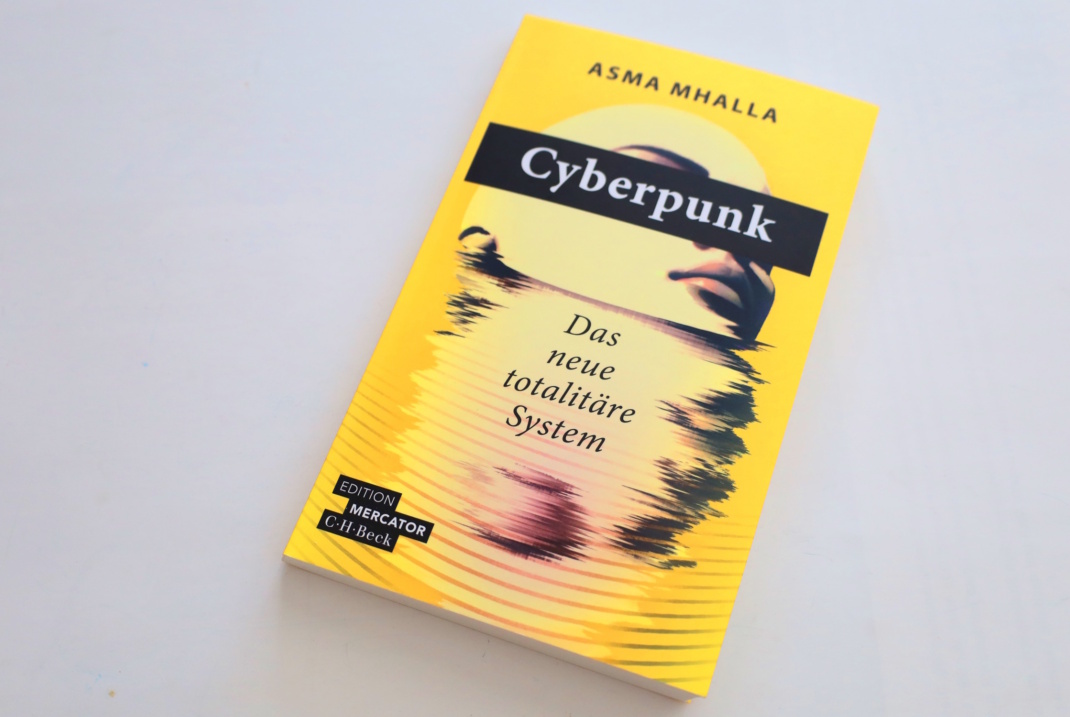
We are already living in the dystopias of the 1980s. Sometimes it takes someone to rub it in so bluntly, as the French political scientist Asma Mhala does in this book, which is not called ‘Cyberpunk’ for no reason. For what we are experiencing today – the transformation of the liberal Western world into a dystopia of surveillance, unresolved crises and a shattered democracy – is something readers of 1980s science fiction are already familiar with. Back then, a completely new wave of science fiction caused a stir: cyberpunk. And not without reason.
For the authors of this new genre described a world that was, even back then, the wet dream of programmers and tech entrepreneurs: a world in which everything is interconnected, digital platforms control and manipulate people, and the state has been reduced to a hollow shell because gigantic digital corporations have simply taken it over.
The heroes featured in the novels of gifted authors such as William Gibson lived in a dystopia thoroughly dominated by algorithms. A world which, on the one hand, bore a striking resemblance to the Big Brother-ruled world of George Orwell’s *1984*, but which, due to its complete digitalisation, seemed all the more hopeless. For where digital machines dominate, regulate, authorise, control and evaluate everything, there is no longer any room for human intervention. It is a merciless world.
And it is – as Asma Mhalla illustrates in her essay, which has already caused quite a stir in France – the very essence of a completely unbridled form of mega-capitalism, in which huge corporations have simply taken over the state. This is exactly what is happening right before our very eyes. And we stand by and watch, even going so far as to hand over our data to these behemoths on a plate, data which is then used to manipulate us.
We are already right in the thick of it. Possibly so deeply that we can no longer halt this development, as Mhalla suggests. For whoever controls the minds shapes the picture people have of the world. There’s a system to it. Because we lose our sense of what is real when the digital worlds – to which we’ve become addicted – constantly feed us a different narrative.
Hacking reality
We are dealing with a small, filthy-rich elite that finally has the means to destroy all our notions of justice, reason, participation and freedom. A word for this has long since become established: disruption. We simply didn’t take it seriously and believed that people like Musk, Thiel, Bezos or Zuckerberg didn’t really mean it. But they do mean it exactly that way.
Or, to quote Asma Mhalla: “Venture capitalists invest in these ideas just as they invest in start-ups. They are banking on theoretical, violent disruption and ideological experiments that could bring about the desired rupture – in pursuit of a prospect that is as profitable as it is messianic: hacking reality.”
That is exactly what they are doing. The DOGE programme spearheaded by Musk or Milei’s chainsaw massacre in Argentina are prime examples of this. The state is not merely being hijacked; it is being gutted. The regulatory mechanisms that protect the vulnerable are all sidelined and rendered powerless. And the post-fascist rhetoric, sold on ‘social media’ as completely unbridled freedom of expression, is already changing people’s minds even before the Trumps take power, fuelling hatred and contempt, and ruthlessly divides the world – a thoroughly fascist trope – into friend and foe.
Manipulated minds
Liberal democracy dies first and foremost in people’s minds. When people cease to accept tolerance and respect as fundamental values of peaceful coexistence, and end up in bubbles where hatred, violence, contempt and dehumanisation are constantly practised. Right-wing extremist parties were the first to recognise just how well so-called ‘social media’ lends itself to this. They feed the machinery of hate production with vast numbers of people and with complete abandon.
And the chaos that people like Trump cause with their contradictory theatrics is simply part and parcel of it, as Mhala observes. For when reality disappears, because every day ever more lies, boasts, threats and whingeing tirades are blasted out into the cosmos, then something akin to the ‘Doublethink’ from ‘1984’ emerges. Reality does not disappear entirely – but those thus manipulated begin to take the wild world of lies and assertions seriously. They learn to think in both terms simultaneously. The new fascism establishes itself directly in people’s minds.
For Mhala, this gives rise to a double Leviathan. The image of the all-powerful Leviathan comes from Thomas Hobbes, who used it to describe the (all-powerful) state. But when mega-corporations such as the multi-billion-dollar American Big Tech firms hijack the state, it becomes a two-headed monster – a Dileviathan.
“The Dileviathan is cyberpunk by nature,” writes Mhalla. “It embodies the dystopian fusion of the disintegrated and reconstituted state and the mega-corporations.”
So, according to Mhalla, are we heading towards the “total cybernetic state”? It is the wet dream of the tech bros. And it is the nightmare in which we are, to some extent, already living. Everyone notices it – in private and political discussions alike. More and more people are arguing in a post-factual manner, questioning reason, science and the free press, even declaring them to be enemies. This is undermining the very foundations of our democracy. And there is a pattern to it. It is paralysing all political decision-making. The state appears as a powerless, bloated monster. The calls for cuts, scrapping and streamlining are growing ever louder.
Big State
Calls behind which looms the – post-fascist – idea of the ‘Big State’, a state that will ultimately be taken over by Big Tech. With hyper-technology, the private interests of corporate bosses alone will then seize power. The state itself becomes a corporation that manages its citizens – digitally – as if they were employees. “Total technology is more than a complex technical system,” Mhalla observes, “it has a single goal: control of the x- and y-axes, of time and space. The radical acceleration of Total Technology paves the way to new frontiers. If no one stands in its way, our future will belong to it.”
And the seeds of all this were already sown back in 1984. Even back then, the digital junkies were dreaming of this totally controlled digital world. William Gibson depicted this ‘brave new world’ back then in his novel *Neuromancer*, which Asma Mhalla recommends at the end as a must-read for anyone in need of intellectual nourishment to defend themselves against the overwhelming tactics of today’s manipulation networks. Anyone who has long been grappling with the big question of what human freedom really is will find here Orwell’s ‘1984’ as well as Camus’s ‘The Rebel’ and Thoreau’s ‘Civil Disobedience’.
Mhalla even offers a simple little guide: small exercises for free thinkers. This, however, has nothing to do with the follies of the so-called ‘lateral thinkers’, who have, in recent years, taken the madness of these runaway bubbles out onto the streets. For on ‘social media’, any old nonsense is amplified and cemented as long as enough fools gather together to reinforce each other’s views. There is no real corrective there.
The Code and the Power
The right books are more likely to help. And it’s worth re-reading the seminal cyberpunk novels to get a sense of the kind of world we’ll end up in if we actually hand over power to the tech corporations and fail to fight back. And to defend our freedom – specifically against what the corporations try to impose on us every day as their version of ‘freedom’. A freedom in which, ultimately, algorithms determine what we think, do and who we are. ‘Whoever has the code has the power,’ Mhalla observes.
With this book, she has not only explained to her fellow countrymen how post-fascism actually works today and how it is linked to the creeping takeover of control by Big Tech – by corporations that couldn’t care less about the individual. Just as little, incidentally, as they care about the foundations of our lives and our future.
This, too, can already be read in Gibson’s work: that paralysing feeling of being stuck in an unchanging present and being unable to change anything – absolutely nothing – about it. A feeling that is truly paralysing. Mhalla herself describes it, for it is ever-present when one considers the futuristic promises of the digital corporations (along with all that nonsense about eternal life, chips in the brain or cities on Mars, where the wealthy elite will then seek refuge once they have plundered the Earth).
Promises that are so utterly devoid of any future. This goes a long way towards explaining why our politics today seem so devoid of vision and meaning, as if our ruling politicians were themselves already zombies who no longer even dare to imagine the future, because the clamour of the tech bubble is ever-present and causes even political debate to derail completely into absurdity.
It is no different in Germany than in France. And Asma Mhalla is also quite right to point out that we have simply stood by and watched this development unfold the whole time, doing nothing to set limits on Big Tech’s greed. The real question is: have we long since missed the window of opportunity to act? Have we stumbled into the dystopian world of data behemoths and are we now experiencing for ourselves what the heroes in *Blade Runner* and *The Matrix* go through?
It is high time to give this some thought.
Asma Mhalla, *Cyberpunk: The New Totalitarian System*, C. H. Beck, Munich 2026, 16 euros.
Empfohlen auf LZ


So können Sie die Berichterstattung der Leipziger Zeitung unterstützen:





There is one comment