Dieser Artikel ist auch in deutscher Sprache verfügbar: Zum deutschen Artikel.
How long will this heatwave actually remain in the memories of the people of Leipzig? On 1 July, it was still cool. Even the Leipzig City Council was delighted that the first LVB trams were running again at all, after the local transport company had been forced to suspend all services over the weekend of 27–28 June.
The reason: nothing was working anymore. The joint sealant on the tracks had softened and stuck the trams’ points and undercarriages together.
And somehow, of all places, Leipzig seemed to be the only city in Germany affected by this. Enough material for a heated mayoral question time.
This session then took place at the end of the council meeting on 1 July. Three political groups had tabled urgent questions, with the Greens submitting a huge package of questions on heat protection in Leipzig in general. After all, this was a first for Leipzig: for the first time, temperatures here too had soared to 40 degrees. Even the Leipzig Transport Authority (LVB) had never experienced anything like it. Which is why they were caught completely off guard when, at these temperatures, the joint sealant suddenly turned liquid.
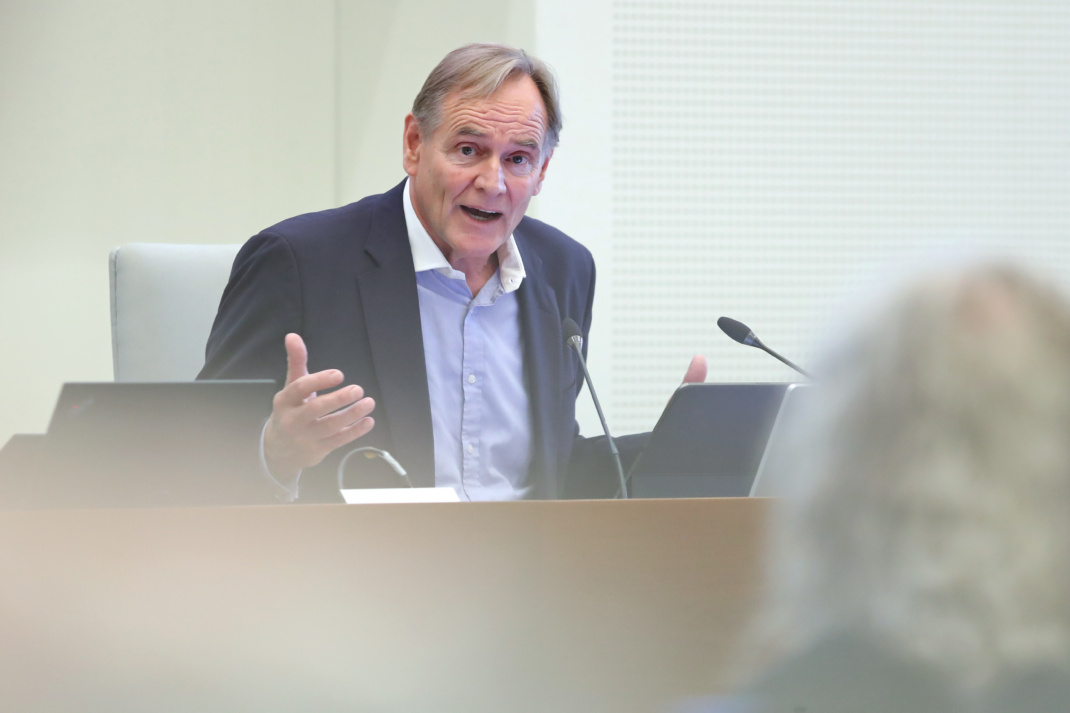
And it is foreseeable that Leipzig will experience such temperatures again in the future – and probably more often. Climate change is having exactly the impact one would expect when there is more and more energy in the atmosphere – with extreme weather events for which even a city like Leipzig is unprepared. The Green Party’s detailed question will, of course, take some time to be answered in full. That is why Mayor Burkhard Jung had it omitted from his half-hour report. It will be discussed once the full response from the administration is available.
Why Leipzig of all places?
But the main cause for concern was, of course, the suspension of all tram services. This was specifically addressed by the CDU parliamentary group in its question: what could possibly be said on 1 July about the reasons for the joint sealant bubbling up?
Initial findings were already available, even though the expert commissioned by the LVB had only just begun his work. After all, the LVB management naturally wants to know why, of all places, the joint sealant turned liquid in Leipzig. Because this has not only caused enormous financial damage. It simply must not happen again. The LVB’s rail network must also – as Mayor Jung put it – become more resilient. In other words, more heat-resistant.
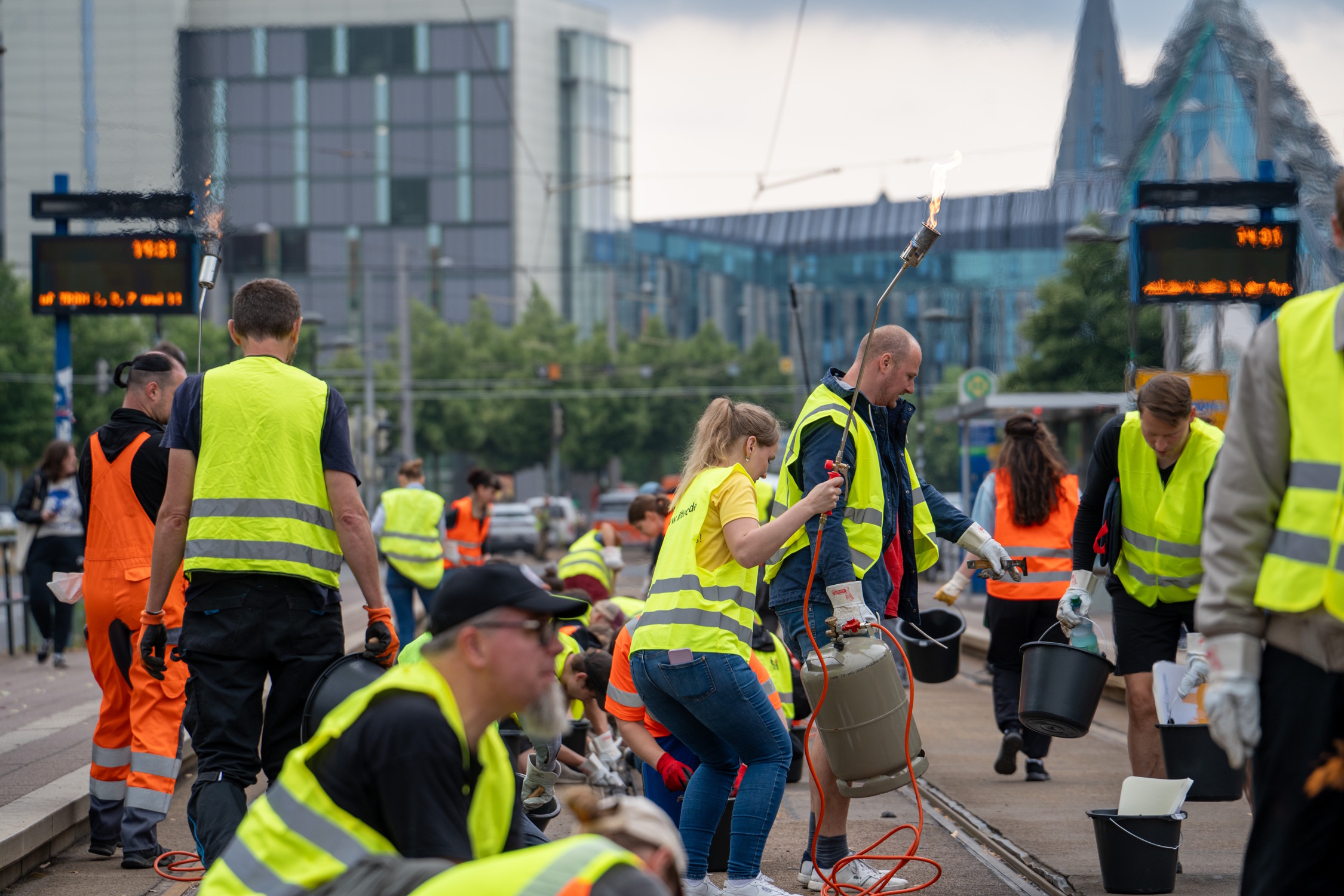
LVB staff and volunteers removing the joint sealant at Augustusplatz. Photo: Ferdinand Uhl
In its response to the CDU’s enquiry, the Department of Urban Development and Construction stated: “Under the weather conditions experienced to date, the bituminous joint sealant has proved suitable. Notwithstanding this, the LVB has already initiated an expert assessment process. The jointing material between the grooved rail and the adjacent surface paving complies with the technical regulations. The ‘Supplementary Technical Contract Conditions and Guidelines for Joints in Traffic Areas’ (ZTV Fug-StB 2015) define the requirements for joint filling.
However, one particular feature has come to light that warrants closer investigation: over 90 per cent of the damage is on the left-hand side of the track and the vehicle. Furthermore, track sections of varying ages and constructed using different methods have been damaged. Discussions between the LVB and the cities of Nuremberg and Bremen revealed a similar pattern of damage in those cities. This pattern of damage, which is currently considered highly unusual, does not yet allow for a clear assessment or identification of the cause.
From the perspective of the city administration and also the LVB, the analysis of the causes cannot stop at the properties of the joint sealant. Climate-adapted urban spaces are a joint responsibility.”
Why not in Halle and Dresden?
But the CDU parliamentary group naturally also wanted to know why this happened in Leipzig and not elsewhere. Was Leipzig really the exception?
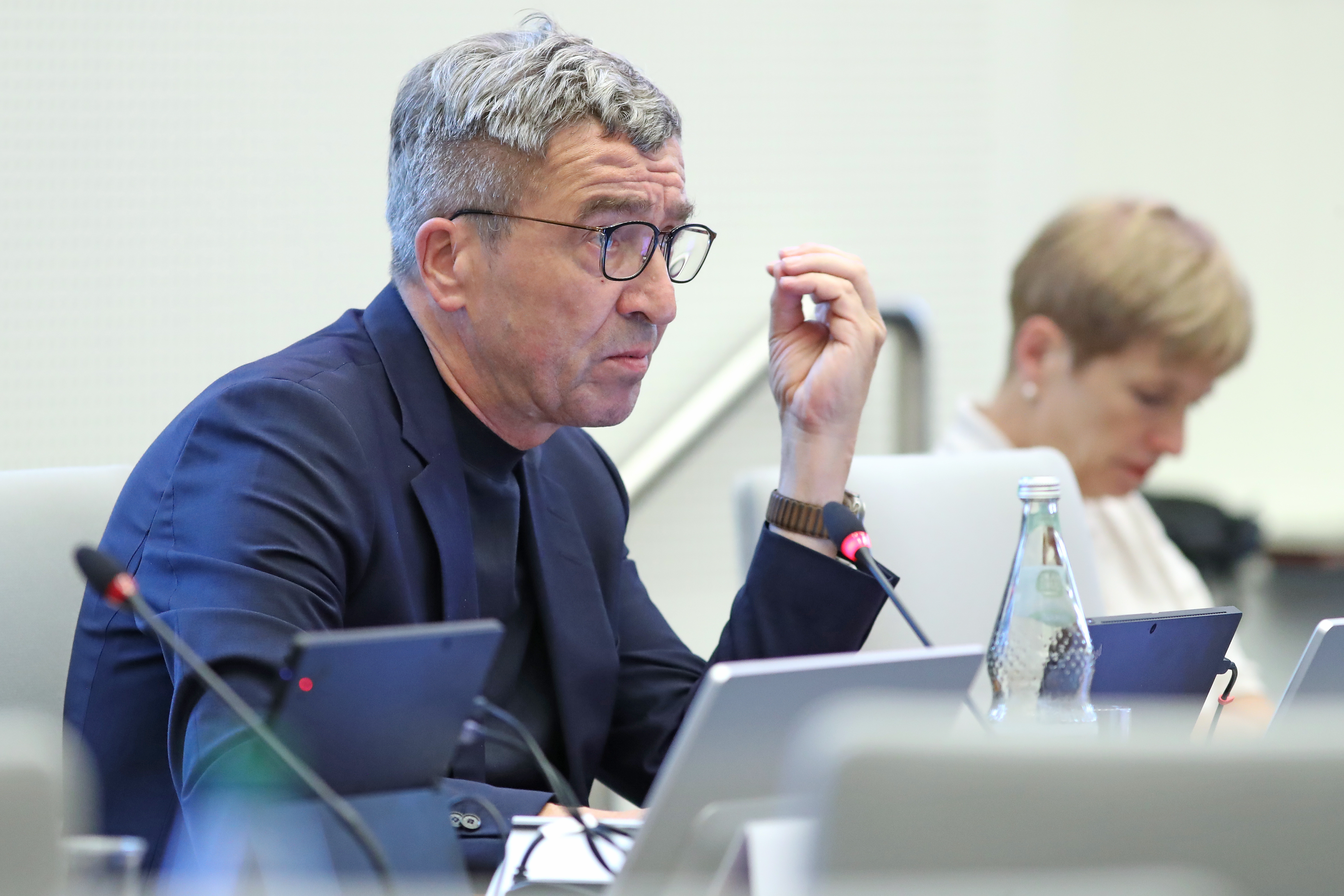
Not quite, noted Thomas Dienberg, the councillor responsible for construction. Whilst the public transport operators in Halle and Dresden were not affected, and discussions were also underway with the relevant stakeholders there, Leipzig was not entirely alone.
“As well as Leipzig, similar problems also arose in the public transport companies in Bremen, Würzburg, Essen, Heidelberg and Nuremberg. A corresponding exchange of experiences took place between the LVB and VAG Verkehrs-Aktiengesellschaft Nürnberg,” states the response to the CDU parliamentary group. “At this stage, the LVB is unable to assess why the public transport companies in Halle, Dresden and Chemnitz were not affected. An initial assessment indicates that ground temperatures in Leipzig were higher than in Dresden.”
The LVB really want to know why Leipzig was affected and what the actual causes were. Perhaps there were even several, as Dienberg suggested. After all, quite a few of the particularly affected sections of track were located in streets with no shade, such as along the Ring, where the sun could shine unhindered onto the track and the joint sealant.
And this was also emphasised by the Department of Construction in its response to BSW group leader Eric Recke: “At the present time, however, the damage pattern appears to be very heterogeneous overall, which is why, based on current knowledge, the damage that has occurred cannot be attributed to a single cause.
From the perspective of the city administration and also the LVB, the analysis of the causes cannot stop at the nature of the joint sealant. Climate-adapted urban spaces are a joint responsibility.”
The LVB will have to plan differently in future
And it is a task that is already changing the LVB’s planning, as can be read in the same response: “Even today, when planning joint construction projects between the City of Leipzig and the L-Group (complex projects), care is taken to ensure that street spaces are designed to be heat-resilient.
This is achieved, amongst other things, primarily through the incorporation of street trees, grass verges and infiltration facilities (swales), but also through other elements in the street environment that provide shade and cool traffic areas. Thanks to the committee structure for the ‘Base-Module-Main Axis’ scheme with the LVB, as well as the introduction of a joint ‘Phase 0’, these issues are already on the table and being addressed from the very first planning stages.
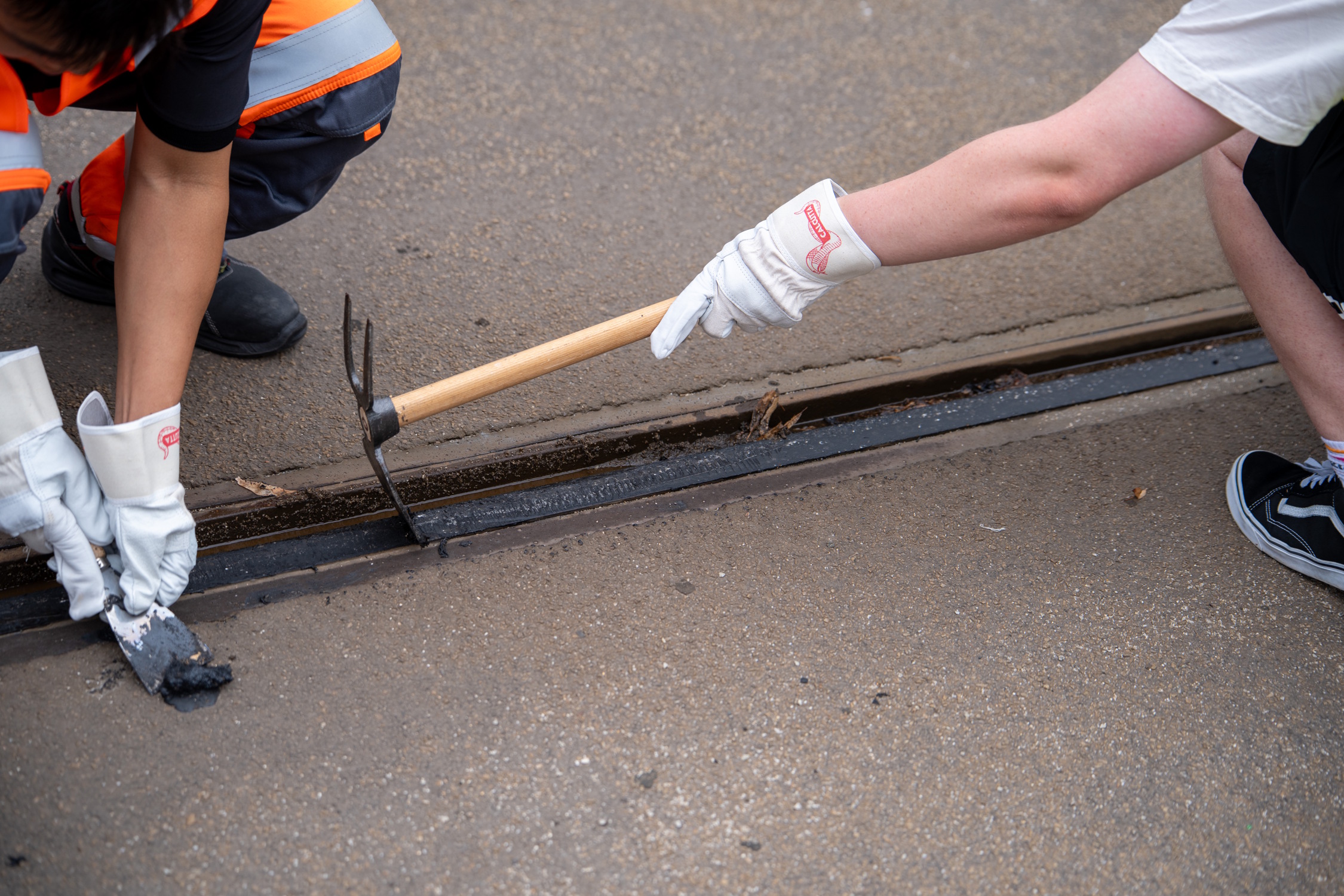
Using a trowel and scraper to remove the melted joint sealant. Photo: Ferdinand Uhl
However, it is also clear that, on the basis of the analyses, the current planning objectives and their prioritisation for the preparation of preliminary plans must be critically reviewed. As one measure to prevent similar incidents, LVB is therefore having its existing standard track construction methods reviewed. Furthermore, to ensure the sustainable fulfilment of its duties as a mobility service provider, a supplementary concept for dealing with extreme heat events is being developed.”
Recke against the climate emergency
It is therefore quite astonishing that, in his speech, Recke immediately spoke of “shoddy construction work” and even called for the lifting of Leipzig’s climate emergency, arguing that Leipzig could not change climate change anyway by reducing CO₂ emissions. What’s more, he claimed that Leipzig’s climate protection measures had also contributed to the budget shortfall. It’s simply impossible to make head or tail of this man, because on the very same day, in a similarly accusatory speech, he blamed Germany’s defence spending and rising energy prices for the situation.
It was then Green Party city councillor Kristina Weyh who quite rightly accused Recke of being frivolous in his speech. And she naturally asked the mayor responsible for the environment, Heiko Rosenthal, when he would finally present the promised action plan for the city’s heatwave response. After all, the extreme heat from 19 to 28 June clearly demonstrated that this is long overdue.
And the debate made one thing at least abundantly clear: not only the city, but also the LVB must now prepare for heatwaves during which the thermometer rises to 40 degrees and perhaps even higher. This makes it all the more important to identify the actual cause of the swelling joint sealant now and to take preventative measures in future construction projects.
It was only natural, of course, that thanks were repeatedly expressed to the LVB staff and the many volunteers who helped remove the joint sealant.
Empfohlen auf LZ


So können Sie die Berichterstattung der Leipziger Zeitung unterstützen:





There is one comment