Dieser Artikel ist auch in deutscher Sprache verfügbar: Zum deutschen Artikel.
On 1 July, the City Council did not manage to get through all the items on the agenda. There were still some important items left, which then had to be carried over to the continuation of the meeting on 2 July. And once again, the discussion centred on the city’s financial difficulties – for which it is not to blame. It is the mandatory tasks for which the federal and state governments have not provided sufficient funding that are pushing Leipzig into the red.
And, strictly speaking, the federal and state governments are not allowed to do this. The Basic Law states otherwise. Yet local authorities are repeatedly treated as the lowest priority. This is unacceptable. The Left Party parliamentary group therefore drafted a clear resolution.
“Leipzig City Council calls upon the Federal Government, the German Bundestag and the Saxon State Government to create the legal conditions necessary to ensure that local self-government is maintained in the city of Leipzig, by ensuring that the federal and state governments fully provide the financial resources required to fulfil statutory and voluntary tasks,” states this revised version of the resolution, which was adopted by the City Council on 2 July.
“To guarantee local self-government in accordance with Article 28 of the Basic Law, it must be ensured, with future and retroactive effect, that the funding for the tasks delegated by the federal and state governments to cities, municipalities and districts is fully covered by the federal government and the Free State of Saxony on a one-to-one basis, in accordance with the principle of connexity as set out in Article 104a of the Basic Law and Article 85 of the Saxon Constitution. The principle that ‘whoever assigns the task pays for it’ must be taken into account 100 per cent in the actions of the Federal Government and the Länder in future.”
After all, it is not just Leipzig that is in this situation. Virtually all local authorities in Germany are suffering under these imposed tasks – particularly those assigned by the Federal Government – which are not adequately funded.
300 million or 900 million?
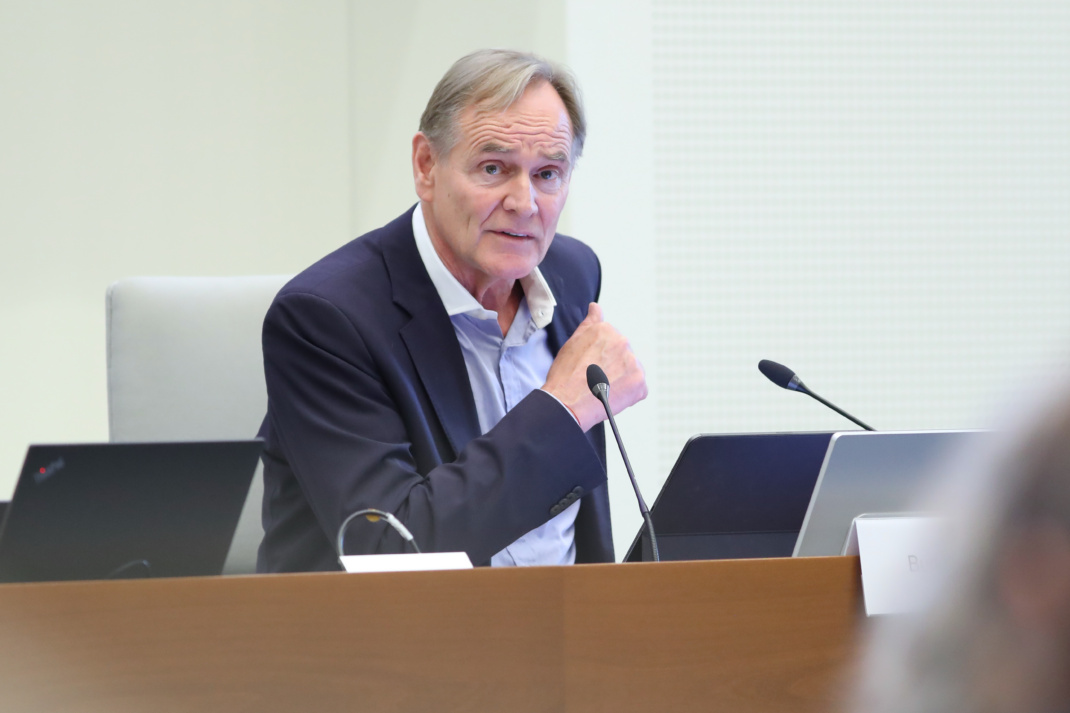
In his speech on the motion, Left Party city councillor Enrico Stange pointed out that the city council still does not know how high this underfunded shortfall is for Leipzig. On 1 July, Mayor Burkhard Jung had spoken of a structural deficit of 300 million euros. However, the figure now being bandied about is 945 million euros, for which the federal government, in particular, is leaving the city of Leipzig to foot the bill.
Enrico Stange noted, however, that Torsten Bonew, the councillor responsible for finance, has not yet presented any truly definitive figures. Unravelling the financial tangle takes time. Since August 2025, the Left Party parliamentary group has been repeatedly asking for clarification. The outcome remains unclear.
The only thing that is clear is that the sum is so large that it has completely undermined Leipzig’s budget for the past three years and is forcing the city to take on debts of around 300 million euros annually.
A tax system riddled with loopholes
On 2 July, Burkhard Jung combined the vote on the Left Party’s resolution with a motion from the Green Party, which had, for its part, been considering where the money should come from.
This did the matter no favours whatsoever, for by the time FDP city councillor Sven Morlok took the floor, it had become clear that there could be no unanimity on the subject of taxation, even within the Leipzig City Council. Green Party city councillor Katharina Krefft emphasised – as the motion also stated – that Germany urgently needs to reintroduce the wealth tax and amend inheritance tax legislation.
She referred to a cross-party campaign with the amusing name ‘vergnuegt’, which calls for precisely that. After all, it is the suspension of the wealth tax in particular that has deprived the federal states of massive amounts of funding.
Katharina Krefft pointed out that the issue at stake here is placing a greater burden on those “strong shoulders” that are actually capable of bearing it. Meanwhile, Sven Morlok, as an FDP politician, immediately started talking about raising VAT. Which, unfortunately, would place a burden precisely on those who are not rich. Ordinary people – the average Joe and Jane, the everyday consumers.
It stands to reason that Burkhard Jung would have preferred the Leipzig City Council not to discuss tax issues. After all, tax matters are decided at federal level. And the Leipzig city councillors would do well to persuade their own party colleagues in the federal government to finally initiate a proper tax reform. It’s just a pity – as CDU city councillor Michael Weickert pointed out – that their own party colleagues in Berlin aren’t even thinking about it. Regrettable?
Not really. That’s the reality in Germany.
Local authorities are suffering as a result.
A clear appeal from Leipzig
But at least Leipzig’s city council managed to issue one appeal on 2 July. The Left Party’s proposal for a clear resolution to restore local government finances was adopted by the Leipzig city council by 53 votes to 0, with 7 abstentions.
“We can go out and promote this,” noted Mayor Burkhard Jung, “and that is exactly what I intend to do.”
The AfD’s motion to limit this issue solely to delegated statutory duties was, as expected, rejected by 13 votes to 42. AfD city councillor Tobias Keller had already set the tone for the whingeing beforehand, using his speech more to accuse the other groups on the city council of lacking democratic competence because they simply would not agree to the AfD’s wild motions.
Well, they didn’t, did they?
And for good reason, as Mayor Jung explained. After all, local government funding is not merely about the federal and state governments fully funding the responsibilities they have transferred to the local authorities. It is – as stated in paragraph 2 of Article 28 of the Basic Law: “Municipalities must (sic) be guaranteed the right to regulate all matters of the local community on their own responsibility within the framework of the law. Municipal associations, too, have the right to self-government within the scope of their statutory remit and in accordance with the law. The guarantee of self-government also encompasses the foundations of financial autonomy; these foundations include a source of revenue based on economic capacity, to which local authorities with the right to set tax rates are entitled.”
However, self-government comes to an end when mandatory tasks alone – which, according to SPD city councillor Christinas März, account for 90 per cent of Leipzig’s budget – plunge local authorities into the red.
Get your act together on taxes at last!
Which is precisely why the city council is still the wrong forum in which to resolve the issue of nationwide tax reform. The parties’ positions on this are simply too divergent. That does not, however, mean that the Greens’ motion was rejected in its entirety. Points 1 and 2 of the motion did, in fact, secure a majority of 29 votes to 26, with 5 abstentions.
They read as follows: “The City Council notes that the financial resources available to local authorities to tackle the upcoming transformation tasks (including climate protection, heating planning, infrastructure renewal and social services) are currently insufficient. Leipzig City Council calls on the Federal Government, the German Bundestag, the Saxon State Government and the Saxon State Parliament to do everything in their power to secure better financial resources for local authorities and, in doing so, to advocate for a higher share of federal tax revenue for local authorities. Furthermore, the City Council calls on political decision-makers at state and federal level to ensure, in the forthcoming budget deliberations, that federal legislation on social benefits is adequately funded. The principle must apply: ‘Whoever commissions it, pays for it’.”
The other two points then concerned the specific details of the tax. But that really does need to be fought out at federal level – if the members of the democratic parties can finally persuade their Members of the Bundestag to tackle this thorny issue. Unfortunately, however, there is currently no sign of this whatsoever. Michael Weickert is, regrettably, right about that.
Empfohlen auf LZ


So können Sie die Berichterstattung der Leipziger Zeitung unterstützen:


There is one comment