
Dieser Artikel ist auch in deutscher Sprache verfügbar: Zum deutschen Artikel.
‘Love in Times of Hate’ is nothing new. When you’re handed a paperback by grateful schoolchildren, you simply have to read it. Especially as I’d already come across the title of this comprehensive, research-based work by Florian Illies (*1971), published in 2021. Years ago, I’d come across his *Generation Golf* – quite interesting – and I enjoyed following the ZEIT journalist’s literary explorations of contemporary social issues.
It is particularly important – and only natural – when dealing with the young and up-and-coming generation to understand where these young people come from and where they are heading, or wish to go. Illies is a journalistic authority, a true professional. He has been honoured with numerous awards; most recently, the bestselling author was delighted to receive the Bavarian Minister-President’s Honorary Award. So, on to a new reading experience, in a self-imposed blend of inclination and a sense of duty.
The advance coverage and subsequent reviews of this work by Illies, published in 2021, were, without exception, positive and favourable, ranging from ‘Phenomenal!’ to at least ‘Interesting’. By way of example, let me mention the passionate plea from fellow best-selling author Ferdinand von Schirach on the back cover: ‘Please read this book; it is captivating. I have learnt so much that was new to me – about love, art and horror.’
And Illies’ follow-up to *1913* (which I went out and bought afterwards) is certainly not bad either. His line-up of biographies covering the arts and culture of the Weimar Republic and beyond is truly impressive. It ranges from Brecht to Zweig. It whets the appetite for more. But this time, too, I found it difficult to piece together a complete picture – a ‘virtuoso portrait of the era’ (back cover) – from the wealth of information, from the many fragments of the jigsaw. In the end, I managed it after all. More on that now.
Florian Illies’s feature-style ‘intervention’ into the biographies of the art and culture scene of the Weimar Republic is set in the year 1929. In hindsight, one might describe it as the ‘fateful year’ of Germany’s first, earlier democracy. With the Social Democrats at the helm of government, the country was heading for turbulent times; the prevailing coalition arrangements at the helm of state were anything but harmonious, and a year later the first ‘Grand’ bourgeois coalition comprising the German Democrats, the German People’s Party and the Centre Party would also collapse.
The republic’s sole unifying figure on the state ship that had been lurching for years – the crisis helmsman and conciliatory politician, Gustav Stresemann, who was open to compromise in foreign policy – died in early October. In the same month, share prices in New York plummeted, leading to devastating consequences for German public finances, so that the brief ‘false boom’ from 1924 onwards became visible and palpable only as such. For the ‘Republic without Republicans’ – specifically for the working people of the lower and middle income groups.
Unemployment figures soared, the domestic political climate grew harsher and more brutal, culminating in the political impotence of those in power. From 1930 onwards, a minority or presidential cabinet ruled under the sometimes covert, sometimes overt aegis of Reich President Hindenburg. The ‘father’ of the ‘stab-in-the-back myth’ (motto: ‘It’s the others’ fault.’), who, by his own admission, found the First World War to be like a “spa treatment”. Radical parties are calling for “Soviet Germany” (KPD) or putting up posters proclaiming “Our only hope – Hitler” (NSDAP).
On the threshold of the third decade, most people at home and abroad still have no inkling of the impending catastrophe of a new, global war that the German right wing will unleash just under 10 years later. People are still reading Erich Maria Remarque’s sensational bestseller *All Quiet on the Western Front*, following the harrowing frontline accounts of the protagonist Paul Bäumer, and looking forward to the forthcoming Hollywood film adaptation. And Remarque, the self-confessed pacifist, who was taken aback by his overwhelming commercial success, continued writing straight away and, in *The Way Back*, described the homecoming of a lost generation of soldiers.
Illies succeeds brilliantly, stylistically, in exposing the self-absorption of the German (and European) cultural elite, rhetorically illustrating – and even, now and then, satirising – their private and love lives, the ‘radicalism of the heart’ (again, from the back cover). Here it takes shape: the mosaic-like portrait that illustrates the cluelessness and political naivety of the leading intellectuals, from Hermann Hesse to Thomas Mann. The latter serves as a prime example here of both the mood and the author’s style. p. 115: ‘And even “holidays” [for the Mann family] are placed in quotation marks. Thomas Mann explained to his wife early on that he “did not understand” rest without occupation.
And she accepted that. He cannot work outdoors, he says; he needs a roof over his head, ‘so that his thoughts do not evaporate in a dreamlike state’. Yes, that is really how Thomas Mann speaks. Even at thirty degrees in the shade.” One can read similar everyday anecdotes about his brother Heinrich, who favoured voluptuous young women when casting for the film adaptations of his novels (“The Blue Angel” premiered in Berlin in 1930, starring the rising star Marlene Dietrich, who is also featured in Illies’ selection) or finds it in Bertolt Brecht, who stages his love life ‘alongside’ *The Threepenny Opera*, oscillating between his ‘permanent partner’ Helene Weigel and his ‘part-time interns’.
In Illies’ brief biographical juggling act, everything boils down to webs of relationships; the joy of meeting someone new (Sartre and Beauvoir) alternates with the pain of separation (Lisa Matthias and Kurt Tucholsky). So far, so good. In the early 1930s, everything still seems solvable on an individual level; ‘big politics’ has not yet affected the country’s (better-off and thriving) educated middle-class elite. Not yet. But that was about to change.
In the cold winter of 1933, left-wing liberals, middle-class artists with utopian-humanist visions, communists such as Brecht, and anarchists such as Mühsam were left with nothing but a choice between the lesser and greater evils. Between imprisonment and mortal danger, or an uncertain flight to countries from which one would soon have to flee again to escape Nazi persecution.
The underestimation of the unrestrained terror of the ‘National Revolution’, as well as an all too blind faith in bourgeois democracy, drove countless artists, scientists and philosophers to all corners of the world, into solitude and despair (Tucholsky, Zweig), into artistic resistance (Klaus Mann, Bertolt Brecht) or, in the worst case, into the murderous concentration camps (Erich Mühsam, Carl von Ossietzky).
Illies describes frantic escapes (Joseph Roth), then fearful concealment (Victor Klemperer), and one gets a sense of the horror of persecution when anti-democrats put into practice what they had initially announced in veiled, metaphorical, almost euphemistic terms (Goebbels, 1933: ‘A time will come when the Jews’ insolent, lying mouths will be shut.’) and later carry out with brutal calculation: the extermination of dissenters.
Iliie’s range of characters ultimately extends to 21-year-old Sophie Scholl, who, following her experiences in the BDM, found her way to the ‘White Rose’, sacrificed her young life, and courageously stood up against a majority characterised by resignation and error in a ‘generation of war’.
This brings the author’s account full circle. Having read the more than 400 pages, I became increasingly aware of the ‘relevance’ of Illies’ account to the present day, to the ‘Generation Crisis’ of today’s young people. The historical biographical jigsaw does, after all, come together to form a comparable sketch of the situation.
That said, I am aware of the difficulty involved in attempting to draw analogies between the past and the present. Parallels can never be drawn in a straight line. There was simply no experience of dictatorship in Germany on a fascist scale prior to 1933. But, in my experience of reading Illies’ work, one discerns something dystopian: what happens when one takes liberal-democratic norms for granted – that is to say, universally and perpetually guaranteed human rights – and basks in a hybrid arrogance of freedom and prosperity.
It is not only then that one should take the time to follow the arguments of the *Zeit* journalist. New biographical details or descriptions of the everyday experiences of famous figures from the past are not only interesting – as we know, knowledge is no substitute for insight – but also serve indirectly as a reminder never, if at all possible, to let ‘times of love’ be followed by such ‘times of hate’ again.
Florian Illies, *Love in Times of Hate*, Fischer-Taschenbuch, Frankfurt am Main 2021, 431 pp.
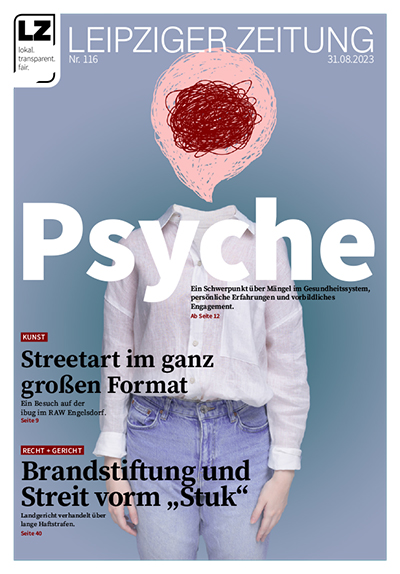
‘Interview: On the work of the initiative “Psychotherapy? In Short Supply!”’ first appeared in the ePaper LZ 116 of the LEIPZIGER ZEITUNG, completed on 31 August 2023.
Empfohlen auf LZ


So können Sie die Berichterstattung der Leipziger Zeitung unterstützen:




There is one comment