
Dieser Artikel ist auch in deutscher Sprache verfügbar: Zum deutschen Artikel.
If the current federal government gets its way with its pension plans, it will become even harder for many people who have actually reached retirement age to make ends meet. They are already having to get by on meagre pensions. But rather than having to beg the local authorities for help, more and more older people are deciding to stay in the workforce and carry on working for as long as their health allows.
This is also the case in Saxony. This is confirmed by new figures requested by Susanne Schaper, a member of the state parliament for The Left.
According to the Employment Agency, by mid-2025 more than 61,500 people in Saxony were in work, even though they had reached retirement age. Whilst the number of people in marginal employment above the standard retirement age fell in 2025, the number of full-time employees rose (Parliamentary Paper 8/7071). 3,822 people over the age of 70 and as many as 1,477 people over the age of 75 were in full-time employment. Furthermore, 17,375 people over 70 and 8,212 people over 75 were in marginal employment.
“We have no objection to people of retirement age wishing to continue working. There are many possible reasons for this – for example, those affected may want to stay fit, maintain social contacts or increase their pension entitlement. This is good for them and for businesses, especially as there is a shortage of skilled workers in many sectors. However, no one should be forced to continue working simply because their pension is not enough!” comments Susanne Schaper, Chair and social policy spokesperson for the Left Party parliamentary group in the Saxon State Parliament, on the new figures from the Ministry of Economic Affairs.
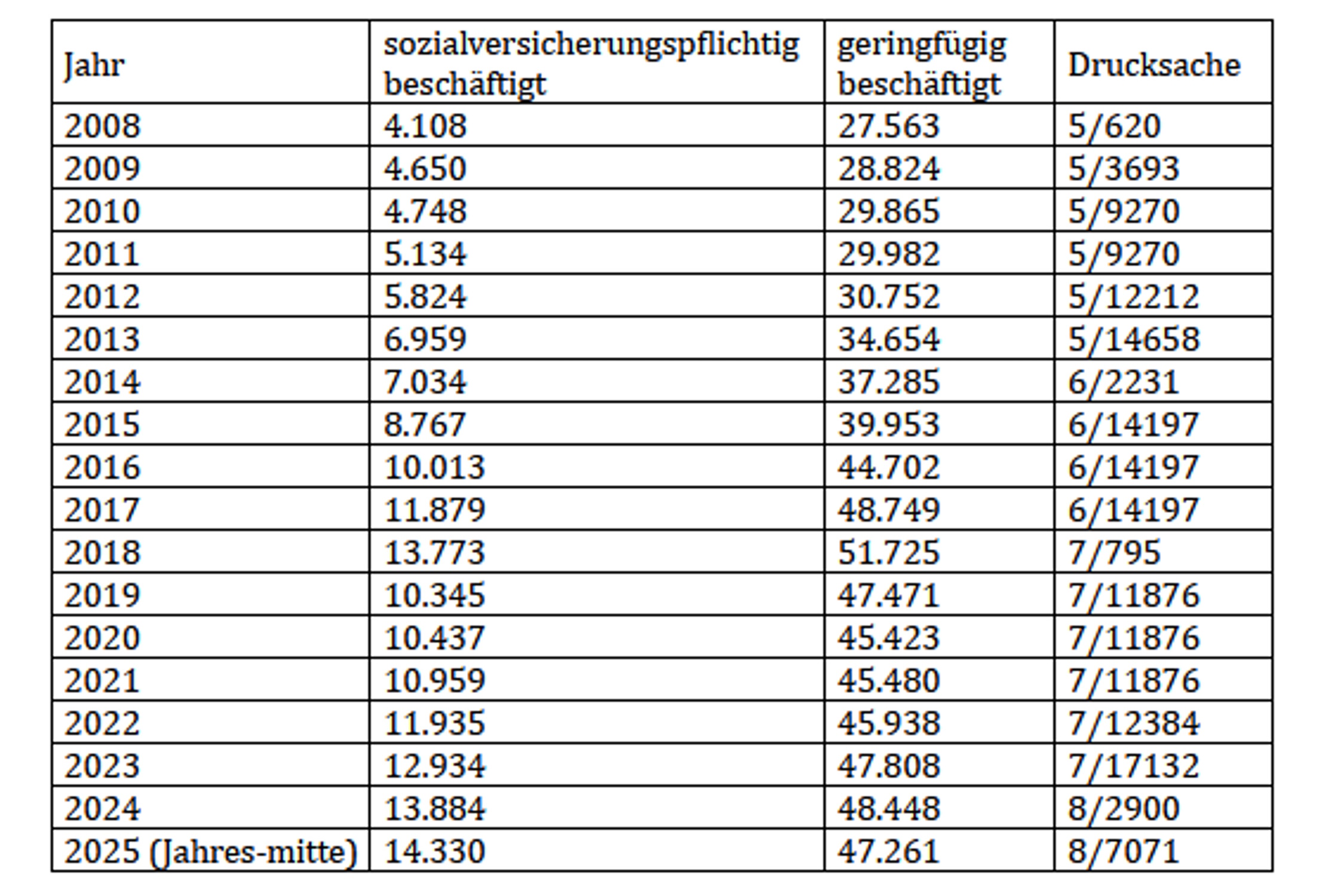 Trend in the number of working pensioners in Saxony. Graphic: Left Party parliamentary group, Saxony
Actual pension rates are falling
In the east, the state pension is the sole source of income for many people in old age. Existing pensioners in Saxony receive an average of 1,355 euros, whereas new pensioners received an average of just 1,250 euros, as reported by the German Pension Insurance Scheme as of October 2025. Rising prices and rents are also causing poverty in old age to increase in Saxony.
“To ensure that everyone can enjoy their retirement and freely decide whether and how much they wish to work in old age, the state pension scheme must be a secure foundation for all,” says Susanne Schaper. “However, the federal government’s reform plans will not guarantee this. They will still fail to ensure that all working people contribute to the pension pot on the basis of their total income from employment and financial markets. The contribution assessment ceiling must be abolished so that people on high and very high incomes also contribute to the solidarity-based community as required.”
Then, Susanne Schaper notes, a solidarity-based minimum pension of 1,400 euros net per month would also be possible for everyone. And: “Generous tax allowances must apply to pension income.”
Empfohlen auf LZ


So können Sie die Berichterstattung der Leipziger Zeitung unterstützen:




There is one comment