Dieser Artikel ist auch in deutscher Sprache verfügbar: Zum deutschen Artikel.
Following the “Enough is enough!” demonstration on 15 June, nursing staff from Leipzig’s hospitals and trade union representatives from ver.di met with Holger Mann (SPD), the Member of the Bundestag for Leipzig, on 18 June.
The trade union’s invitation stated: “We would like to discuss our demands in an open dialogue with Leipzig MPs Holger Mann (SPD) and Jens Lehmann (CDU). The debate will be accompanied by nursing staff from Leipzig’s hospitals, who will report on their day-to-day work and illustrate the practical implications of the law.”
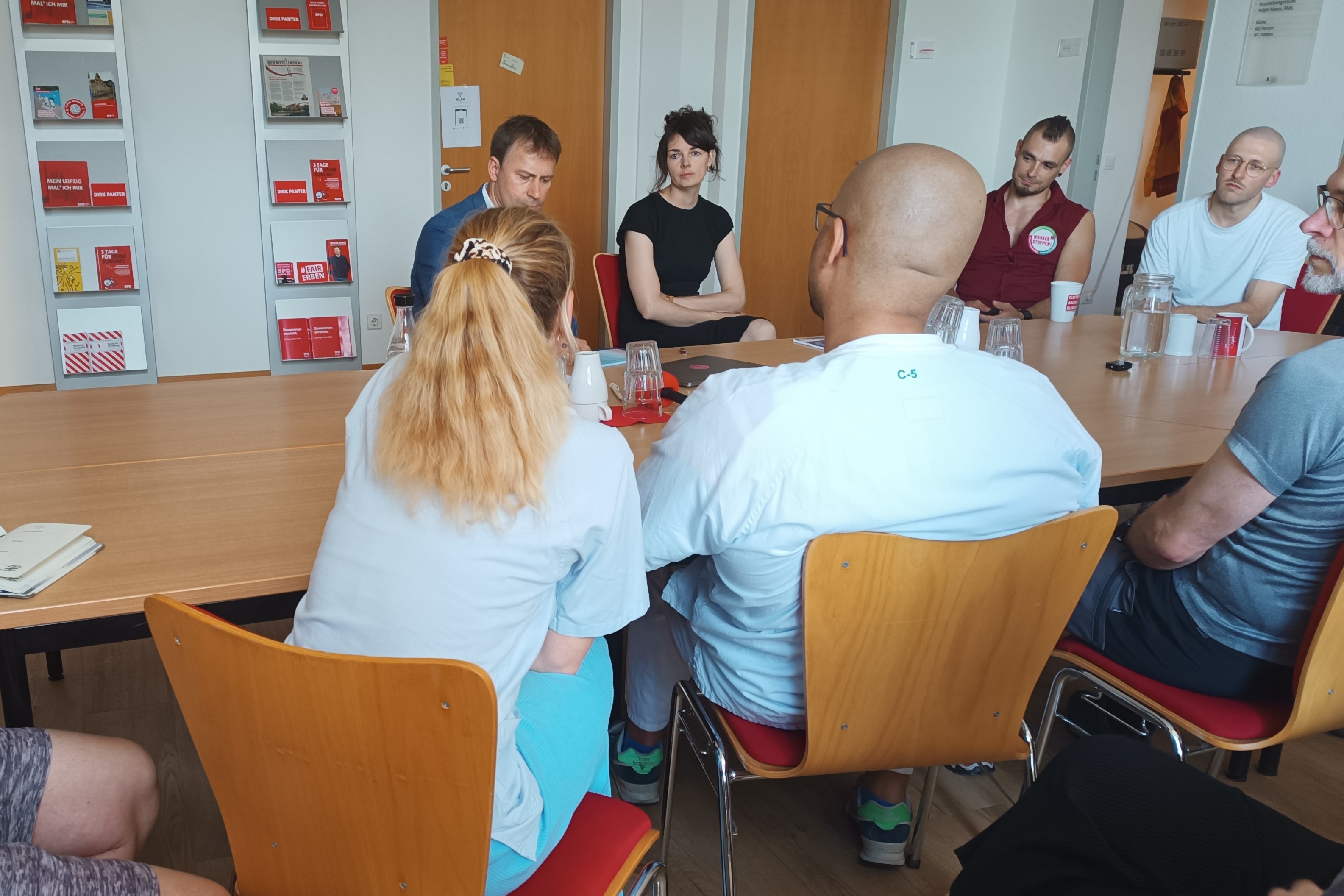
The round-table discussion hosted by Holger Mann was held in two parts: a public session and a closed session. We attended the public session and, once it had concluded, asked some of the participants for their comments.
The round-table discussion
Eleven nurses from four hospitals in Leipzig were present; they described the problems they face in their day-to-day work. Trainees fear they will not be offered permanent positions, and everyone expects increased workloads for staff and a decline in the quality of care for patients.
Frauke, who has worked in oncology and haematology for many years and is now in an intensive care unit, gave a powerful account of the impact that staff shortages have on patients, but also on nursing staff. We have included some extracts at the end of the article. All the nurses present expressed the view: “We want to do our job well, in the best interests of our patients. But to do that, we also need the resources.”
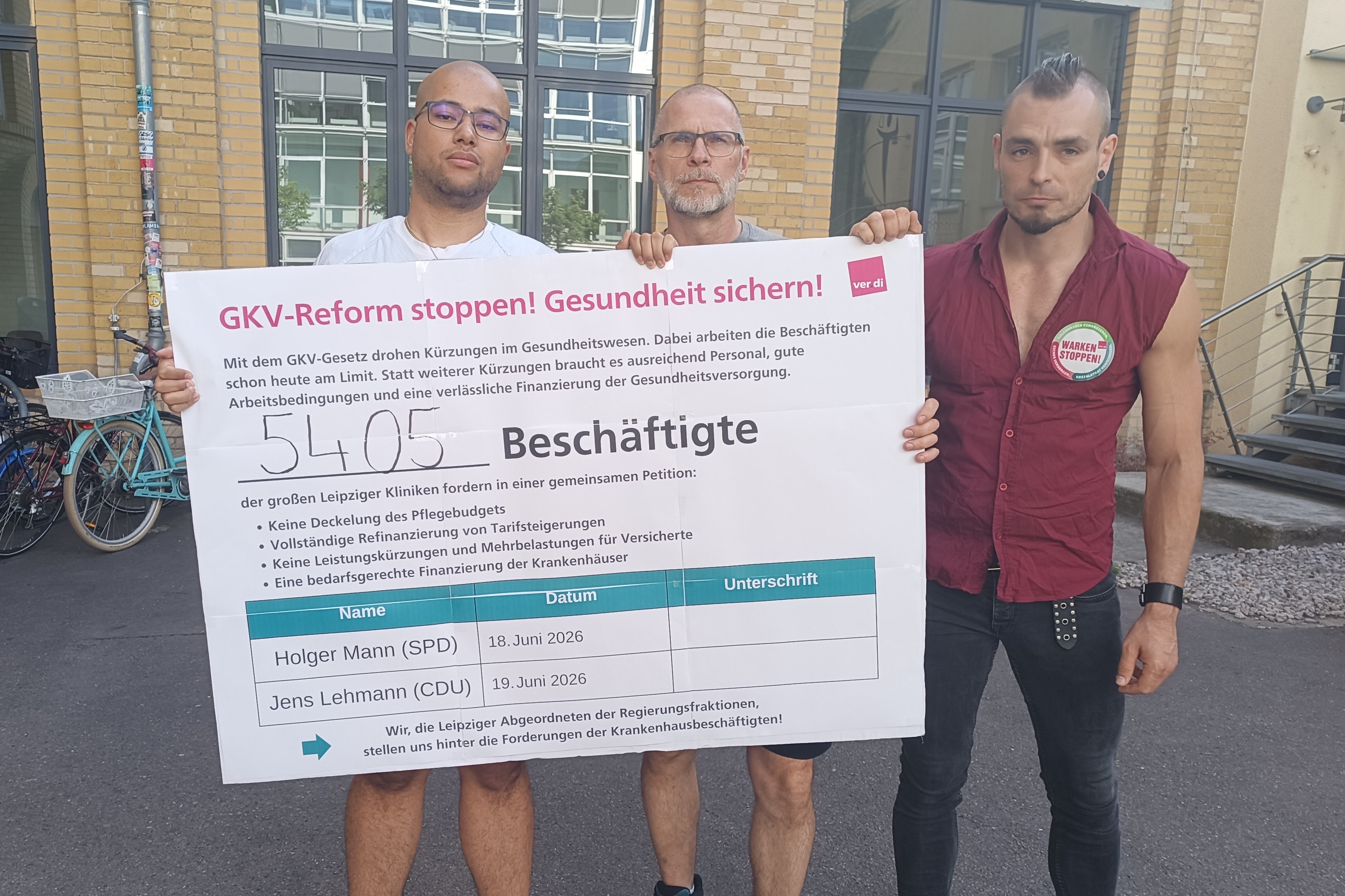
Participants in the discussion with a petition. Photo: Thomas Köhler
Holger Mann expressed fundamental understanding for the cause, emphasised that he was not a health policy maker, and once again listed all the reasons for healthcare reform. How have costs risen, how much needs to be saved, how does the rise in costs affect premium trends and increases in supplementary contributions within the statutory health insurance (GKV) system – all of this covered in almost epic detail. He called for specialist politicians to be allowed to do their job and emphasised that proposals for healthcare reform ultimately always require a consensus within the coalition. He doubted whether there would be support within the coalition for a citizens’ insurance scheme.
The nursing staff had brought along a petition, signed by 5,405 employees of Leipzig’s hospitals, and called on Holger Mann to sign it. Frauke commented: “That is why the majority of staff in each hospital have signed this petition. Perhaps they can rely on our professional expertise at the moment. That is why we are calling on them to vote against it, even if it is difficult for them.”
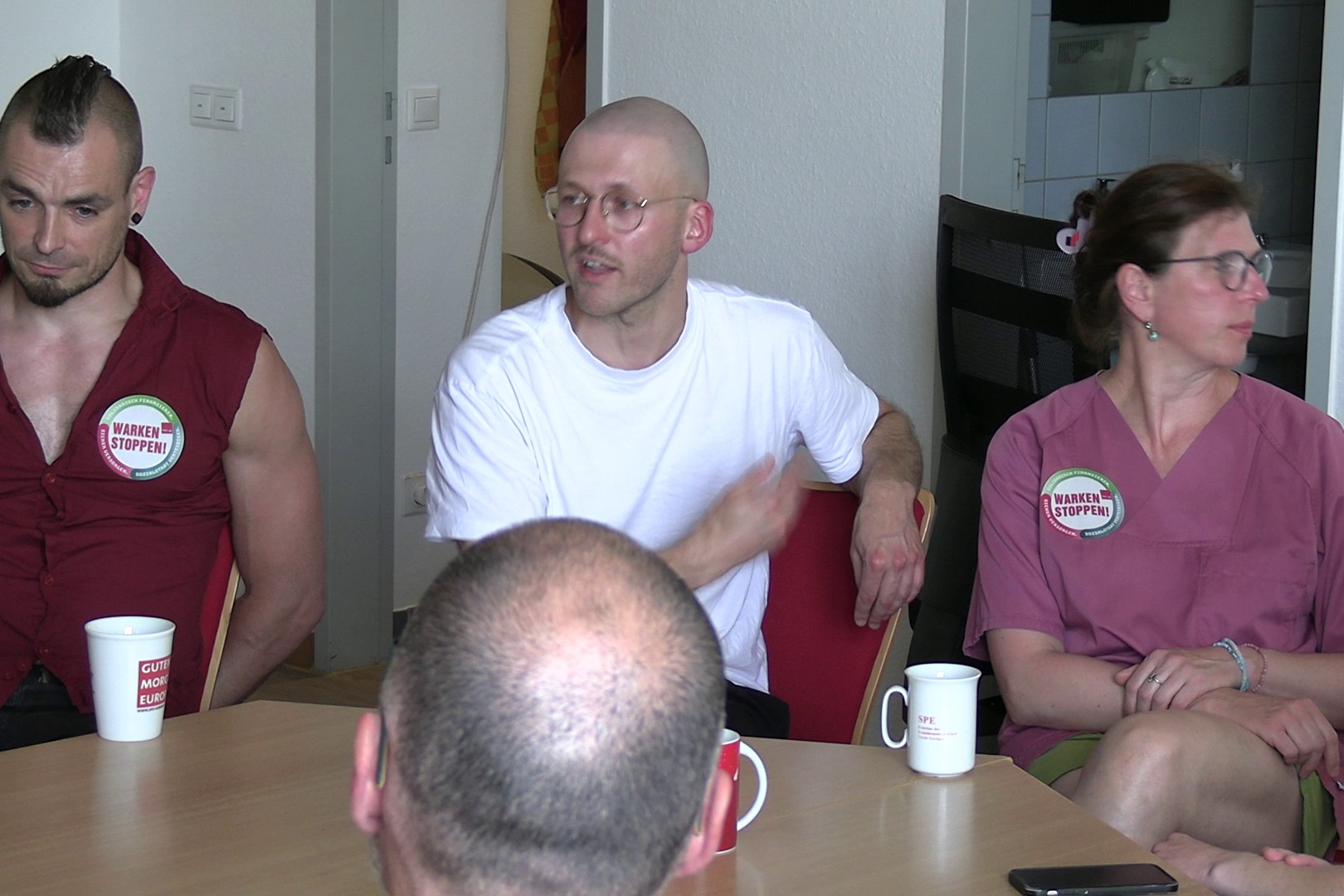
Max Leurle, trade union secretary at ver.di, added: “We’ve printed this out and put it in writing so that you have the opportunity to get behind our demands. That doesn’t mean you’re rejecting the bill, because we know full well that this is a parliamentary process. It means that changes can still be made to this bill. But our demands are clearly set out there. And this is your opportunity to back our demands: that the cap on the care budget must be removed from this bill, and that full refinancing of pay rises under collective agreements must remain in place. These are the two pillars that are extremely important for hospital funding. However, we also stand alongside the insured; fundamentally, a needs-based funding system for hospitals must be adopted in the long term.”
Holger Mann reiterated the need for healthcare reform and asked for understanding regarding his decision not to sign the petition. He would, however, accept it “because it is, after all, a very clear expression of the will of a great, great many staff members here in the four hospitals in Leipzig.” Our colleagues then decided not to hand over the petition.
This was followed by the closed-door session, which we did not attend.
Conclusion and statements
There was no official conclusion to the event. For various reasons, such as the start of their shifts or childcare commitments, some of the nursing staff left the discussion early. They expressed their disappointment at how things had gone to us. After the event had ended, we asked Holger Mann for a brief statement.
Julian, a trainee nurse, also shared his impressions of the discussion.
Conclusion: The four Leipzig Members of the Bundestag were approached. Sören Pellmann (The Left) and Paula Piechotta (The Greens) stated that they would vote against the proposed legislation. In conversation with Holger Mann, he did not sign the petition, but he intends to raise the issues with his parliamentary group. It remains to be seen what position Jens Lehmann of the CDU will take; unfortunately, we cannot be there. However, it is likely that he will not sign either.
The Health Reform Bill is highly likely to be passed by the Bundestag; it remains to be seen whether any further amendments will be incorporated into the Warken bill.
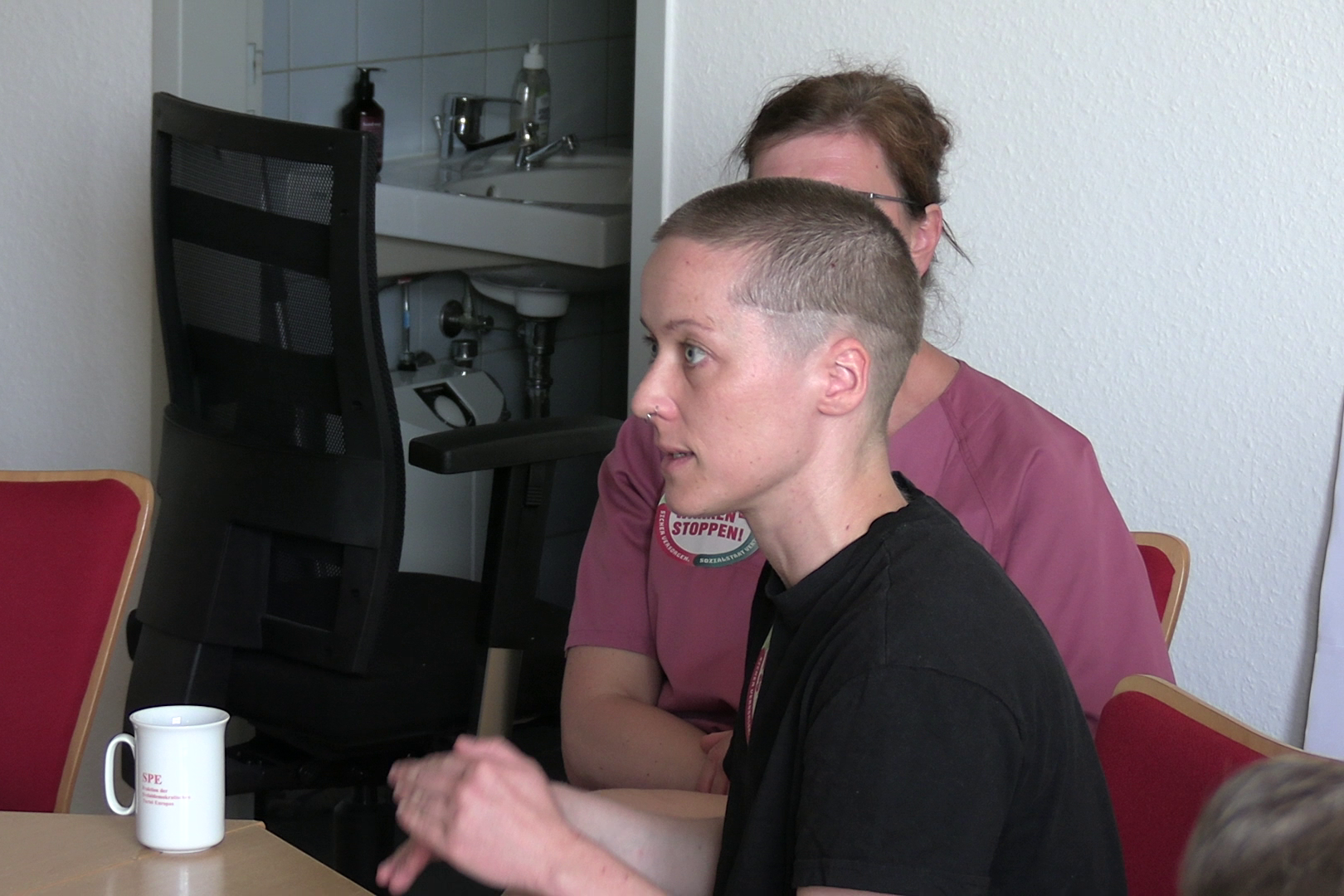 Frauke urges Holger Mann to sign the petition. Photo: Thomas Köhler
From Frauke’s comments on the current situation:
“Long before I started working in intensive care, I worked in haematology and oncology – that’s the leukaemia ward – and people are admitted there who, in some cases, have acute leukaemia. That means we could be sitting here today and know tomorrow that, if I don’t get treatment within three weeks, I’ll be dead. People come there whose everyday lives have been completely upended. They can no longer go to work; they know they’re not just in hospital for two weeks, but for the next few months. I might not be able to see my children anymore, because those under 14 aren’t allowed to visit at all. I’m undergoing treatment, and I don’t know if it will help me. I don’t know what they’re going to do to me. But I do know that I’ll probably lose my hair, I’ll feel constantly sick, and I won’t be able to go to the toilet on my own. Suddenly I’ll need care, even though I might only be 36.”
She then described the nurses’ perspective: “In my practical experience, when people are about to have chemotherapy, for example, there’s a preliminary consultation with a doctor where they’re given the information. The consultation lasts perhaps ten minutes. Then the day arrives when I, as a nurse, come in with the chemo. And sometimes it’s purple, sometimes orange, sometimes red. It’s simply frightening. I hook them up to the infusion stand whilst the patients are lying in their beds. But I might not have any time left to do anything other than fulfil my minimum duty. That is to check whether it really is the right chemotherapy in the right dosage for the right person.
These people are scared; they want to be looked after. They can’t even make sure themselves that someone is there to support them. We can’t just say: ‘The chemo will be administered at 2 pm.’ In everyday hospital life, with all these schedules constantly shifting, that’s not possible. People need support from the nursing staff; they need plenty of information, plenty of explanation and simply time. But when I’ve got a lot of people to look after, I know full well that I won’t have that time. I go in there, hook it up, switch it on. I can still see that a patient is afraid, but I ignore it. And I ignore it quite deliberately; I have to swallow it myself, walk out and then try to leave it behind me.
These are avoidable circumstances; they could be different if there were more staff. But they aren’t different, and they’ll get worse as a result of this reform. For us as carers, this means we have to ignore people time and time again and can’t do our jobs properly. Not because we don’t want to, but because it’s simply not possible. And then we go home knowing: I haven’t done my job properly. It’s not just any job I haven’t done properly; it’s that today I haven’t looked after this person properly. That’s a terrible feeling, which is why people are leaving the profession. It’s a form of work-related stress that you have to put up with for a while.”
Empfohlen auf LZ


So können Sie die Berichterstattung der Leipziger Zeitung unterstützen:





There is one comment