Dieser Artikel ist auch in deutscher Sprache verfügbar: Zum deutschen Artikel.
It was to be expected that this would cause trouble once again. It’s only to be expected when a city, under massive pressure from a budget that has spiralled out of control, is forced to cut 500 jobs. And to do so within a very, very short timeframe, in order to have any impact at all on the next two-year budget for 2027/2028. Even in Leipzig, 500 jobs are no small matter. And inevitably, this causes uncertainty not only amongst the workforce, but also amongst the elected city councillors. So things got a bit heated at the council meeting on 3 September.
This was particularly true of Left Party city councillor Enrico Stange, who gave the mayor in charge of administration a proper telling-off. After all, before cutting so many jobs, a review of the city’s functions should first have been presented to the city council. How many staff are needed to carry out which tasks? How many staff are actually required in Leipzig’s administration? First the review of functions, then the job cuts. That is how the process should be turned on its head, Stange emphasised.
Behind this dilemma, of course, lies a resolution that the city council was forced to pass in 2025 under mounting pressure from a budget that was spiralling out of control. This is also mentioned in the motion tabled by the Left Party faction: “With its resolution of 12 March 2025, the City Council had commissioned a comprehensive review of tasks and organisation in detail. However, in implementing this resolution, senior management has prioritised staff reductions and has used the review of tasks and organisation solely to facilitate job cuts and staff reductions.
Not only did this approach cause considerable uncertainty amongst staff regarding their professional future within the city administration, but it also exacerbated the staffing situation by compounding existing bottlenecks.
In some cases, vacancies could not be filled for months; unfilled posts or part-time positions were strictly reallocated across departments against the backdrop of percentage-based reallocation targets – in other words, withdrawn from the relevant areas. Only after additional requirements had been confirmed were job shares, where necessary, redirected back to departments in need.”
All of this is, in fact, a logical consequence. When fears about job security are rife, those affected naturally want to be informed earlier, more effectively and more transparently.
And what if more staff are actually needed?
Which, from the perspective of Ulrich Hörning, the Mayor for Administration, is indeed happening. In his speech, however, he also criticised the City Council for having denied him the 5 million euros needed for external support during the downsizing process. Stange explained that the council groups had done so for entirely different reasons.
He also pointed out that the structural review for some departments – which had in fact already taken place in 2025 – had not identified any ‘redundant’ posts at all, but rather, on the contrary, an additional need for 80 posts. As is well known, all three areas are now characterised by excruciatingly long waiting times – whether for naturalisation (where applicants
have to wait two and a half years for an appointment
), housing benefit (where processing times are now 6 to 9 months
) or the vehicle registration office (where processing applications now takes seven weeks
). Even AI can’t help here.
But these three problem areas do show that Leipzig is indeed understaffed in certain sectors. And the interest shown by the council groups in finding out whether this also applies to other areas is only too understandable. This was also emphasised by Green Party councillor Marvin Frommhold, who found the process of clarifying this matter in the Administrative Committee to be very opaque for over a year.
Hörning said that his department had now provided the relevant information. This was actually just before the council meeting, so even Frommhold had not yet had a chance to study it.
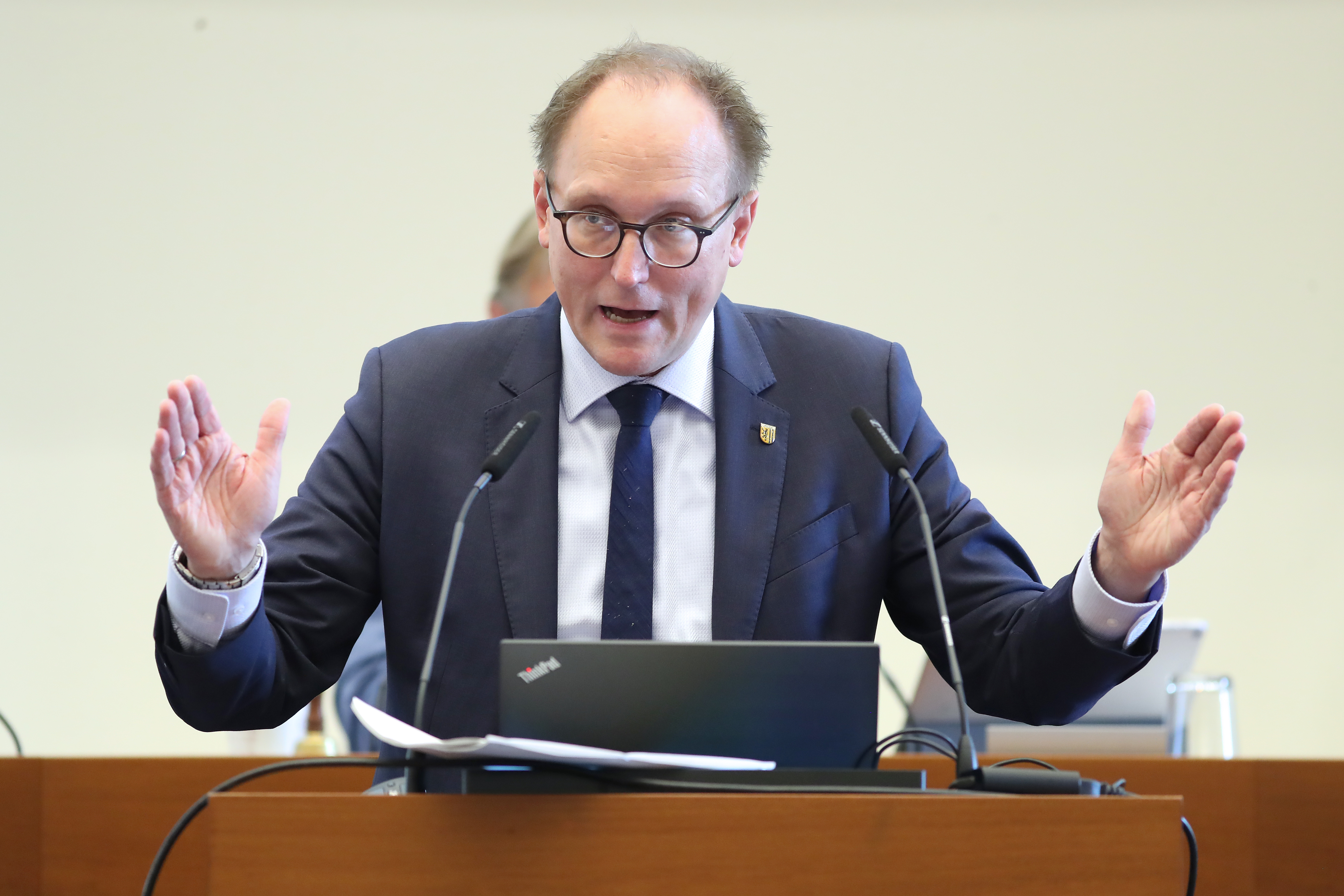
Ulrich Hörning (SPD), Councillor for General Administration, at the Leipzig City Council on 2 September 2026. Photo: Jan Kaefer
He also expressed understanding for the Left Party’s wish to suspend the job cuts for the time being until a transparent review of duties had been carried out. However, this would simply not be feasible, as it would contravene the decision by the State Directorate approving Leipzig’s budget. The State Directorate only gave the green light because the massive job cuts were included in the budget.
Leipzig in a bind
Thus, the brief exchange at the council meeting on 3 September essentially highlighted once again the constraints Leipzig now faces, as budgets are increasingly spiralling out of control and borrowing is rising dramatically. This inevitably means that the city will ultimately have to cut not only the 300 posts already created, but also the promised 500.
This, in turn, gives rise to fears – as Enrico Stange points out – that the workload for the remaining staff will increase, leading to a rise in the number of sick leave cases. And one can certainly understand the concern: will it still be possible to carry out all tasks adequately, or will there be even more backlogs in some departments?
This is a question that will occupy the City Council even more frequently. That is foreseeable. Even though Ulrich Hörning promises to involve the affected staff in the restructuring process and – should their posts be made redundant – to retrain them for other roles. After all, this whole process is not simply about job cuts, as his department’s statement put it: “The ASK process is not exclusively a job-cutting programme. It is the procedural framework within which the city administration is, for the first time in years, taking fundamental decisions on organisational structure and operational processes.”
It also describes how the job cuts will be implemented: “The decision to cut posts as part of the ASK process lies with the deputy mayors and the heads of their respective departments. The relevant departments submit their technical proposals regarding job cuts to the Lord Mayor and coordinate these with him. The identification of potential savings and jobs to be made redundant is deliberately not carried out on a blanket basis, but has been consistently managed in a decentralised manner by the specialist departments themselves.
The deputy mayors responsible for specific areas and their department heads are familiar with the priorities, workloads and potential for efficiency gains within their own structures and are thus able to make decisions based on their specialist knowledge and responsibilities. This safeguards the administration’s ability to act and the autonomy of the departments. The assessment of potential savings and the evaluation of consequences are therefore carried out in a logical and consistent manner.”
Leipzig is not alone
Nor is Leipzig alone in facing this pressure to make savings. In other cities across the Free State, too, financial strain is hitting with full force: “The pressure to act is not limited to Leipzig. Dresden and Chemnitz, just like major cities of a comparable size in other federal states, are implementing consolidation programmes with staffing targets. The priorities chosen in this regard are consistent: the consolidation of cross-functional areas (financial accounting, IT, procurement, vehicle fleet), the standardisation of mass-processing procedures and automation.”
Leipzig, of course, finds itself in a tight spot. Consequently, the debate also revealed a certain degree of helplessness. After all, the next two-year budget must not only be adopted by the city council but also approved by the State Directorate. And that will certainly not be the case without the remaining job cuts.
The fact that Enrico Stange was so incensed also illustrates that such developments, in the face of deficit budgets for which the city is not itself to blame, massively curtail the elected city council’s ability to act.
The Left Party’s motion was ultimately rejected by 13 votes to 32, with 14 abstentions.
Empfohlen auf LZ


So können Sie die Berichterstattung der Leipziger Zeitung unterstützen:





There is one comment