Dieser Artikel ist auch in deutscher Sprache verfügbar: Zum deutschen Artikel.
Amid protests by activists and a large police presence, another mass deportation to Afghanistan appears to have taken place at Leipzig/Halle Airport. Also: Investigators have recovered a video confession pledging allegiance to IS from the mobile phone of the suspected CSD attacker who was shot dead on Saturday. The LZ summarises the key events from Tuesday, 28 July 2026, in Leipzig, Saxony and beyond.
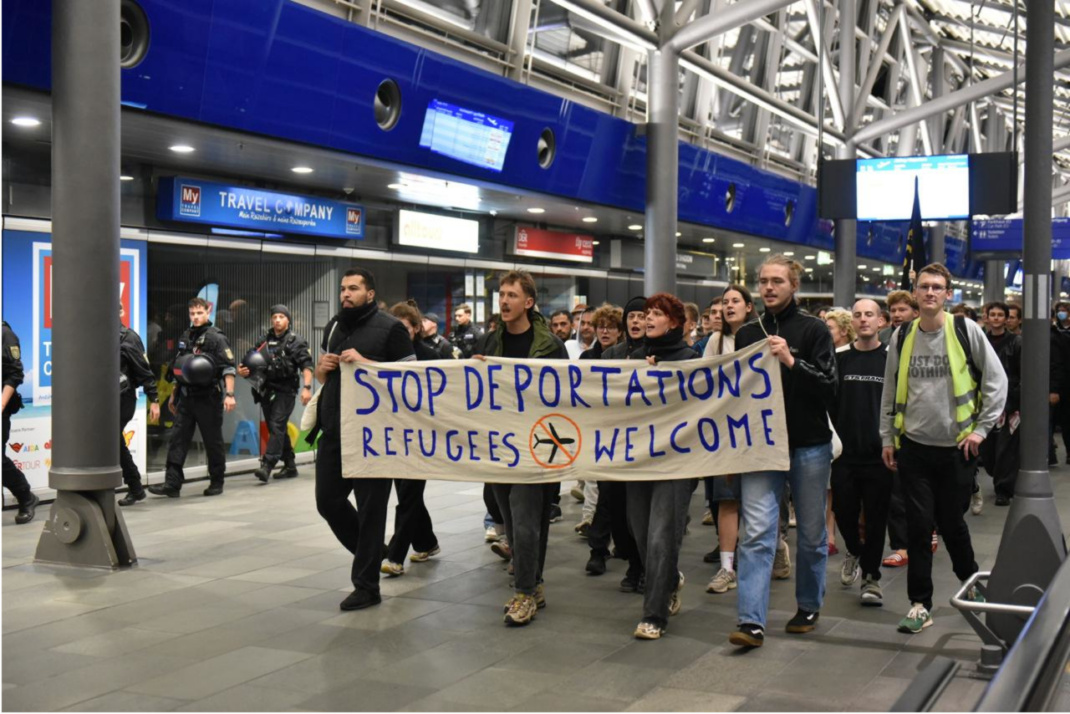
Leipzig/Halle Airport: Deportation sparks protest
Amid protests and a large police presence, another deportation to Afghanistan was apparently carried out last night at Leipzig/Halle Airport. According to a reporter, the flight took off at around 01:45. The Airbus was reportedly due to fly via Turkey to Kabul. No confirmed information was initially available regarding the number of people deported or other details. There were apparently no notable incidents during the gathering.

The aircraft took off shortly before 1.45 am. © Michael Strohmeyer
According to the anti-racist alliance that had called for the protest, more than 260 people gathered at the terminal late in the evening, including many from Leipzig’s Afghan community. Speeches were given by members of the group as well as
Criticism has been levelled at deportations to the Islamist Taliban regime, which has been back in power in Afghanistan for almost five years. Harsh accusations are also being levelled at the federal government, which is cooperating with the regime – despite its oppression of girls, women, minorities, opponents of the regime and journalists – in order to forcibly return people. This, it is argued, makes the government politically dependent on the Taliban.
It was recently revealed that the practice of deportation is to be extended to Afghanistan – it is feared that this could now mean that even people who have not committed any criminal offences could be subject to deportation. Until now, this has been a key justification put forward by politicians.
Following the CSD attack: Suspected perpetrator claimed allegiance to IS
Following the attack on Christopher Street Day (CSD) in Berlin on Saturday evening, which left one person dead and many injured, a claim of responsibility video was discovered on the suspect’s mobile phone. As reported by rbb today , this has been confirmed by the Federal Public Prosecutor’s Office. In the video footage seized, a person completely covered in a balaclava is said to have pledged allegiance to the terrorist organisation “Islamic State” (IS). Investigators believe this to be the suspected attacker, Abdul B.
The 21-year-old is alleged to have driven a van into a crowd near the Berlin CSD celebrations last Saturday evening and subsequently attacked several people with a machete. One woman died in the attack; 29 people were injured, some seriously.
Abdul B. was tracked down on Sunday evening after fleeing to an allotment garden in Berlin-Spandau, where, according to police, he lunged at officers with a bladed weapon. He was subsequently shot dead. The man, who was born in Germany to Lebanese parents, is said to have been known to the authorities for some time as a person of concern.
What the LZ reported today:
2027 mayoral election in Leipzig: Fabian Schmidt wants to become mayor for the Humanists Video
Hello Leipzig: How Tuesday, 28 July 2026, begins
What else was happening:
A new police station was inaugurated today in Borna. The modern new building is set to accommodate 140 officers from the patrol and criminal investigation departments.
Autumnal atmosphere? You might have thought so over the last few days – but now the next heatwave is set to hit central Germany …
Ukrainian President Volodymyr Zelenskyy (48) is meeting his US counterpart Donald Trump (80) in Washington. Talks are likely to focus on Ukraine’s missile defence in the conflict with Russia.
Calendar entry: The Geneva Convention on Refugees was adopted 75 years ago
In Geneva, on 28 July 1951, the ‘Convention Relating to the Status of Refugees’ – now more commonly known as the Geneva Convention on Refugees (GCR) – was signed at a UN conference. The GFK, signed by 26 states by 1954, arose from the experience of the Second World War and the intolerable fact that many Jews and others persecuted by the Nazi regime might well have been saved had there already been a provision enshrined in international law as to who qualifies as a refugee.
A solution was now provided in the form of a definition: the GFK (which, however, did not come into force until 1954) establishes a legal framework for the protection of refugees, sets out forms of assistance for these people in countries of refuge, and specifies the obligations of refugees. The Convention was subsequently amended and expanded – yet it remains to this day an indispensable legal basis for dealing with people fleeing their homes.
In times of global migration and refugee movements, it has come under considerable pressure, which is why it is worth taking a closer look at what it actually protects, says commentator Kirsten Krampe of the Heinrich Böll Foundation
.
Empfohlen auf LZ


So können Sie die Berichterstattung der Leipziger Zeitung unterstützen:





There is one comment